
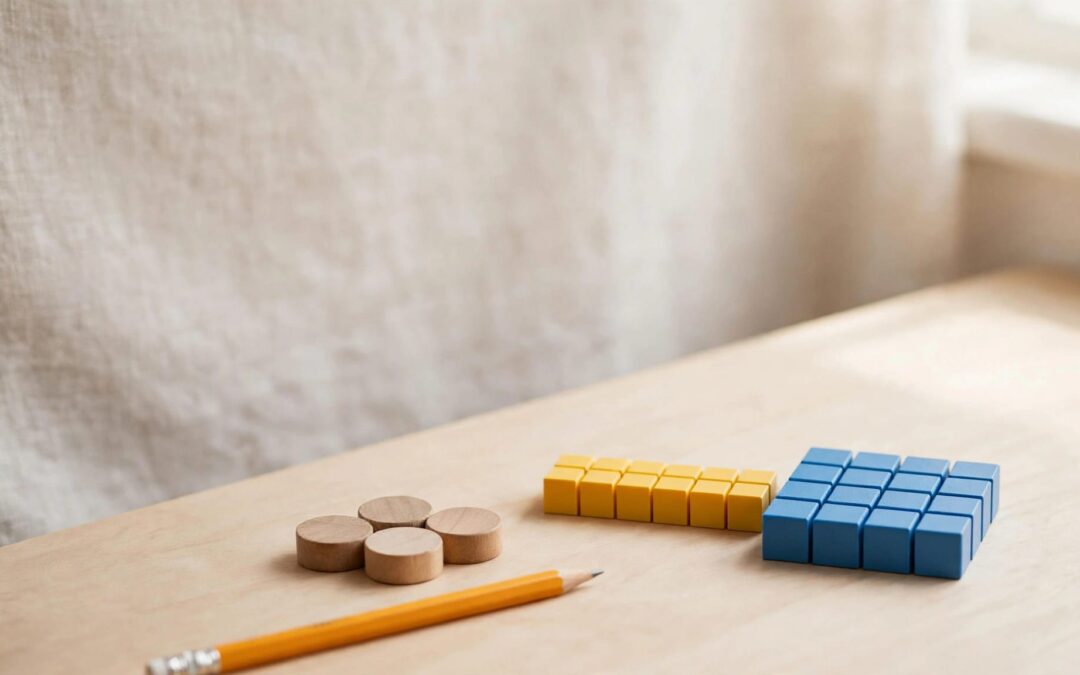
Addition with regrouping means trading ten ones for one ten when a column adds up to 10 or more. Your child writes the leftover ones, then includes the new ten in the next column.
The small carried digit can look mysterious until your child connects it to place value. Blocks, drawings, and a clear written example make that connection easier.
Start with the trade itself, then move to the pencil-and-paper steps.
What Addition With Regrouping Means
Regrouping, also called carrying over, changes how an amount is grouped without changing its value. Ten ones make one ten, and ten tens make one hundred.
The rule is simple: when a column totals 10 or more, keep its ones digit in that column. Carry the remaining group or groups to the next column on the left. “More than nine” means exactly the same thing.
Compare these two sums:
| Problem | Ones calculation | Regrouping needed? | Sum |
|---|---|---|---|
| 12 + 24 | 2 + 4 = 6 | No | 36 |
| 38 + 14 | 8 + 4 = 12 | Yes | 52 |
For 12 + 24, both column totals stay below ten. For 38 + 14, the 12 ones become 1 ten and 2 ones.
The Grade 2 base-ten standards connect groups of tens and ones, organized by place value, with addition and subtraction. Before teaching carrying, ask your child to show why the 3 in 38 means 30.
Build the Trade Before Writing the Algorithm
Start with blocks or bundles
Build 38 using three tens rods and eight ones cubes. Then build 14 using one tens rod and four ones cubes.
Push the ones together. Your child now has 12 ones. Exchange ten of them for one tens rod, leaving two loose ones.
Count again: five tens and two ones make 52. The exchange hasn’t added anything; it has reorganized the same amount.
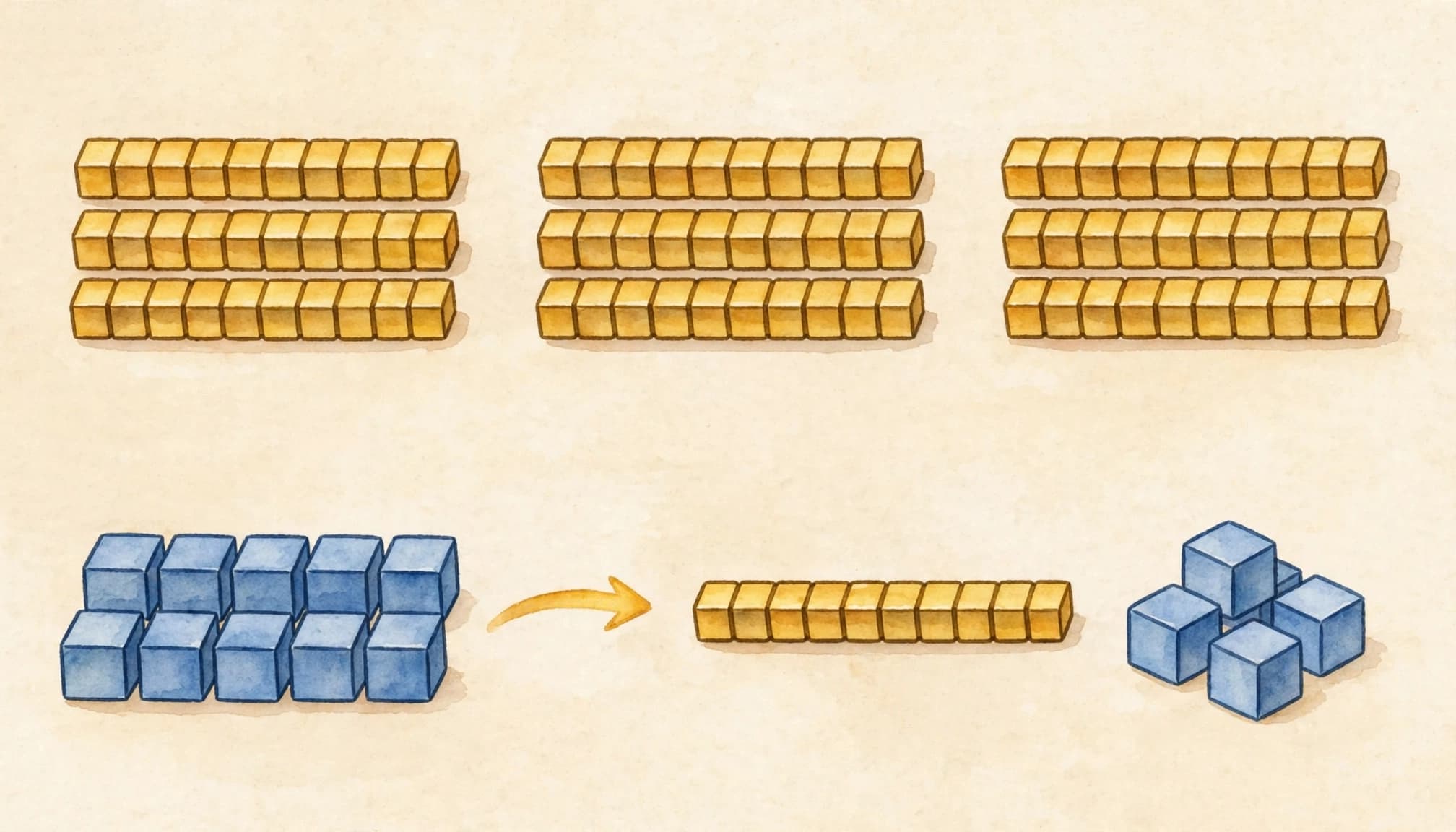
Base-ten blocks are useful, but bundled craft sticks work too. Keep each bundle at exactly ten. A suspicious nine-stick bundle deserves a recount.
Draw the same exchange, then write it
Next, draw sticks for tens and dots for ones. Circle ten dots, cross out that group, and draw one new tens stick.
Finally, connect that new stick to the small 1 above the written tens column.
This is the concrete, pictorial, abstract sequence, often called CPA: handle the groups, draw them, then record the calculation.
Common Core standard 2.NBT.7 calls for adding and subtracting within 1,000 using models or drawings and place-value strategies connected to a written method. Keep the blocks nearby while the notation becomes familiar.
Two-Digit Addition With Regrouping, Step by Step
Work through 38 + 14
Write the numbers vertically, with ones under ones and tens under tens. Start in the ones column because its total may create another ten.
This table shows where every digit belongs:
| Row | Tens | Ones |
|---|---|---|
| Carried digit | 1 | |
| First number | 3 | 8 |
| Add this number | 1 | 4 |
| Sum | 5 | 2 |
Follow these steps:
- Add the ones: 8 + 4 = 12.
- Write 2 in the answer’s ones column.
- Write a small 1 above the tens column. It records the ten made from those 12 ones.
- Add all the tens: 3 + 1 + 1 = 5. Write 5 in the answer’s tens column.
Therefore, 38 + 14 = 52.
Say “three tens plus one ten plus the new ten” before shortening the calculation to 3 + 1 + 1.
The carried 1 means one ten here, not one extra single object. Its position tells you its value.
Try 28 + 37
Again, begin with the ones: 8 + 7 = 15.
Write 5 in the ones column, then carry 1 to the tens column. Now add 2 + 3 + 1 = 6 tens.
The answer is 28 + 37 = 65.
Ask your child to explain why 15 doesn’t fit entirely beneath the ones column. Listen for “one ten and five ones,” rather than only “because that’s the rule.”
Finally, check with expanded form: 20 + 30 + 15 = 65.
Carrying With More Addends and Bigger Numbers
Three addends can create two new tens
In 26 + 37 + 18, the ones total 6 + 7 + 8 = 21.
Write 1 in the ones column and carry 2 tens, because 21 ones contain two complete groups of ten. Then calculate the tens: 2 + 3 + 1 + 2 = 8.
The sum is 81.
This example helps children avoid assuming that every carried digit must be 1. The digit depends on how many complete groups the column produces.
Three-digit addition follows the same rule
For 371 + 145, work right to left:
The ones give 1 + 5 = 6, so write 6.
The tens give 7 + 4 = 11 tens. Keep 1 ten in the tens column and exchange 10 tens for 1 hundred.
Finally, add the hundreds: 3 + 1 + 1 = 5. The answer is 516.
A new hundred always requires ten tens. If your child has seven tens, three more tens complete that hundred.
Later, five-digit addition uses the same exchanges. Decimal addition does too, although children must align matching place values and decimal points. Those extensions can wait until whole-number regrouping makes sense.
Try an Open Number Line
An open number line gives your child another way to show the addition. It doesn’t need every number marked.
For 28 + 37, start with the larger addend, 37. Split 28 into 20 and 8.
Make two tens hops: 37 to 47, then 57. Next, add eight ones. Your child can jump three to reach 60, then five to reach 65.
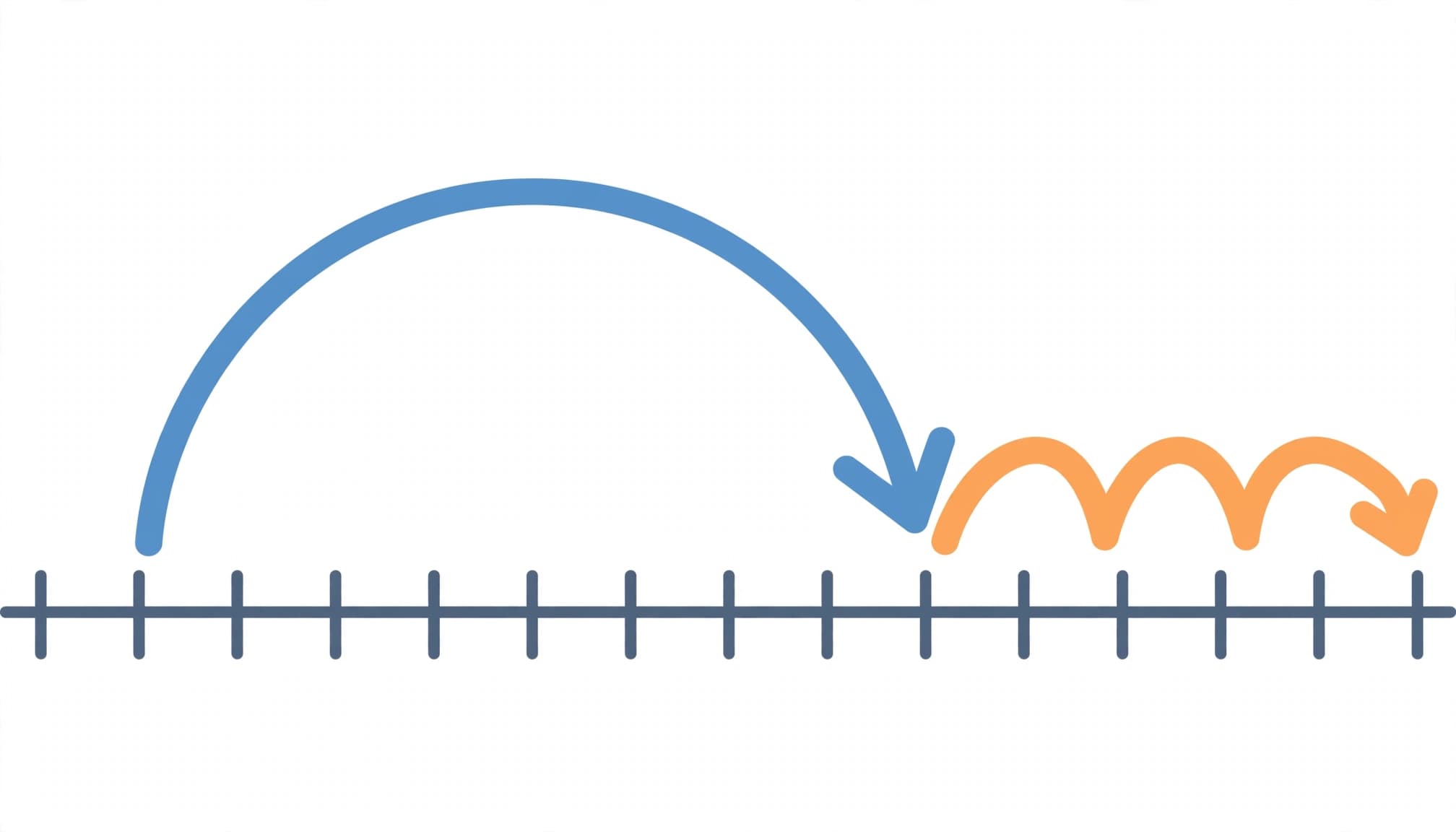
Compare that route with the column method. Both combine the same quantities, but the number line makes crossing a ten visible.
Introduce this after one method feels comfortable. A whole strategy buffet can leave everyone staring at the plate.
Fix the Mistake Before Adding More Practice
Separate fact errors from regrouping errors
If your child writes 8 + 7 = 14, the difficulty is an addition fact. Use counters or review addition facts up to 20 before adding more column work.
However, if they find 15 correctly but forget the carried ten, focus on recording the exchange. Ask them to point to the new ten in their model and in their written calculation.
Graph paper can help wandering digits stay in their columns.
Watch the carried digit and the direction
Common errors include writing both digits of 12 beneath the ones column, placing the carried 1 above the ones, or forgetting it when adding tens.
Use the same short verbal check: “Add this column. Record the leftover units. Move complete groups left. Include those groups next.”
Also distinguish addition from subtraction. For 31 – 14, exchange one of the three tens for ten ones. Now calculate 11 – 4 = 7 and 2 – 1 = 1, giving 17.
Children often hear “borrow,” but “exchange one ten for ten ones” explains what happened. Addition and subtraction regroup in different directions.
Practice Two-Digit Sums and Explain the Answers
Begin with one example together, then let your child attempt two independently. Cover the answers while they work.
| Problem | What to notice | Answer |
|---|---|---|
| 12 + 24 | Neither column needs regrouping | 36 |
| 35 + 27 | Twelve ones make a new ten | 62 |
| 56 + 37 | Thirteen ones leave three ones | 93 |
| 53 + 68 | The total reaches the hundreds place | 121 |
| 26 + 37 + 18 | Carry two tens | 81 |
| 371 + 145 | Regroup ten tens as one hundred | 516 |
Correct answers matter, but ask for one explanation too. A child who can describe the trade gives you more information than a page of unexplained totals.
Put familiar numbers into a story
For story practice, reuse 38 + 14 with pencils: “There are 38 pencils in one container and 14 in another. How many altogether?” The answer is 52 pencils.
Then use 28 + 37 with books. Ask your child to draw the quantities, write the equation, and finish with 65 books.
If the calculation is correct but the story causes trouble, separate reading from solving. SEDL’s Grade 2 teaching video offers another demonstration of connecting models and place-value calculations.
Step back only as far as needed
If ten-for-one exchanges remain confusing, revisit teen numbers from the Grade 1 curriculum. Targeted Grade 1 worksheets can support that review without restarting an entire grade.
Within a homeschool curriculum, keep this practice focused on one skill. Return to the model whenever the written steps lose meaning.
Key Takeaways for Parents
Regroup whenever a column totals 10 or more. Help your child name the unit being exchanged: ten ones become one ten; ten tens become one hundred.
Keep the model and written calculation side by side until your child can connect them. Then look at errors separately: a mistaken fact needs different practice than a forgotten carry.
Move to larger numbers when your child can explain a fresh example independently. Speed can wait while the meaning takes hold.
Frequently Asked Questions
What does addition with regrouping mean?
Regrouping changes how an amount is grouped without changing its value. Ten ones become one ten, and ten tens become one hundred.
When should a child regroup?
Regroup when a column totals 10 or more. Write the ones digit in that column, then carry the complete groups to the next column on the left.
What does the carried 1 mean?
Its value depends on its place. In the tens column, a carried 1 means one ten, not one single object.
How can I help my child understand regrouping?
Build the numbers with base-ten blocks or bundles of ten, then draw the same exchange and connect it to the written calculation. Keep the model nearby until your child can explain what the carried digit means.
Make the Next Math Session Count
Choose one two-digit sum, build it together, and ask your child to explain the exchange before writing the carried digit. That explanation is the strongest check that the small number above the column means something.
For follow-up, browse our free worksheets for Grades 1 through 8 and choose practice matching today’s skill. A few well-understood sums are a useful place to stop.