PARENT RESOURCES & ARTICLES

Grade 2 Skip Counting: A Step Toward Multiplication
Grade 2 skip counting by 2s helps children find totals by counting in equal steps, such as 2, 4, 6 or 5, 10, 15. Before multiplication facts enter the picture, your child needs to understand equal groups and what each counting jump adds. A memorized chant can sound...

Grade 1 Math Practice: Addition Within 20 Made Clear
Two numbers add to 20 or less when their total is no greater than 20. To help your child, start with objects, teach one strategy at a time, and keep practice short. Children begin building these early math skills in kindergarten and develop them further in Grade 1....

Addition With Regrouping: A Grade 2 Parent Guide
Addition with regrouping means trading ten ones for one ten when a column adds up to 10 or more. Your child writes the leftover ones, then includes the new ten in the next column. The small carried digit can look mysterious until your child connects it to place value....
Grade 6 Ratios FAQ: Unit Rates, Tables, and Models
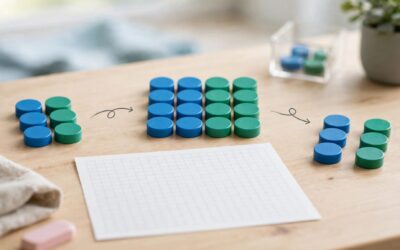
A ratio compares quantities through multiplication, such as two goats for every five sheep. To help your child, start with objects, label each quantity, and show how both numbers change by the same factor. Tables and drawings make the relationship easier to follow...

Grade 5 Math: Multiplying Fractions With Models
When multiplying fractions, multiply the numerators together and the denominators together, then simplify the answer. For Grade 5 learners, a visual model makes the rule easier to understand because it shows what taking a fraction of another fraction means. If your...

Grade 1 Reading: Help Your Child Retell a Story
Your child closes the book and announces, "There was a rabbit!" That's a start, but the rabbit probably did more than exist. Story retelling helps your first grader name key events in order and connect them to the beginning, middle, and end. You can teach sequencing...