
Grade 2 skip counting by 2s helps children find totals by counting in equal steps, such as 2, 4, 6 or 5, 10, 15. Before multiplication facts enter the picture, your child needs to understand equal groups and what each counting jump adds.
A memorized chant can sound impressive while hiding confusion about the objects being counted. Start with groups your child can touch, then connect those groups to number patterns using the grade 2 skip counting sequence below.
What second graders need to learn
Grade 2 skip counting means counting forward or backward by a number other than 1. Children practice steps of 2, 5, 10, and 100 within 1,000 to find totals faster.
The Common Core Grade 2 standards call for counting within 1,000 and skip counting by 5s, 10s, and 100s. Counting by 2s also supports equal-group work, although that standard doesn’t specifically list it.
The goal is more than reciting numbers. Your child should connect each number to a growing total, explain the amount added, and use place value to make sense of the pattern.
Begin with familiar objects and small totals. Hundreds can wait until tens make sense.
Teach grade 2 skip counting in this order
Start with 10s, then introduce 5s and 2s. Add 100s when your child is comfortable with hundreds and place value.
Start with skip counting by 10s
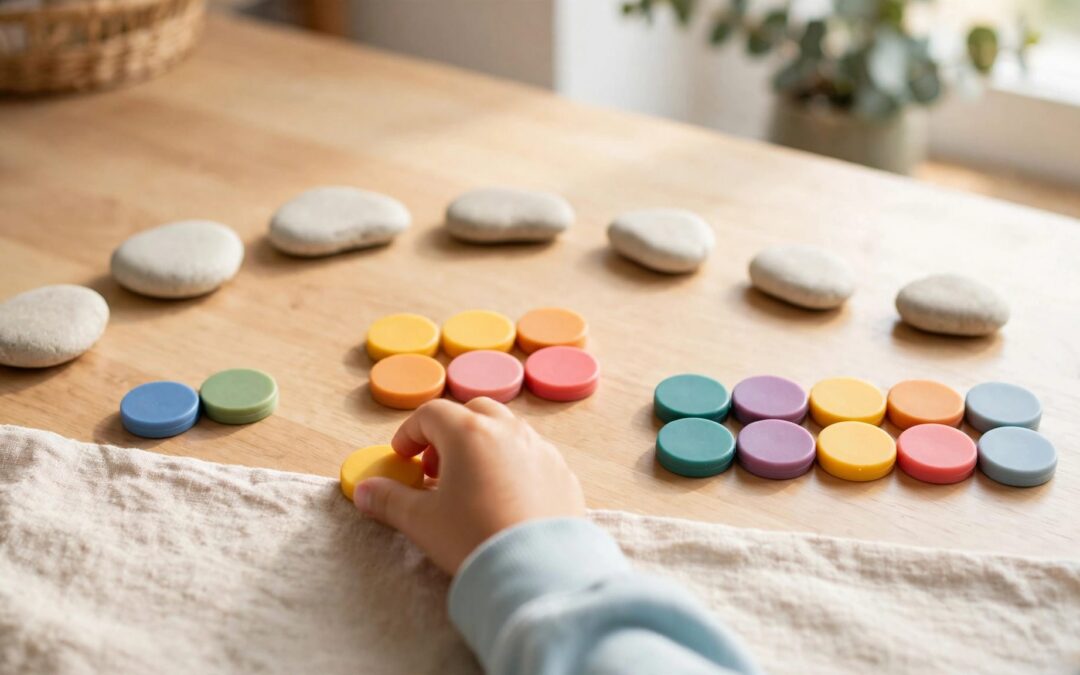
Arrange three groups of ten counters. Point to each group while saying, “10, 20, 30.”
In 10, 20, 30, 40, 50, the tens digit increases by 1 while the ones digit stays 0. Explain the rule as “add one ten.” At 90, another ten makes 100, so the hundreds digit changes too.
Introduce skip counting by 5s
When counting by 5s, show groups of five counters: 5, 10, 15, 20, 25. Each new group adds five.
When counting starts at zero, the totals end in 5 or 0. Two groups of five make ten, so connect this pattern to the tens your child already knows.
Give skip counting by 2s extra practice
Use pairs of socks: 2, 4, 6, 8, 10, 12. Starting at zero produces numbers ending in 0, 2, 4, 6, or 8.
Counting by 2s often needs the most practice because children must keep track of many small jumps. Begin with six pairs, and point to one pair per number.
Extend the pattern to 100s
Use drawings of hundred-blocks: 100, 200, 300, 400. Each step adds one hundred.
Before reaching 1,000, adding 100 increases the hundreds digit by 1 while the tens and ones stay unchanged. Try 142, 242, 342 to show that the starting number doesn’t have to be zero.
Use a short, repeatable teaching routine
A ten-minute session gives you room to model, practice, and listen without turning the kitchen table into a testing center.
- Build three groups of ten counters and ask your child to check that each group contains ten.
- Point to the groups together while saying, “10, 20, 30.”
- Write 10, 20, 30 beneath the groups, then connect the totals with jumps of ten on a number line.
- Add a fourth group and let your child find the new total.
- Hide one written total and ask your child to explain the missing number.
If your child starts counting every counter individually, keep the groups visible. Ask how knowing the first group has ten could help with the next.
Our Grade 2 mathematics topics offer human-curated video explanations for related skills. Pause before a worked answer so your child can build the example first.
Help children cross 100 without losing the pattern

Keep the jump the same across a hundred
A child might say “90, 95, 100, 110” because reaching 100 distracts them from adding five.
Write 95 + 5 = 100, then 100 + 5 = 105. Use a labeled number line to show equal jumps. Practice 90, 95, 100, 105, 110 before starting elsewhere.
For tens, rehearse 980, 990, 1,000. Landing on 1,000 introduces a new place, but the jump remains ten. Don’t require counting beyond 1,000 for this Grade 2 target.
Practice counting backward deliberately
Begin with objects and remove one equal group each time. Removing groups of five gives 25, 20, 15, 10, 5, 0.
Then cross a boundary: 110, 105, 100, 95, 90. Say “subtract five” while your child moves left on the number line.
When counting backward, mark the starting number first. Count the jumps, rather than treating the starting point as the first jump.
If your child stalls, reduce the numbers while keeping the same step size.
Make number patterns hands-on
Build a skip-counting chain
On a 120 number chart, have your child color 10, 20, 30, and the remaining multiples of ten through 120.
Cut the chart into horizontal strips containing ten numbers each. Curl each strip into a link and staple the ends together to make a chain.
Ask how many numbers each link contains. Three links hold 30 numbers, connecting the counting sequence to groups of ten. Handle the stapling yourself when needed.
Order self-checking popsicle sticks
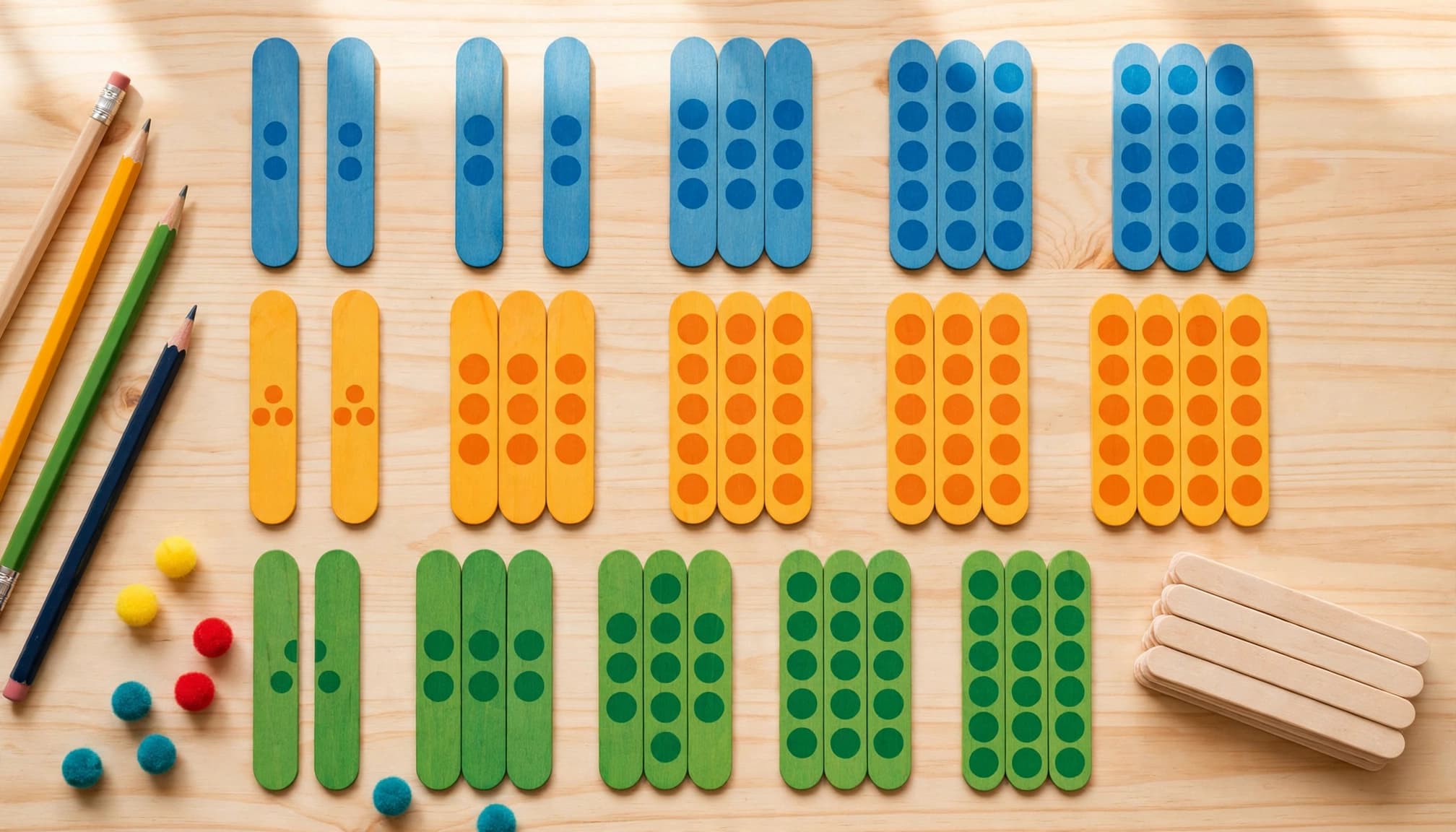
Write one number per popsicle stick, such as 5, 10, 15, 20, and 25. Arrange them in order, flip them together, and draw one continuous diagonal line across their backs.
Mix the popsicle sticks. Your child reorders them, then flips them over to check whether the line reconnects.
Change only one feature next time: the interval, direction, or starting number.
Try these skip-counting practice questions
Use these skip counting prompts after hands-on practice. Cover the answers and begin with three questions, leaving space to draw jumps on a number line.
Parents looking for skip counting worksheets can use these prompts as a short written check.
Each row targets a different part of the skill.
| Practice focus | Complete the pattern |
|---|---|
| Skip counting by 10s | 20, 30, ___, 50 |
| Counting by 5s | 15, 20, ___, 30 |
| Forward by 2s | 6, 8, ___, 12 |
| Across 100 | 90, 95, ___, 105 |
| Backward by 5s | 110, 105, ___, 95 |
| Backward by 10s | 140, 130, ___, 110 |
| Forward by 100s | 230, 330, ___, 530 |
| A different starting point | 142, 147, ___, 157 |
Answers, in order: 40, 25, 10, 100, 100, 120, 430, 152.
The final row adds five each time, but its numbers don’t end in 0 or 5. That familiar ending pattern applies when counting by fives from zero or another multiple of five.
For additional standards-based tasks, Illustrative Mathematics’ counting activities connect to the same Grade 2 expectation.
Finish by asking your child to explain one answer. A correct guess and an understood pattern can look identical on paper.
Connect equal groups to multiplication and division
Place three groups of five counters on the table. Count the totals: 5, 10, 15.
Then write 5 + 5 + 5 = 15. Skip counting records the running totals of repeated addition without writing every step. The same repeated addition idea works with pairs and tens. Counting by 2s is skip counting by 2s; counting by 10s is skip counting by 10s. Once that connection makes sense, introduce 3 × 5 = 15 as three groups of five.
Ask your child to point to each group while using skip counting. This keeps the number of groups separate from the total number of counters.
Reverse the task for an early division connection: arrange 15 counters into groups of five. Counting 5, 10, 15 shows that three groups fit.
The Grade 3 operations standards in the Common Core develop multiplication and division through equal groups and arrays. Second-grade practice builds number sense and place value without rushing into fact drills.
Choose resources that match the sticking point
Choose practice based on the error you see. A child who loses their place needs a different task than one who can’t recognize a group of five.
Our free worksheets by grade provide printable practice for Grades 1 through 8. Choose Grade 2 questions that match the skill you’ve modeled instead of assigning a whole page automatically. Skip counting worksheets are useful when their questions practice that same skill.
If counting in small groups remains difficult, selected Grade 1 worksheets can provide focused review. One shaky skill doesn’t require restarting an entire Grade 1 curriculum.
For a homeschool curriculum or after-school support, our full curriculum for Grades 1 through 8 organizes learning by grade and topic. Pair a relevant video with objects and a few written questions. Your child’s explanation should guide the next lesson, rather than the number of pages completed.
Key takeaways for parents
- Teach 10s before 5s and 2s, linking each spoken number to an equal group.
- Keep counters or a number line available when crossing 100 or counting backward.
- Ask your child to explain a missing number before introducing longer sequences.
- Connect skip counting to repeated addition before expecting multiplication facts.
Frequently asked questions
Should my child always start at zero?
Start at zero when introducing equal groups, because every landing number then matches a group total. Later, use other starting points to check whether your child understands the interval.
For example, 23, 33, 43 adds ten while keeping three ones. Ask your child to explain what changes and what stays the same.
What if my child can chant but can’t solve a problem?
Return to visible groups. Ask your child to build four groups of two, then point to each group while saying 2, 4, 6, 8.
If the spoken sequence doesn’t match the pointing, slow down. Keep the same small set until your child connects each count to its total.
Make the next counting session count
Grade 2 skip counting becomes useful when your child can show what each jump adds. Equal groups give the pattern meaning before multiplication symbols arrive.
Choose one interval, build a few groups, and finish with one explanation. For another teaching demonstration, try our free curriculum learning resources, with ad-supported, human-curated videos organized by grade and topic.