
When multiplying fractions, multiply the numerators together and the denominators together, then simplify the answer. For Grade 5 learners, a visual model makes the rule easier to understand because it shows what taking a fraction of another fraction means.
If your child can repeat the rule but can’t explain the answer, start with a drawing. Then connect the picture to the calculation before adding mixed numbers or longer problems.
What Grade 5 Fraction Multiplication Builds On
Children usually learn fraction-by-fraction multiplication around ages 10 or 11, but the groundwork starts earlier.
The Grade 4 fraction multiplication standard covers multiplying fractions by a whole number. Standard 4.NF.B.4b connects products such as 3 × 1/5 to counting unit fractions.
Standard 5.NF.B.4 extends multiplication to a fraction or whole number multiplied by a fraction. Standard 5.NF.B.4b connects this work to rectangular area.
Before starting, check whether your child understands equal parts and equivalent fractions. Our Grade 4 fraction models guide offers a useful refresher without restarting an entire grade.
See Multiplying Fractions as a Part of a Part
Draw one-half of one-third
The expression 1/2 × 1/3 shows a part of a part: one-half of one-third.
Draw a rectangle and divide it into three equal columns. Shade one column to represent 1/3. Then split the entire rectangle horizontally into two equal rows.
Half of the shaded third covers one small section. Ask your child to describe what the overlap represents: a part of a part. There are six equal sections altogether, so the product is:
1/2 × 1/3 = 1/6
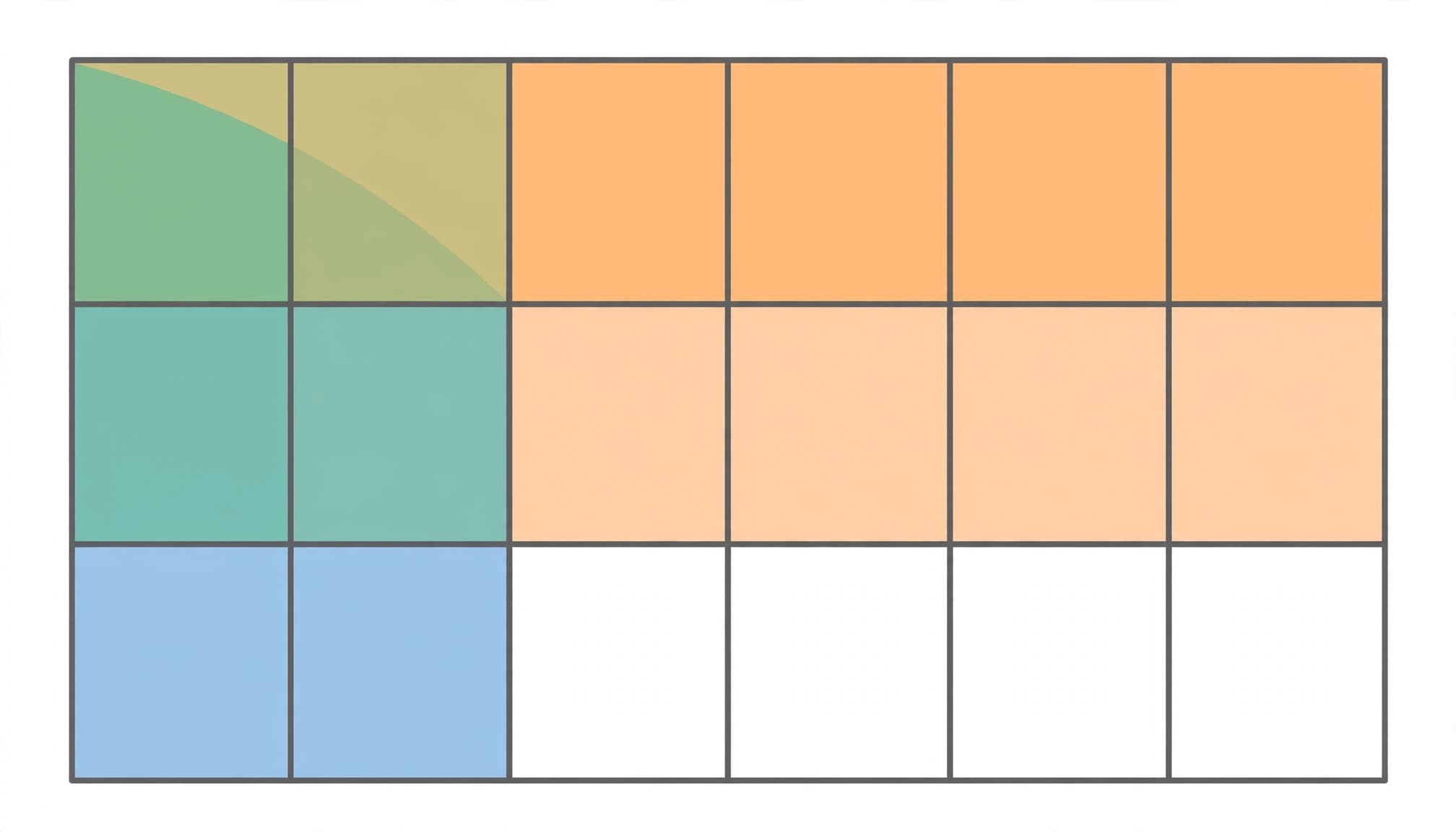
Keep the whole fixed throughout the drawing. Changing its size halfway through gives the fractions a moving target.
Pair this visual model with SEDL’s fraction-area video lesson, pausing so your child can explain the overlapping region.
Explain why the answer gets smaller
Repeated addition explains 4 × 1/3 as four copies of one-third. However, “half a copy” needs a different explanation.
For positive amounts, multiplying by a factor between 0 and 1 takes only part of the starting amount. Therefore, 1/2 × 1/3 is smaller than 1/3.
Multiplying by 1 keeps the amount unchanged. A factor greater than 1 makes it larger: 3/2 × 1/3 = 1/2.
Multiply Fractions Step by Step
Multiply the tops, then the bottoms
The numerator is the top number, and the denominator is the bottom number.
Use this routine:
- Multiply the numerators together.
- Multiply the denominators together.
- Simplify the product to lowest terms.
For example:
2/3 × 4/5 = (2 × 4)/(3 × 5) = 8/15
You don’t need a common denominator for multiplication. Cross multiplying uses diagonal products to compare fractions, while fraction division uses a reciprocal.
An area model explains the denominator: three rows and five columns create 15 equal cells. Shading two rows and four columns produces eight overlapping cells, so the product is 8/15.
Simplify with the greatest common factor
Simplifying changes a fraction’s name without changing its value.
For 3/4 × 2/5, multiply straight across to get 6/20. The greatest common factor of 6 and 20 is 2.
Divide both numbers by 2 to simplify:
6/20 = 3/10
Because 3 and 10 share no common factor greater than 1, the answer is in simplest form.
Cross Cancellation Keeps the Numbers Smaller
Simplify before multiplying
Cross cancellation means dividing a numerator and a denominator by the same shared factor before multiplying. The factors can come from different fractions.
For 2/3 × 1/4, 2 and 4 share a common factor of 2.
Divide both by 2:
2/3 × 1/4 = 1/3 × 1/2 = 1/6
The value stays unchanged because cross cancellation removes the same factor from the overall top and bottom.
Cancel a numerator with a denominator, never two numerators or two denominators.
Compare both valid methods
For 1/3 × 3/10, either route works:
| Method | Calculation | Answer |
|---|---|---|
| Multiply first | 1/3 × 3/10 = 3/30, then divide both by 3 | 1/10 |
| Cancel first | Divide the numerator 3 and denominator 3 by 3, then multiply 1/1 × 1/10 | 1/10 |
Both methods give the same product. Cancelling first can simplify the arithmetic, but your child can multiply first while learning the idea.
Handle Whole Numbers, Mixed Numbers, and Three Fractions
Write whole numbers over 1
Write any whole number as a fraction with denominator 1. For example, 4 = 4/1.
4 × 3/5 = 4/1 × 3/5 = 12/5 = 2 2/5
A drawing shows four groups of three fifths. Ten fifths make two wholes, with two fifths left.
The improper fraction 12/5 and the mixed number 2 2/5 name the same amount. Use either form as the directions request.
Convert mixed numbers before multiplying
A mixed number combines a whole number and a fraction. Convert it to an improper fraction first.
For 1 3/4, the whole number 1 contains four fourths. Add the remaining three fourths:
1 3/4 = (1 × 4 + 3)/4 = 7/4
Now multiply:
1 3/4 × 2/3 = 7/4 × 2/3 = 14/12 = 7/6 = 1 1/6
You could also use cross cancellation first, producing 7/2 × 1/3 = 7/6.
To convert 7/6 back, divide 7 by 6. The quotient is 1, and the remainder becomes the numerator over 6. Use the improper fraction or mixed number as the directions request.
Multiplying three fractions works the same way
The rule doesn’t change when you multiply three fractions.
5/12 × 3/5 × 7/9 = 105/540
The greatest common factor is 15, so simplify 105/540 to 7/36 in lowest terms.
Cancelling first avoids larger numbers. Cancel the two 5s, then divide the numerator 3 and denominator 9 by 3:
1/12 × 1/1 × 7/3 = 7/36
Connect the Calculation to a Word Problem
The Grade 5 fraction standards include solving real-world multiplication problems with fractions and mixed numbers. A labeled drawing helps children choose the operation.
Scale a recipe
A recipe needs 3/4 cup of oats for one batch. Your child wants to make 2/3 of a batch.
Calculate:
2/3 × 3/4 = 6/12 = 1/2
The product is 1/2 cup of oats. That makes sense because two-thirds of a batch uses less than three-fourths of a cup.
Find a rectangular area
A rectangular garden bed measures 1 1/2 meters long and 2/3 meter wide. The length is a mixed number.
Area equals length multiplied by width:
3/2 × 2/3 = 1 square meter
The units matter. Length uses meters, while area uses square meters.
Ask your child to label the rectangle’s sides before calculating. That separates understanding the problem from performing the multiplication.
Catch These Common Fraction Mistakes
When an answer goes sideways, inspect the method before assigning another page.
- The “keep, flip, multiply” shortcut is for dividing fractions. You multiply by the reciprocal of the divisor.
- When multiplying fractions, don’t take a reciprocal. Cross multiplying isn’t the method; multiply the numerators together and the denominators together.
- A common denominator isn’t needed for multiplication. Our guide to adding and subtracting unlike fractions explains when that step belongs.
Also watch for children multiplying the whole-number parts and fractional parts of mixed numbers separately. Convert each complete mixed number first, so every part stays in the calculation.
Try a Short Practice Set With Answers
Start with the first three questions. Add the others when your child can explain their steps.
| Number | Problem |
|---|---|
| 1 | 1/2 × 2/5 |
| 2 | 3/4 × 2/3 |
| 3 | 4/7 × 3/8 |
| 4 | 5 × 2/3 |
| 5 | 1 1/2 × 3/5 |
| 6 | 2/3 × 3/4 × 4/5 |
| 7 | A ribbon is 3/4 meter long. What is 2/3 of its length? |
These questions progress from simple products to whole numbers, a mixed number, three fractions, and an application.
Answer key: 1) 1/5; 2) 1/2; 3) 3/14; 4) 10/3, an improper fraction, or 3 1/3; 5) 9/10; 6) 2/5; 7) 1/2 meter.
After checking, ask your child to simplify any fraction that isn’t in lowest terms, then draw question 2. A correct explanation shows more than a lucky answer. If the drawing doesn’t match, revisit the model before introducing larger numbers.
Key Takeaways for Practice at Home
For a homeschool curriculum or after-school review, keep the sequence manageable: model one problem, watch an explanation, then try a similar question independently.
Our human-curated educational videos organize learning by grade and topic. Pause before a worked answer so your child can attempt the next step.
Then choose practice that matches the difficulty. A child who struggles with equal parts needs drawings. A child who understands the model but calculates incorrectly needs focused multiplication-fact practice.
Our free worksheets by grade and subject provide printable follow-up. The same directory includes Grade 1 worksheets for younger siblings, so everyone can work at an appropriate level.
A shaky counting skill calls for targeted review, rather than restarting a Grade 1 curriculum. Keep the remedy as small as the snag.
Frequently Asked Questions
What’s the best starting method for multiplying fractions?
Start with an area model, then connect its equal sections to the written rule. Once your child understands the picture, multiply straight across and simplify.
Introduce cancellation afterward. It reduces arithmetic, but children should understand why dividing a numerator and denominator by the same factor preserves the product.
Must every answer become a mixed number?
An improper fraction is a valid answer unless the directions request a mixed number. For example, 12/5 and 2 2/5 are equivalent.
However, simplify either form when possible. Being able to explain both names is more useful than changing notation automatically.
Make the Next Fraction Lesson Focused
Multiplying fractions becomes easier when your child connects the picture and the procedure. Keep the whole consistent, multiply numerators and denominators, and simplify without changing the value.
For your next session, choose one worked example and one independent problem. Use our worksheet directory for a short follow-up, then ask your child to explain what the answer means.