
A fourth grader can answer “What is one-half?” and still freeze when asked whether 3/8 or 2/5 is larger. If grade 4 fractions feel like a sudden jump, you’re seeing a real shift: children must explain why fractions are equal, compare different-sized parts, and calculate with them.
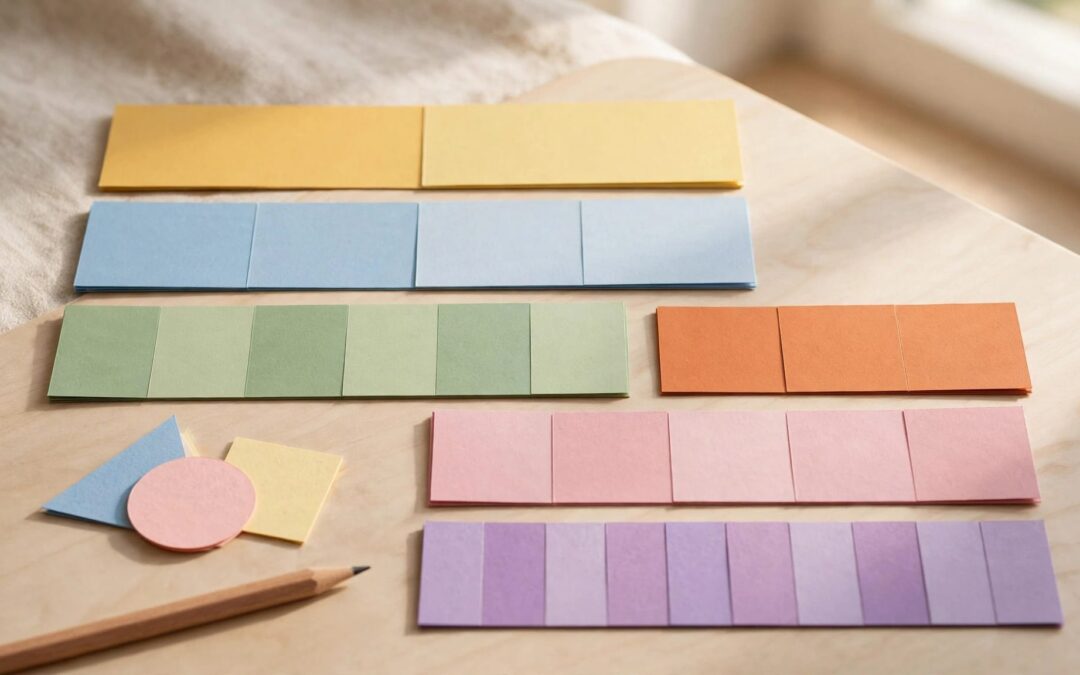
You don’t need fancy supplies to help. A few equal-sized strips of paper, a pencil, and questions about what the pieces mean will take you a long way.
What grade 4 fractions cover in Common Core
The Grade 4 fraction standards organize grade 4 fractions into three areas: equivalence and comparing fractions, addition and subtraction with the same denominator, and multiplying fractions by whole numbers. They also connect fractions with denominators of 10 and 100 to decimal notation.
The thread connecting the skills
Every fraction describes parts of a particular whole. A unit fraction represents one equal part of that whole. If one child cuts a small cookie into fourths and another cuts a large cookie into fourths, their pieces aren’t necessarily the same size. Keep the whole the same size when drawing models or comparing fractions.
Ask your child to name the unit before calculating: “These are eighths.” That habit makes 2/8 + 3/8 easier to understand. They’re joining five eighth-sized pieces with the same denominator, not combining the numerators and denominators into 5/16.
What to save for later practice
Fourth graders practice comparing fractions with different denominators, but addition and subtraction focus on fractions with the same denominator. Don’t treat unlike-denominator addition as the next required worksheet just because your child can order those fractions. Finding common denominators to add unlike fractions can come later.
Formal division steps for converting improper fractions and multi-step regrouping routines can be useful extensions. Start with models and grade-level operations first.
Make equivalent fractions visible before teaching the rule
Equivalent fractions name the same amount in different-sized pieces. Fraction models make that idea easier to see than numbers alone.
Start with two identical rectangles
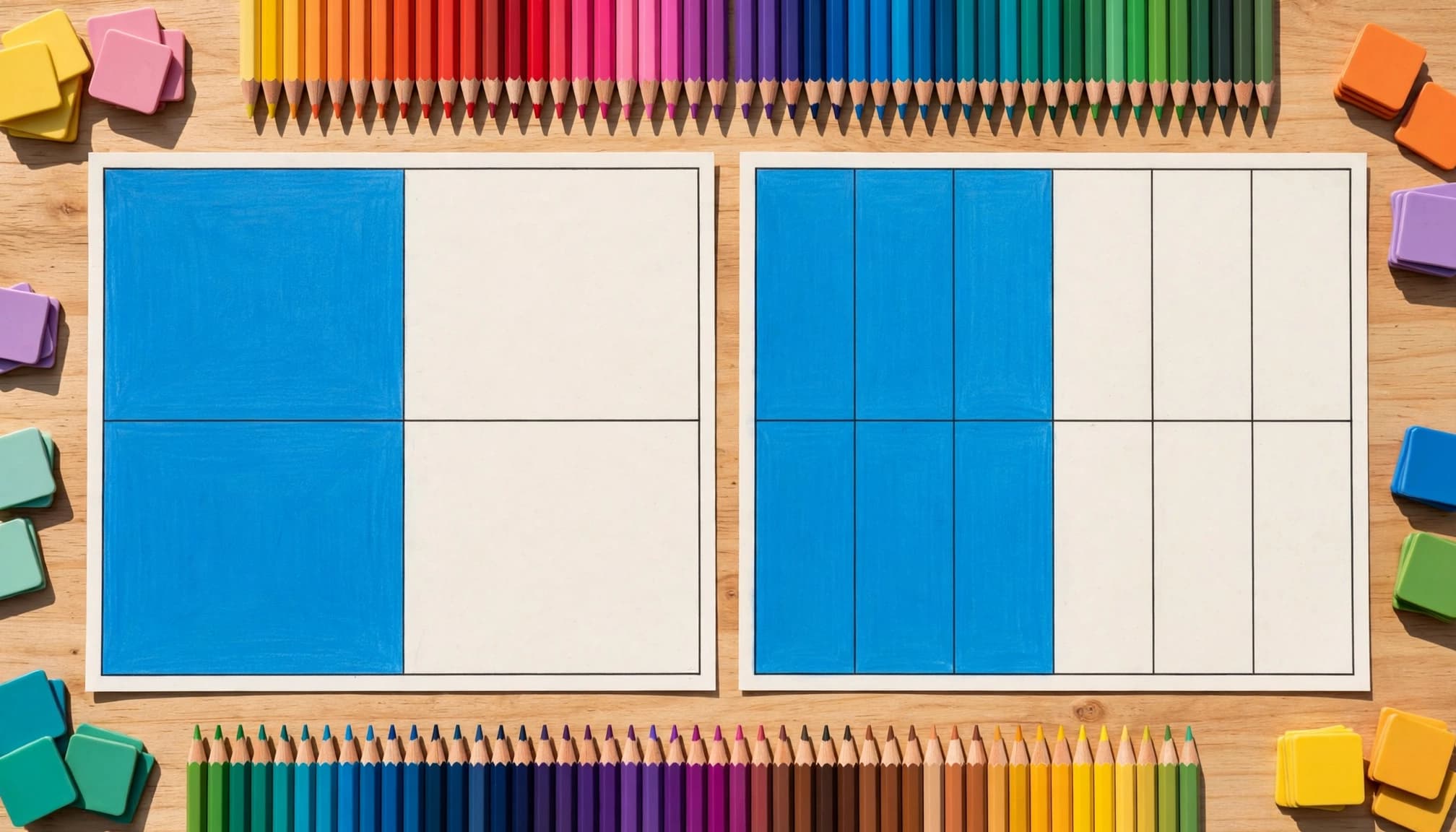
These area models use two equal rectangles, each representing the same whole. Divide the first into four equal parts and shade one. Divide the second into eight equal parts and shade two. The shaded fraction parts match, so 1/4 = 2/8. These are equivalent fractions, even though the rectangles don’t have the same denominator.
Now ask what changed. Each fourth became two smaller eighths, and the number of shaded pieces doubled too. Your child can see why multiplying both the numerator and denominator by 2 preserves the amount. The Michigan fourth-grade math guidance also pairs fraction equivalence with visual models.
Check the idea on a number line
Mark 0 and 1 on a line. Locate 1/2, then divide the same line into fourths. The point for 2/4 lands on 1/2. Unlike shaded shapes, this makes clear that equivalent fractions identify one location.
If your child writes 2/6 = 4/12, ask them to draw both on equal-length strips. Drawing is a check, not a punishment for getting the arithmetic right.
Compare fractions with different denominators
When comparing fractions with different denominators, a child who says “eight is bigger than five” needs to look at the size of each part. More pieces in the same whole means smaller pieces.
Use one-half as a quick landmark
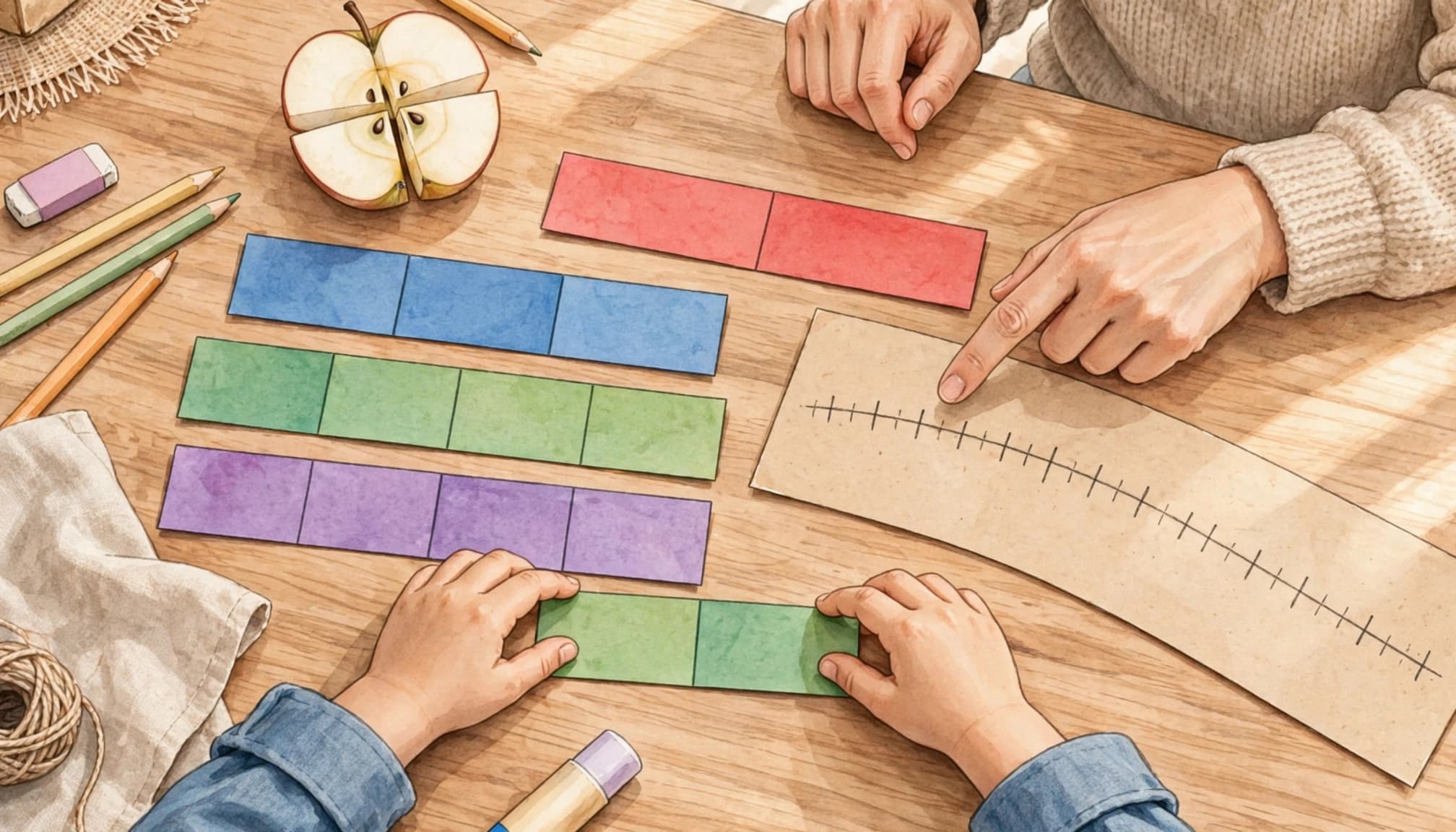
One-half is a useful benchmark fraction for comparing fractions with different denominators. Draw equal-length bars for 3/8 and 2/5. Half of the first bar is 4/8, so 3/8 is less than half. Half of the second is 2.5/5, so 2/5 is less than half too. That benchmark alone doesn’t settle this pair, but it can catch wild guesses. A number line can also help show where each fraction falls.
For 3/8 versus 3/5, the shared numerator helps: three fifths cover more of the same whole than three eighths. When fractions have the same denominator, the one with the larger numerator is greater. For 2/3 versus 3/8, one-half settles the comparison immediately. Two thirds is above half; three eighths is below it.
Use equivalent fractions when the picture is close
To compare 3/4 and 5/8, split each fourth in two. Now 3/4 is 6/8, so both fractions have the same denominator and 3/4 is greater than 5/8. Equivalent fractions create common denominators when a benchmark doesn’t decide the comparison. Both fractions must refer to the same-size whole, whether your child uses fraction models, paper strips, or a drawing.
Have them finish with a sentence: “Six eighths is greater than five eighths, so three fourths is greater than five eighths.” That explanation shows more understanding than circling an answer.
Add and subtract fractions with like denominators
Once the pieces match, adding fractions means joining them, while subtracting fractions means taking some away. With the same denominator, each fraction names the same kind of piece.
Keep the unit while counting parts
For 3/8 + 2/8, use fraction models: draw eight equal sections and shade three, then two more. Five sections are shaded, so the answer is 5/8. The denominator stays 8 because both fractions have the same denominator, so the pieces haven’t changed size.
The same idea works past one whole. For 7/6 + 2/6, count nine sixths. Six sixths make one whole, leaving three sixths. Your child can say 9/6 or 1 3/6, then recognize that 3/6 is one-half.
When adding fractions with the same denominator, children count the same kind of piece. Changing the denominator in the answer changes the unit without changing the pieces.
Let a word problem choose the operation
These two word problems show how the story guides the operation. Suppose a child walks 3/8 of a mile before breakfast and 2/8 of a mile afterward. The question “How far altogether?” calls for 3/8 + 2/8 = 5/8 mile.
Change the story: the planned walk is 7/8 mile, and the child has completed 3/8 mile. Now subtracting fractions with the same denominator gives 7/8 – 3/8 = 4/8 mile remaining. Ask your fourth grader to sketch the distance before writing either equation. Words such as “more” can mislead; the story and the drawing should agree.
Multiply a fraction by a whole number
Multiplying fractions by whole numbers can look intimidating beside a fraction bar. Repeated addition gives your child a familiar starting point.
Build equal groups
If one ribbon is 2/5 meter long, three such ribbons measure 2/5 + 2/5 + 2/5. Write this repeated addition as 3 × 2/5 = 6/5 meters. Draw three bars, each divided into fifths, and shade two fifths in each bar.
Count the shaded fifths together. Five fifths make a whole, with one fifth left. The answer is 1 1/5 meters. The fractions have the same denominator because each group contains same-sized pieces, all fifths.
Check with unit fractions
Try 4 × 1/6 next, using unit fractions. Four copies of one sixth make 4/6, which is also 2/3. The 2/3 form comes from simplifying fractions, since 4/6 and 2/3 name the same amount. This smaller example with unit fractions lets your child focus on the groups rather than large numbers.
For another visual explanation of multiplying fractions by whole numbers, use 2cool4school’s Grade 4 multiplication and division lessons. Pause a lesson before the solution and ask your child to show the repeated addition with equal groups.
Connect tenths, hundredths, and decimals
Fractions don’t disappear when decimals arrive; only the notation changes. On a strip divided into ten equal parts, six shaded sections show 6/10. Each shaded part represents the unit fraction 1/10, and six unit fractions make 6/10. In decimal notation, place value shows that 6/10 is 0.6, or six tenths.
On a hundred-square grid, sixty shaded squares show 60/100, making tenths and hundredths visible. Place value shows that 60/100 and 6/10 are equivalent fractions, covering the same portion as six full rows of ten. Use this grid as a visual comparison, not a rule to memorize on day one; the Grade 4 focus is decimals, not conversions between decimals and percents.
A number line gives another check. Mark 0, 0.5, and 1, then place 0.6 a little past halfway. Ask whether 6/10 belongs at that same point. Children who connect the picture, fraction, and decimal have something sturdier than a copied conversion.
The Grade 4 fractions and decimals lessons offer more models if your child needs to see the relationship again.
Use mixed numbers as an extension, not a race
Mixed numbers come up when fractional pieces reach or pass a whole. They make sense when children can show how improper fractions group into whole numbers.
Convert by making groups of a whole
With 7/4, draw seven quarter-sized pieces. Four quarters make one whole, leaving three quarters, so 7/4 = 1 3/4. This drawing shows how improper fractions become mixed numbers.
If your child already knows division, 7 ÷ 4 gives a quotient of 1 and a remainder of 3. The drawing explains what that remainder means.
Try the reverse by adding mixed fractions: one whole is 4/4, so 1 3/4 is 4/4 + 3/4, or 7/4. The parts have the same denominator, so work in both directions before relying on a formula.
Regroup only when the picture makes sense
For an extra challenge, try subtracting mixed fractions: 2 1/4 – 1 3/4. One whole can be traded for 4/4, turning 2 1/4 into 1 5/4. Now subtract 1 3/4 to get 2/4, or 1/2.
Use fraction strips if that trade feels slippery. Finding the greatest common factor is an optional later tool. Regrouping mixed numbers is optional practice, not a reason to rush past equivalence and like-denominator operations.
Pair explanations with short, focused practice
A worksheet can show what your child understands, but it rarely explains a new idea by itself. Choose one skill, model a problem together, then let your child try a few on their own.
Find practice that matches the sticking point
If comparisons are hard, look for fraction models such as strips or number lines instead of a page of inequality symbols. For addition, choose problems with the same denominator and room to draw. Browse 2cool4school’s free printable worksheets for Grades 1 through 8 for fraction worksheets by grade or subject.
Teaching more than one child at home? The same directory includes Grade 1 worksheets for a younger sibling while your fourth grader works on fraction models. Each child can practice a suitable skill without sharing a page that’s too easy or too hard.
Try a brief video, drawing, and explanation
For a homeschool curriculum or after-school review, use a simple sequence: watch a short explanation, pause to draw the model, then solve two or three related problems. End by asking, “How do you know?” An answer like “I checked it against one-half” gives you useful insight.
2cool4school’s free curriculum for Grades 1 through 8 organizes human-curated videos by grade and topic. Its free membership includes ads. Use a fraction lesson when your child is stuck, then return to the broader grade sequence when they’re ready.
Key takeaways for parents
- Keep the whole the same size whenever your child compares or models fractions.
- Draw equivalent fractions before using the multiply-both-numbers rule.
- When comparing fractions, use benchmarks such as one-half, then equivalent fractions for a closer look.
- Practice addition and subtraction with the same denominator before moving to harder extensions.
Frequently asked questions
Should my fourth grader add fractions with different denominators?
For Grade 4 Common Core practice, focus on adding and subtracting fractions with the same denominator. Your child may use equivalent fractions to compare fractions with different denominators, but adding those fractions isn’t the same assignment.
How can I tell whether a fraction is greater than one-half?
For a fraction with an even denominator, half the denominator gives the halfway numerator. With eighths, 4/8 is one-half, so 5/8 is greater and 3/8 is less. For thirds, a drawing or number line shows that 1/3 is below half and 2/3 is above it.
What if my child can calculate but can’t explain the answer?
Ask for one drawing, not a longer worksheet. If they say 2/4 equals 1/2, have them shade both on equal-sized rectangles. Then ask what stayed the same. A clear explanation is a better next step than twenty more guesses.
A steady way forward
That tricky 3/8 versus 2/5 question gets easier when your child pictures both fractions on the same-sized whole and uses equivalent fractions to give them the same denominator. Models first, numbers second is a useful habit for comparing fractions, calculations with whole numbers, and decimals alike.
If one skill needs another look, try a free fourth-grade video lesson and a few matching practice problems. Keep the conversation short enough that your child has time to explain their thinking.