

Two numbers add to 20 or less when their total is no greater than 20. To help your child, start with objects, teach one strategy at a time, and keep practice short.
Children begin building these early math skills in kindergarten and develop them further in Grade 1. Aim for understanding before speed, then help your child choose a method that suits the numbers.
Key Takeaways
- Addition within 20 means the total is no greater than 20. Build understanding with objects and clear explanations before focusing on speed.
- Choose a strategy that fits the numbers: count on for a small addend, use doubles or near-doubles for close numbers, and make 10 when one number is near 10.
- Number lines can show each counting step and help find missing numbers. The equals sign means both sides have the same value.
- Short practice sessions work well. Model a problem, solve one together, then let your child try and explain a method.
What Should First Graders Know About Early Addition?
Your child needs more than a collection of memorized answers. They should connect quantities, explain a method, and recognize that an equation stays true whichever side holds the total.
The Grade 1 Common Core standards expect students to add and subtract within 20, while demonstrating fluency within 10. For subtraction, first graders can use strategies and models with larger facts. Every answer doesn’t need to arrive at lightning speed.
Before crossing 10, check whether your child can count objects accurately and recognize combinations such as 6 + 4 = 10. If those combinations feel unfamiliar, our Grade 1 number bond activities offer a useful starting point.
Also include zero: 14 + 0 = 14. Nothing joins the group, so the total stays the same. Zero deserves a seat at the math table, even when it brings nothing.
Start With Counting On and Familiar Doubles
Count on when the smaller number is small
For 12 + 4, start at 12. Then count four more numbers: “13, 14, 15, 16.” Therefore, 12 + 4 = 16.
The starting number doesn’t count as the first step. Your child can raise one finger for each new number to keep track.
Try 15 + 2 next: “16, 17.” Then show 3 + 14. Because changing the order doesn’t change the sum, your child can start at 14 and count three more.
Counting on works well when adding 1, 2, 3, or 4. However, counting eight steps creates more chances to lose track.
Use doubles and near-doubles when numbers are close
A double adds the same number twice: 6 + 6 = 12, 8 + 8 = 16, and 10 + 10 = 20.
Once your child knows a double, a neighboring addition fact becomes easier. For 6 + 7, use 6 + 6 = 12, then add one more: 13.
Similarly, 8 + 9 is one more than 8 + 8, so it equals 17. For 7 + 6, start with 7 + 7 = 14 and subtract one.
Ask your child to explain which number changed. That keeps near-doubles connected to quantities instead of turning them into another rule to memorize.
Make 10 Before Adding the Rest
Making 10 helps when one number is close to 10. Your child splits the other number into useful parts.
For 8 + 5, eight needs two more to reach ten. Split five into two and three:
8 + 5 = 8 + 2 + 3 = 10 + 3 = 13
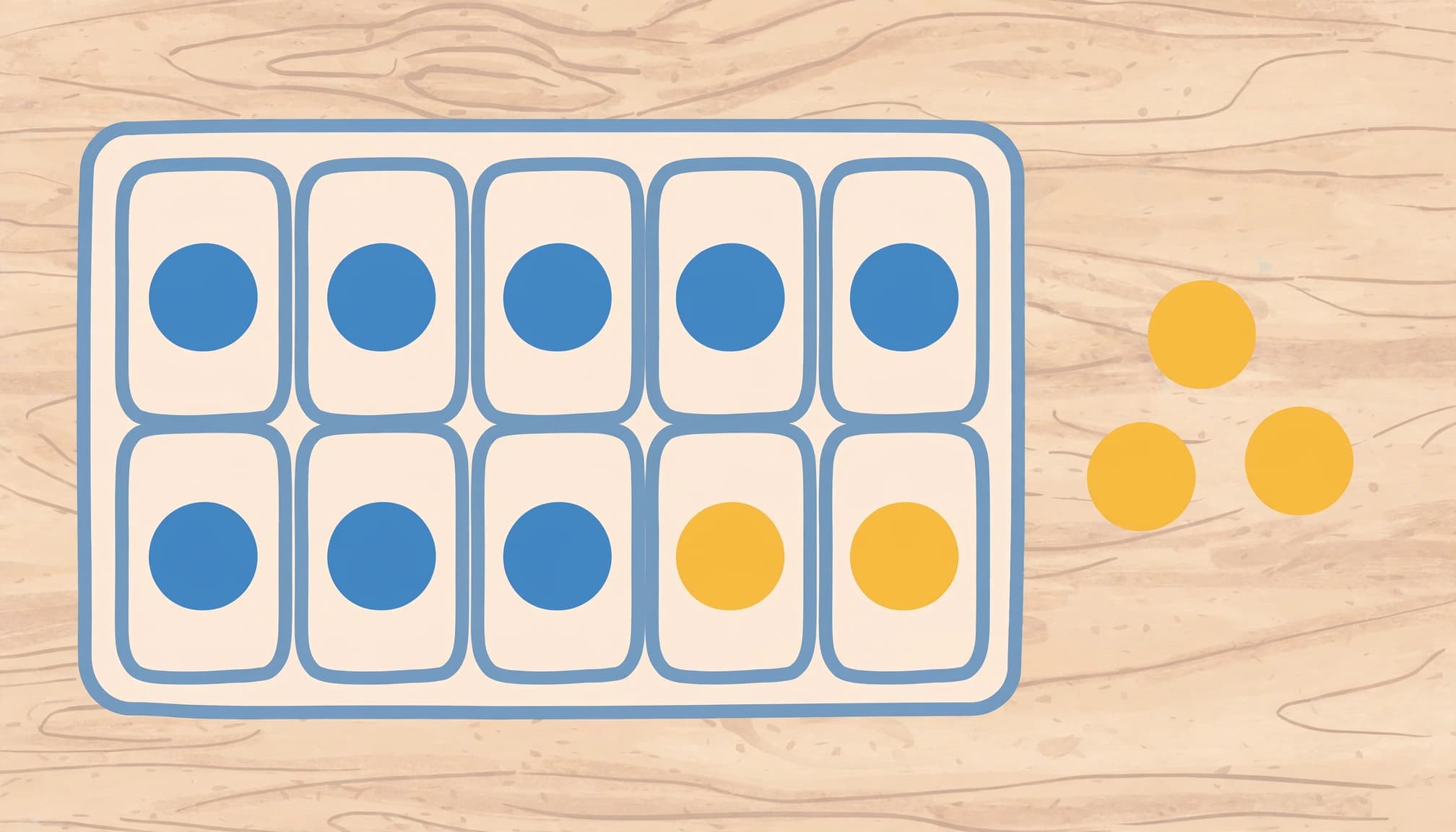
Use counters first. Fill eight spaces in a ten-frame, then bring over five counters. Move two into the empty spaces and leave three beside the frame.
Next, try 9 + 6. Split six into one and five, giving 10 + 5 = 15. For 7 + 5, split five into three and two, giving 10 + 2 = 12.
Watch for children who add extra counters without removing them from the second group. The total number of counters must stay unchanged. You’re rearranging the group, not inviting more counters to the party.
Use a Number Line for Visible Counting
A number line marked from 0 through 20 models addition facts within 20, as long as the sum is no greater than 20.
Use the number line for 13 + 3:
- Put a finger or marker on 13.
- Move forward three spaces, one hop at a time, landing on 14, 15, and 16.
- Read the landing number: 13 + 3 = 16.
Then compare 16 + 3 = 19 with 16 + 4 = 20. One extra hop increases the total by one.
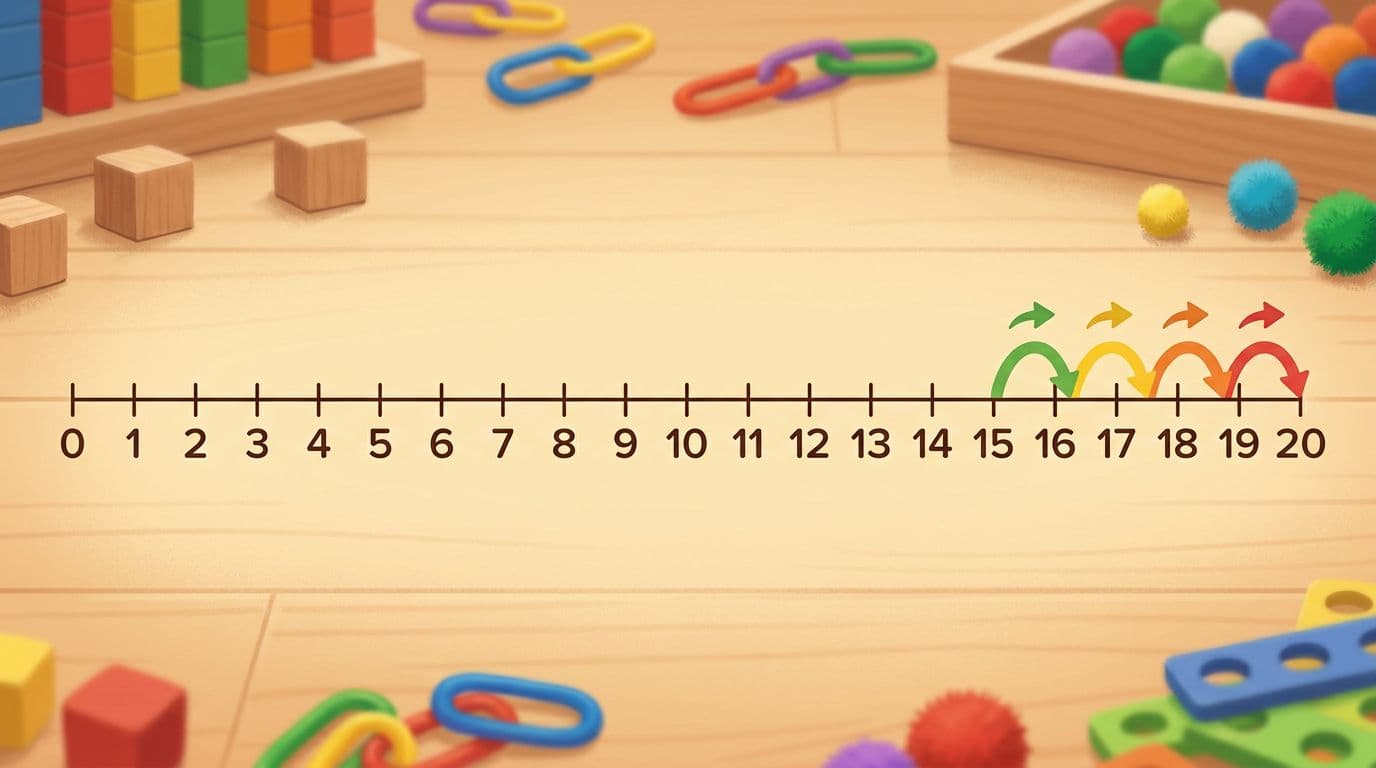
For larger numbers, a number line can be faster than drawing every circle or assembling snap cubes. Keep objects available if your child still needs to see the groups.
Count each hop, not the starting position. Starting at 16 and moving forward four spaces lands on 20, not 19.
Handle Missing Numbers and Connect Subtraction
Find the missing number, even when the answer comes first
For 7 + ___ = 13, start at seven on the number line. Count forward to thirteen. Six hops fill the gap, so the missing number is six.
Now try 18 = ___ + 7. Read it as “Eighteen is the same amount as something plus seven.” Use the number line to count from seven to eighteen and find eleven.
Explain that the equals sign means the same value on both sides. It doesn’t mean “the answer comes next.”
Finally, substitute the missing number: 18 = 11 + 7. Ask your child to explain the answers and check the completed equation.
Connect facts to subtraction and stories
The numbers 6, 7, and 13 belong to one fact family: 6 + 7 = 13, 7 + 6 = 13, 13 – 6 = 7, and 13 – 7 = 6. These facts show how addition and subtraction within 20 are related.
Use that connection to check addition. If 7 + 6 = 13, removing six should leave seven.
Word problems need separate practice because children must understand the situation before choosing an operation. Try this addition word problem: “There are seven pencils. Six more join them. How many pencils are there?” Model 7 + 6 = 13.
Then change the story for another word problem: “There are thirteen pencils. Six are put away.” Model 13 – 6 = 7. Have your child show what happens rather than hunt for clue words.
Printable Addition Practice With Answers
Print this free printable practice on sheets of paper, or copy the problems onto your own sheets. Work down each column, starting with easier facts before the missing number problems, and check answers as you go.
Worksheets often contain 24 or 30 questions and a challenge. Your child doesn’t need to finish every question in one sitting.
| Warm-up | Count on | Make 10 or use doubles | Missing numbers |
|---|---|---|---|
| 1. 3 + 2 = ___ | 7. 12 + 2 = ___ | 13. 8 + 5 = ___ | 19. 7 + ___ = 13 |
| 2. 4 + 4 = ___ | 8. 13 + 3 = ___ | 14. 9 + 4 = ___ | 20. ___ + 8 = 15 |
| 3. 6 + 3 = ___ | 9. 15 + 2 = ___ | 15. 7 + 6 = ___ | 21. 18 = ___ + 7 |
| 4. 7 + 3 = ___ | 10. 16 + 3 = ___ | 16. 6 + 7 = ___ | 22. 14 = 9 + ___ |
| 5. 9 + 1 = ___ | 11. 16 + 4 = ___ | 17. 8 + 8 = ___ | 23. 10 + ___ = 17 |
| 6. 10 + 0 = ___ | 12. 18 + 2 = ___ | 18. 9 + 9 = ___ | 24. 20 = ___ + 9 |
For a challenge, ask your child to explain problem 24 using addition and subtraction, then discuss their answers.
Answer key:
1-6: 5, 8, 9, 10, 10, 10.
7-12: 14, 16, 17, 19, 20, 20.
13-18: 13, 13, 13, 13, 16, 18.
19-24: 6, 7, 11, 5, 7, 11.
Use the answer key to check any answers your child wants to review. For more written practice, browse our free worksheets by grade and select Grade 1 practice that matches the skill you’re teaching.
Build a Short Routine and Check Understanding
Match the strategy to the difficulty
Spend about five to ten minutes on one method. Model a problem, solve one together, then let your child try independently. A short worksheet can provide a few extra problems to practice.
This routine builds the skills children need to add and subtract within 20.
Choose counting on for a small second addend. Use making 10 when eight or nine appears. Try near-doubles when the numbers differ by one.
Introduce these choices gradually. A whole strategy buffet can leave a first grader staring at the plate.
If answers are consistently one too small, check whether your child counts the starting number. If splitting numbers causes confusion, return to counters. More questions won’t repair an unclear model.
Try a three-question self-check
Ask your child to solve 14 + 3, 9 + 6, and 8 + 9, explaining one answer aloud.
The answers are 17, 15, and 17. Counting on suits the first problem. Making 10 suits the second, while a near-double suits the third.
Accept another accurate method your child can explain. Then ask them to check one answer with objects or subtraction. An online quiz can offer another check, but your child should still explain a method instead of relying on the score.
When an answer is incorrect, revisit the exact step that went wrong. Leave the stopwatch out of it; your child’s explanation tells you more.
Choose Practice Resources That Teach, Too
K5 Learning offers free printable addition sheets. Common Core Sheets word-problem worksheets provide practice with word problems and answer keys. iKnowIt offers online addition practice with immediate feedback. Math Salamanders also offers an online quiz with learning points for incorrect answers.
Choose an online quiz that explains an error and helps your child correct a method. Check answers on practice sheets and worksheets together.
For a homeschool curriculum or after-school review, pair a short teaching video with counters and a few written problems. Our Grade 1 curriculum organizes human-curated educational videos by subject and skill, so you can revisit a difficult topic without assigning an entire worksheet pack.
Frequently Asked Questions
What does addition within 20 mean?
It means adding two numbers when their total is no greater than 20. For example, 13 + 3 = 16 is addition within 20.
How can my child add numbers such as 8 + 5?
Make 10 by splitting five into two and three. Add two to eight to make 10, then add the remaining three to get 13.
How does a number line help with addition?
Start at the first number and move forward one space for each number being added. For 13 + 3, move three spaces from 13 and land on 16.
How long should an addition practice session last?
Spend about five to ten minutes on one method. Model a problem, solve one together, and then let your child try independently.
Make the Next Practice Session Count
Help your child choose one useful strategy, explain it, and check the answers. Clear reasoning gives addition and subtraction within 20 a solid foundation for later mental math.
Start with three problems today. If your child gets stuck, change the model before adding more questions.
For a guided next step, try our free curriculum for Grade 1. The free membership includes human-curated teaching videos and ads, but doesn’t include quizzes.