
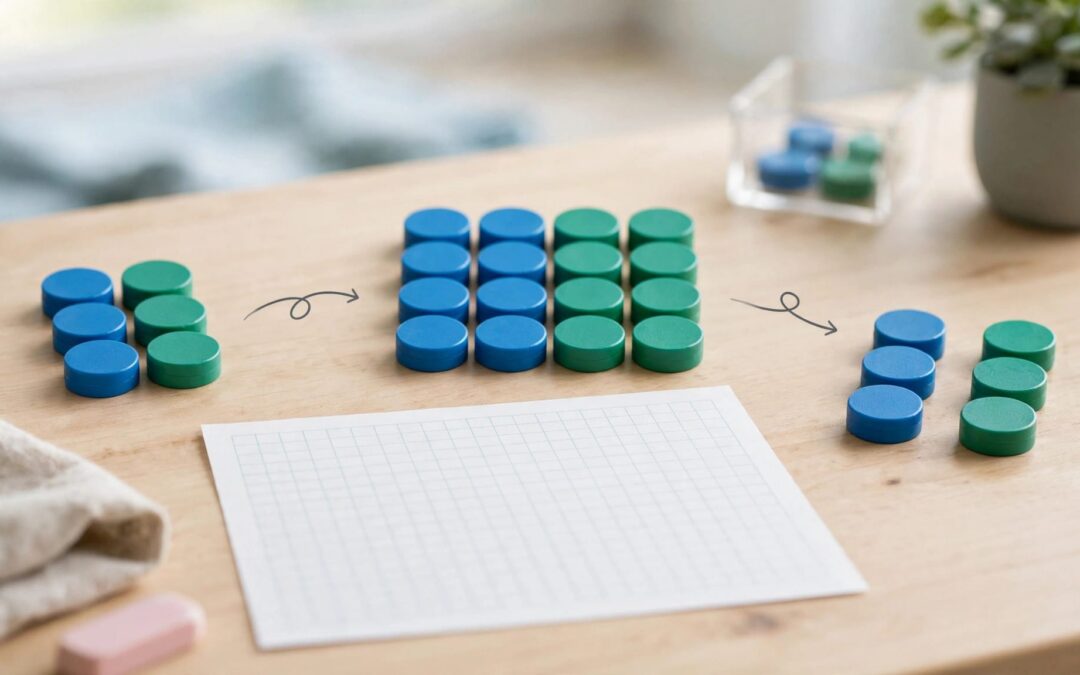
A ratio compares quantities through multiplication, such as two goats for every five sheep. To help your child, start with objects, label each quantity, and show how both numbers change by the same factor.
Tables and drawings make the relationship easier to follow than a memorized rule. Begin with what each number means, then move into simplifying, unit rates, and word problems.
What Do Ratios Compare?
A ratio compares two quantities. You can write “1 to 3” as 1:3 or in fraction notation as 1/3, provided the labels stay clear. Ratio and proportion are related concepts, but they aren’t interchangeable.
Why does the order matter?
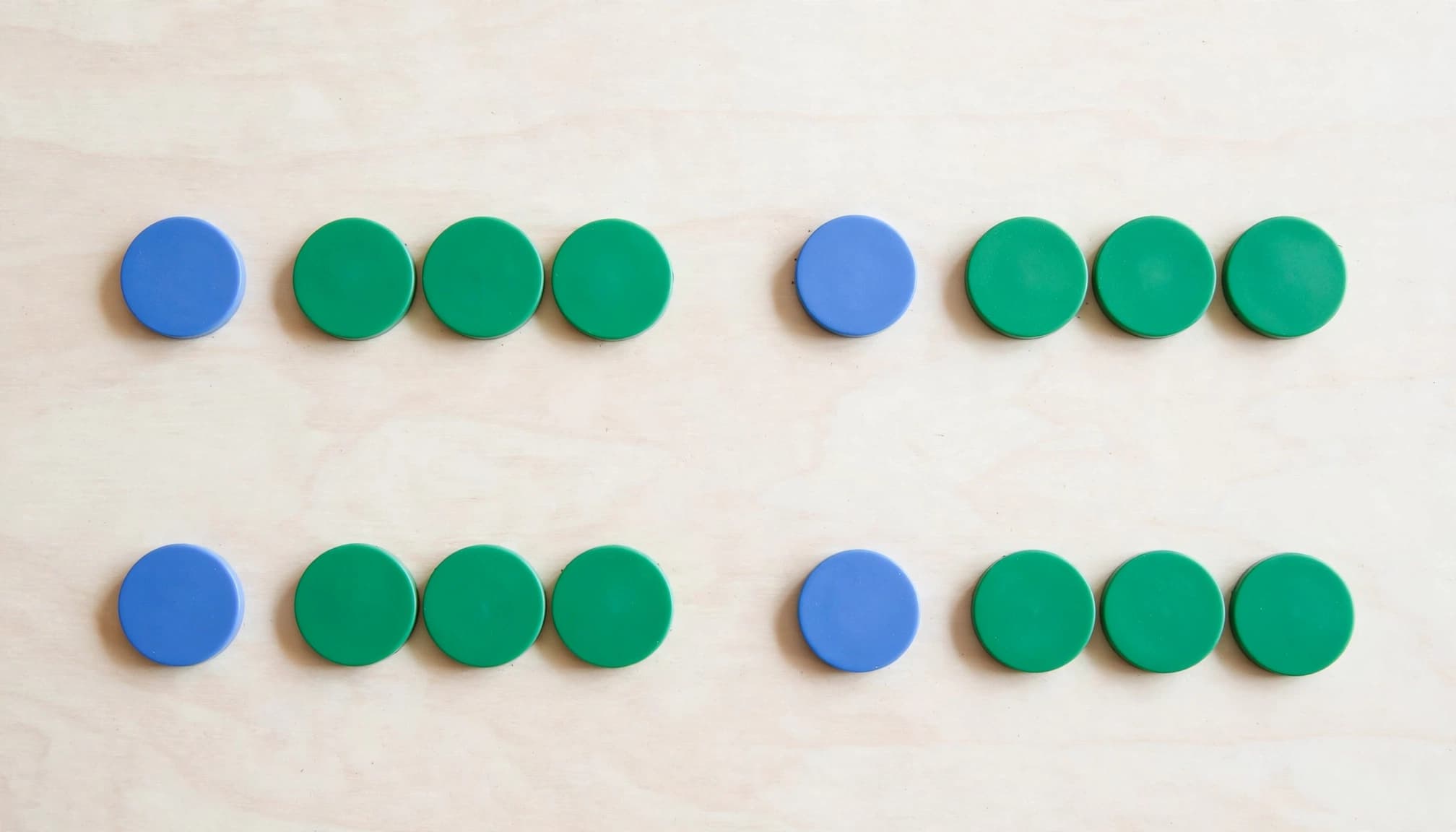
The first number belongs to the first quantity named. For blue to green dots, the ratio 1:3 means one blue dot for every three green dots.
Likewise, five delayed flights and 21 on-time flights give a delayed-to-on-time ratio of 5:21. Reversing the comparison gives 21:5, the on-time-to-delayed comparison.
Have your child write the quantity names above the numbers. Those little labels prevent surprisingly large mix-ups.
What’s the difference between part to part and part to whole?
With one blue dot and three green dots, blue to green is 1:3, a part to part comparison. Green to all four dots is 3:4, a part to whole comparison.
Similarly, five swimmers and three non-swimmers make eight students. Swimmers to non-swimmers is 5:3; swimmers to the whole group is 5:8. In fraction notation, the share who swim is 5/8, not 5/3.
For 53 grams of sugar in 100 grams of spread, sugar to total spread is 53:100, or 53/100.
How Do You Simplify a Ratio?
Simplifying ratios makes the quantities smaller while preserving their relationship. Divide every part by the same nonzero common factor. This scaling down keeps the ratio equivalent.
Whole-number examples
For the ratio 24 ducks:18 geese, the greatest common factor is six:
24:18 = 4:3, because 24 ÷ 6 = 4 and 18 ÷ 6 = 3.
Your child can also simplify in stages: divide by two to get 12:9, then by three to get 4:3.
Both methods are correct. Using the greatest common factor finishes in one step, but smaller common factors work too. Stopping at 12:9 leaves the ratio unfinished if the question requests simplest form.
Fraction examples
For 1 1/2:6, use fraction notation to see that the mixed number is 3/2. Then multiply both parts by two:
1 1/2:6 = 3:12
Then divide both parts by three:
3:12 = 1:4
Multiplying only the fractional part would change the relationship. Every part must receive the same operation.
If this step causes trouble, revisit equivalent fractions and fraction models before adding harder ratio questions. The shared idea is preserving a value or relationship while rewriting its numbers.
How Do Ratio Tables Show Equivalent Ratios?
Equivalent ratios describe the same relationship with different numbers. Multiply or divide every part by the same positive number.
For example, 4:5 becomes 8:10 when both parts double. The three-part ratio 3:5:2 becomes 30:50:20 when every part is multiplied by ten.
Ratio tables keep matching quantities together. For goats to sheep, use the ratio 2:5; each row shows a possible herd.
| Goats | Sheep | Scale factor from 2:5 |
|---|---|---|
| 2 | 5 | × 1 |
| 4 | 10 | × 2 |
| 6 | 15 | × 3 |
| 12 | 30 | × 6 |
These equivalent ratios keep the same relationship in every row. In these ratio tables, the multiplier shows how each row scales the original quantities.
With 12 goats, calculate 12 ÷ 2 = 6. Then multiply five sheep by six to get 30 sheep.
Scaling down from 12:30 means dividing both numbers by three to get 4:10.
Adding the same number to both parts usually changes the ratio. For example, 2:5 and 4:7 aren’t equivalent.
Ask your child to name the multiplier beside each row. That explanation reveals whether they’re scaling or simply guessing a pattern.
Which Visual Models Help Ratios Make Sense?
Counters, tape diagrams, and double number lines help your child see how quantities relate. Choose the model that tracks the information they need.
Tape diagrams show parts and totals
A tape diagram makes a ratio between parts and the total easier to see. For five swimmers to three non-swimmers, draw two bars using equal-sized boxes. Give swimmers five boxes and non-swimmers three.
Together, the bars contain eight boxes. This makes the swimmers’ share, 5/8, visible.
If the group has 24 students, each box represents 24 ÷ 8 = 3 students. Therefore, there are 15 swimmers and nine non-swimmers.
Keep every box the same size. Otherwise, the drawing starts arguing with the arithmetic.
Double number lines show matching amounts
Draw two parallel number lines for goats and sheep. Align 0, 2, 4, 6 goats with 0, 5, 10, 15 sheep.
Each aligned pair expresses the same ratio. Extending both lines reaches 12 goats and 30 sheep.
This ratio model helps children see that both quantities grow together. Unlike a table, it also shows equal intervals and makes positions between known pairs easier to discuss.
How Do You Find and Compare Unit Rates?
A rate compares two quantities with different units, such as dollars and bananas. A unit rate compares an amount with one unit, such as dollars per banana. This ratio gives the cost per banana, while equivalent ratios help compare prices in word problems.
For a unit price comparison, compare the rate for six bananas costing $3 with the rate for eight bananas costing $4.80.
Divide the amounts in each ratio by the number of bananas:
$3 ÷ 6 = $0.50, and 6 bananas ÷ 6 = 1 banana.
$4.80 ÷ 8 = $0.60, and 8 bananas ÷ 8 = 1 banana.
The first unit rate is 50 cents per banana, compared with 60 cents per banana for the second. Therefore, the first has the lower unit price.

The 6.RP.3.b unit-rate standard includes unit pricing and constant-speed problems.
Keep the units beside the calculation. Dividing bananas by dollars gives bananas per dollar, which answers a different question.
How Should Your Child Solve and Check Ratio Problems?
Before calculating, have your child use word problems to identify what’s known and unknown, then name four things:
- State the ratio and what each number counts.
- Write the quantities in the requested order.
- Identify the total, if given or needed.
- Name the missing quantity and choose a table, model, or unit rate.
Check each answer against the original relationship rather than guessing.
For the goat problem, scaling down 12:30 by six gives 2:5. The original numbers are six times 2 and 5, and the final answer has more sheep than goats. Six is the greatest common factor of 12 and 30.
For the swimmer problem, 15 + 9 = 24, and 15:9 simplifies to 5:3. These checks confirm both the total and the ratio.
Match measurement units before comparing. For 32 minutes to three hours, convert three hours to 180 minutes. Then 32:180 = 8:45. Writing 32:3 would compare mismatched units.
Try These Ratio Questions With Answers
Cover the answers while your child works through these five ratio problems. Ask for labels and one explanation, rather than a page of unexplained numbers.
- A group has two blue counters and six green counters. Write blue to green and green to all counters.
- Write the ratio of 24 ducks to 18 geese in simplest form.
- Complete the equivalent ratios: 4:5 = 20:___.
- Goats to sheep is 2:5. How many sheep match 12 goats?
- Six bananas cost $3. What is the cost per banana?
Answer key
1. Blue to green is 2:6 = 1:3. Green to all is 6:8 = 3:4.
2. Divide both numbers by their greatest common factor, six: 4:3.
3. Since 4 × 5 = 20, calculate 5 × 5 = 25.
4. Multiply both parts by six: 30 sheep.
5. The unit rate is $3 ÷ 6: $0.50 per banana.
What to do after checking
Have your child draw question one or explain question four aloud. If the explanation doesn’t match the answer, return to counters or a table before increasing the difficulty.
For additional word problems and practice, our free worksheets by grade include printable resources for Grades 1 through 8.
How Can Parents Organize Ratio Practice?
For homeschool or after-school review, practice ratio and proportion. Model one problem, solve one together, then give your child a similar question independently.
Our human-curated educational videos are organized by grade and topic, so you can pair an explanation with hands-on practice. Pause before an answer appears and ask your child to predict the next step.
The Common Core Math standards for grade 6 ratios identify the main skills:
6.RP.A.1 covers ratio concepts and language. 6.RP.A.2 covers finding a unit rate. 6.RP.A.3 covers solving problems with tools such as tables, tape diagrams, and double number lines. 6.RP.A.3b focuses on unit-pricing problems. A rate compares quantities measured in different units.
If calculations interrupt every step, review multiplication, division, fractions, or decimals separately. Our Grade 5 review for Grade 6 identifies useful foundations without restarting an entire year.
More Grade 6 Ratios FAQ
How can I explain a ratio simply?
Use the phrase “for every” to describe a ratio. Place one blue counter beside three green counters and say, “For every one blue, there are three green.”
Next, build another identical group. Your child can see that 1:3 and 2:6 describe the same relationship, even though the collection grew.
What are some fun math games?
Play ratio-builder with two colors of blocks. One person names a pair, such as 2:3; the other builds an equivalent collection and explains the multiplier.
For practice with ratio problems, write equivalent pairs on cards and match them into families. Include a near miss, such as 4:7 beside 2:5, so your child must explain why it doesn’t belong.
Key Takeaways for Your Next Ratio Lesson
Start with meaning before calculation. Label each quantity, preserve its order, and change every part by the same factor.
Use a table or drawing until your child can explain why an answer fits. Then try our worksheet resources for a short, focused practice session that shows which skill needs attention next.