
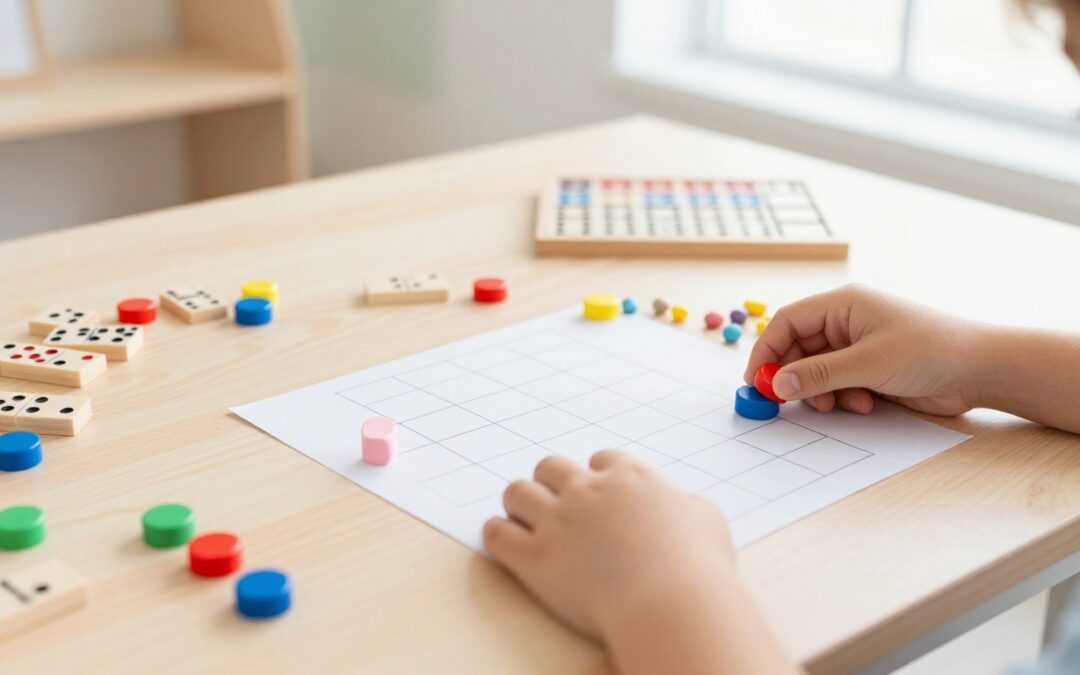
When a child freezes at “6 + 3,” more flashcards rarely fix the problem. In first grade math, they need to see how six and three combine into nine, connecting addition and subtraction.
Grade 1 number bonds make that relationship visible and strengthen everyday math practice. With small objects, simple drawings, and short practice sessions, children can build understanding without turning math time into a tiny courtroom drama.
Start with real objects, move to pictures, and only then ask for equations. That order gives children something solid to hold onto.
Key Takeaways
- Number bonds show a part-part-whole relationship: two parts combine to make one whole. For example, 4 and 5 are parts of 9.
- The same number bonds support two addition facts and two subtraction facts, showing the part-part-whole relationship: 4 + 5 = 9, 5 + 4 = 9, 9 – 4 = 5, and 9 – 5 = 4.
- Children who need extra help should begin with numbers within 5 or 10 before working within 20.
- Counters, ten-frames, dominoes, and quick sketches make abstract equations easier to understand.
- Worksheets work best after a child has built and discussed number bonds with objects.
- Progress is more than speed. Watch for a child who can explain where each number belongs.
What Grade 1 Number Bonds Show
A number bond is a visual part part whole model. It shows one whole number split into two smaller parts. It may use circles, a bar model, or groups of objects. The format matters less than the relationship.
For example, place 7 buttons on the table. Move 2 to one side and 5 to the other. Number bonds help children see that 2 and 5 make 7. Rearrange the buttons, and the total still stays 7. Numbers are stubborn that way, in a good sense.
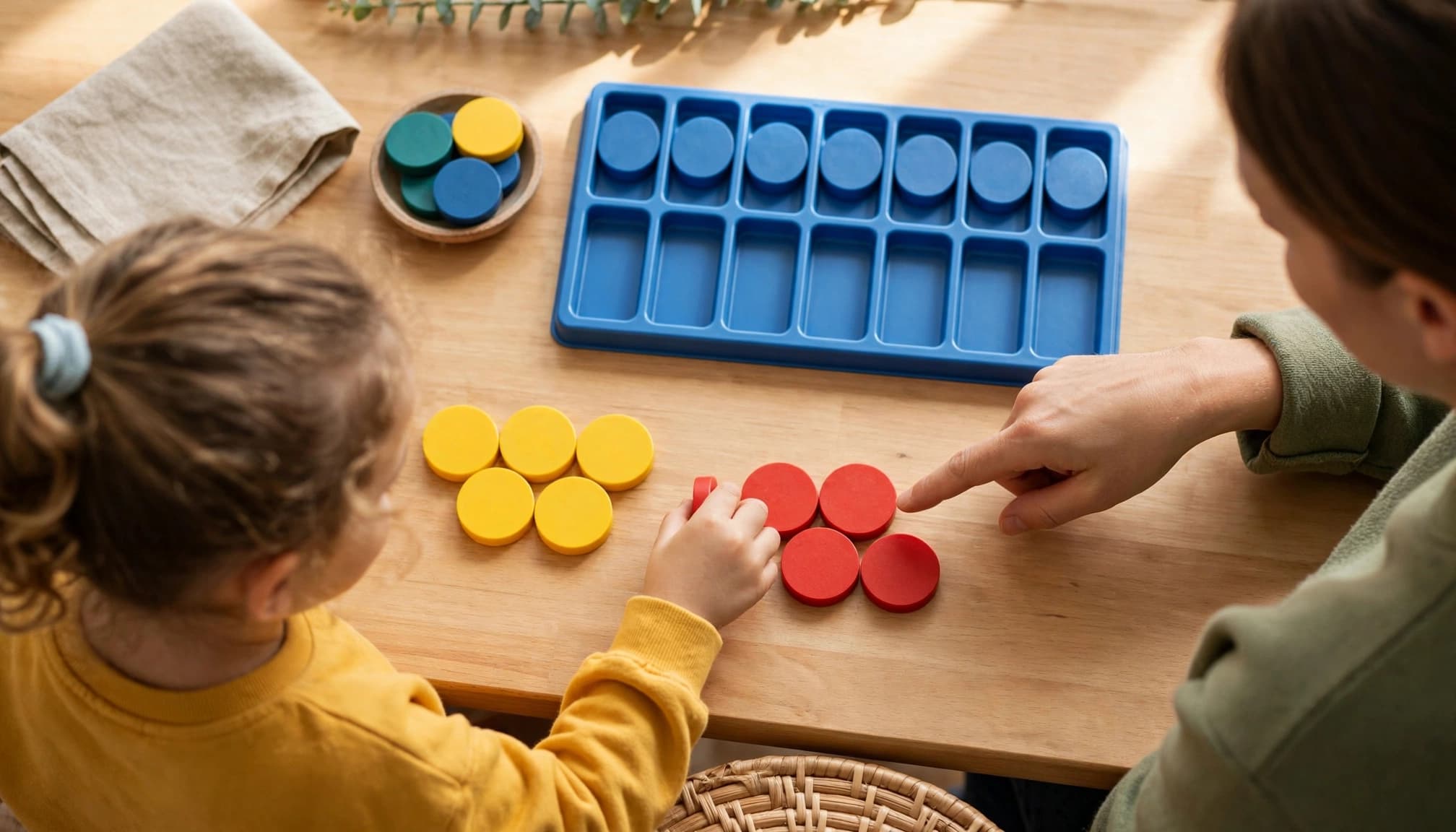
Parts can move, but the whole stays put
The part part whole model shows a part part whole relationship. Say the language out loud as your child works: “Seven is the whole. Two is one part. Five is the other part.”
Then change the split. Show 3 and 4, then 1 and 6. Number bonds let children practice decomposing numbers in several ways. This builds number sense instead of memorizing one isolated fact.
Children use composing and decomposing to break a whole apart and put it back together. This representation is especially useful in first grade math.
Addition and subtraction share the same picture
A child may treat addition and subtraction as unrelated beasts. Number bonds show how addition and subtraction connect.
If 3 and 6 make 9, addition combines the parts: 3 + 6 = 9. Subtraction starts with the whole and finds a missing part: 9 – 3 = 6. The number bond is the representation, while the equations show related facts.
This also prepares children for missing addends such as 4 + ___ = 10. Instead of guessing, they can ask, “What part is missing from 10?”
A Gentle Teaching Sequence for Extra Help
Keep early practice short, about 10 minutes at a time. Stop while your child still feels successful. A cheerful finish beats pushing through one more page when their brain has already hung up its tiny “closed” sign.
Build each number bond before drawing it
Begin with five counters, coins, dry beans, toy cars, or socks from the laundry basket. Any of these can become useful math manipulatives.
Ask your child to split the group into two parts. For 5, they might make 1 and 4. Have them touch each group as they say the numbers, then count all five again. This is a simple part part whole model, with two parts joining to make one whole.
Avoid correcting every unusual split. If a child makes 0 and 5, celebrate it. Zero is a real part, even if it looks like it skipped the party.
This hands-on, interactive math lets your child move objects and explain each split. Splitting 5 is an early way to practice composing and decomposing. After your child can build and explain the bond, connect it to first grade math with a small written activity. Start math practice with one or two equations, and use math worksheets only when the model feels familiar.
Short math centers can reuse the same counters, while simple task cards can offer quick prompts. Neither needs to become a required new set of materials.
Use ten frames to reveal number patterns
A rectangle with two rows of five spaces helps children organize quantities. Children place counters in the spaces from left to right, so they can see groups without recounting every object.
Show 8 as a full row of five and three more. Ask, “How many more spaces would fill the frame?” The answer, 2, connects 8 to 10.
Move from number bonds within 5 to number bonds within 10. After those feel secure, introduce teen numbers with a ten-frame and extra counters. For 13, show one full ten-frame and 3 ones, then split the 3 in different ways to show related number bonds. This gives children practice decomposing numbers while noticing how the parts can change.
A child who counts every counter is still learning. The goal is to help them notice groups, not rush them past the counting stage.
That growing number sense matters more than counting quickly. Give children time to recognize groups, explain their thinking, and gradually record what they built.
Hands-On Number Bond Games That Don’t Feel Like Homework
These games make number bonds feel practical and playful. Children get the most from interactive math when they do the moving, sorting, and explaining. Set these activities up as short rotations in math centers, with a few household supplies and a willingness to let a domino become serious educational equipment.
Play Shake and Spill
Shake and Spill turns math facts into a hands-on check of number sense. Put 10 two-color counters in a cup. The two colors show the parts, and the total shows the whole in a part part whole model.
Shake the cup, spill the counters onto a tray, and sort them by color. If 7 land red and 3 land yellow, your child records the bond for 10.
Repeat several times, but don’t require math worksheets after every spill. Ask your child to explain the two parts and whole before recording anything. Then switch roles so they can check your answer. Occasionally make a deliberate mistake, and ask them to explain what is wrong.
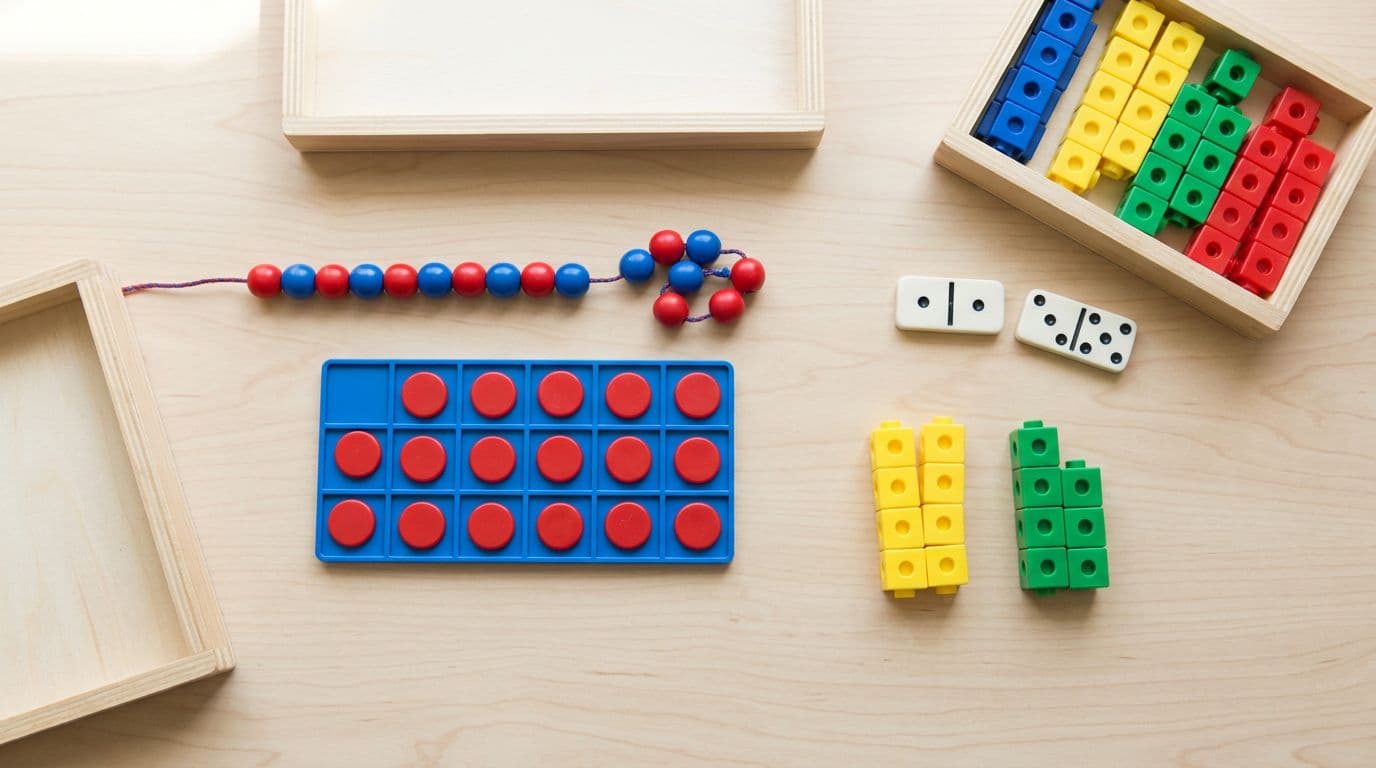
Dominoes also make quick number bonds. Cover one side of a domino with a finger and ask your child to identify the hidden part. Linking cubes work nicely because children can snap the two parts together, then pull them apart for subtraction.
Try a missing-part hunt
This missing-part hunt strengthens number bonds through building and reasoning. Write a whole number from 5 to 10 on a small task card. Build one part with cubes, then ask your child to build the missing part. For a whole of 8 with 3 cubes showing, they need 5 more.
A family can play these math games while waiting for dinner, riding in the car, or sorting snacks. These math activities work best when the numbers stay small enough for a child practicing first grade math to have a fair shot.
Use Worksheets and Digital Practice at the Right Time
Printable pages can show whether a child can transfer a hands-on idea to paper. However, a worksheet shouldn’t be the first teacher in the room. A page should assess number sense and understood number bonds, not replace handling counters.
Choose free printable first grade math worksheets with clear pictures, space to draw, and only a few problems per skill. Good grade 1 worksheets ask children to show number bonds as a part part whole model, fill a missing part, or draw their own split.
Use one problem as a conversation starter. If the page shows 9 with parts 4 and blank, ask your child to build 9 cubes, separate 4, and count what remains. Then have them record the related addition and subtraction equations. The written answer comes last.
Digital practice can add useful repetition with number bonds, especially after a child understands the model. 2cool4school offers curriculum-organized Grade 1 learning with human-curated teaching videos and practice. For interactive math, pause a teaching video before the answer appears, build the bond with objects, and let your child explain it. This keeps digital math practice connected to modeling. Its free curriculum includes ads and no quizzes; premium provides ad-free access, quizzes, progress tracking, and parent email notifications. A short quiz can check recall, but it shouldn’t replace the hands-on step.
For home learning across subjects, free Common Core math worksheets for Grade 1 can help you match practice to the skill your child is working on. Rotate short math worksheets, task cards, and manipulatives through math centers to keep practice focused.
Adjust Number Bond Practice to Your Child
Extra help should feel smaller and clearer, not heavier. If a child is stuck with number bonds to 10, more practice to 20 won’t arrive wearing a cape and save the day.
Make the number range manageable
Start with number bonds totaling 3, 4, or 5. Use counters in two different colors so each part stays easy to spot. This supports decomposing numbers and builds number sense before the work gets harder.
Some children need to say each action aloud: “I have six. I moved two. Four are left.” Others need to draw circles or use fingers. Let them use the representation that helps them think.
Watch for signs that the model isn’t clear. A child might confuse a part with the whole, reject zero as a valid part, or count every object without seeing the groups. Ask the child to build, draw, write, and explain several combinations. Move from totals within 5 to totals within 10 only when they need minimal prompting.
If you’re putting together a homeschool curriculum, free homeschool worksheets for Grade 1 can add short math practice without requiring a giant stack of pages. 2cool4school’s free math curriculum organizes Grade 1 learning by subject and skill. Premium access includes human-curated videos, quizzes, progress tracking, and parent email notifications.
Short interactive math activities can also help children stay engaged. Vary the format with task cards, counters, or quick oral questions, but don’t turn practice into a speed test.
Extend children who are ready
When number bonds within 10 feel familiar, introduce related fact families. A child who knows 2, 8, and 10 can write four equations using those numbers. This connects addition and subtraction and provides a useful check for understanding.
Then offer missing-addend equations:
- 7 + ___ = 10
- ___ + 4 = 9
- 12 – ___ = 10
For numbers above 10, show a full ten-frame first. A child may see 14 as 10 and 4, then split the 4 into 1 and 3. This is another way of decomposing numbers, keeping teen numbers connected to place value rather than turning them into mysterious two-digit furniture.
Introduce mental math later, after the child can build, draw, write, and explain the bond. If a child starts copying a procedure, return to the concrete model and ask, “How do you know?” Four correct answers aren’t enough if the explanation still needs constant prompting.
How Number Bonds Fit Grade 1 Math Standards
Number bonds are a representation within Grade 1 Operations and Algebraic Thinking, not a separate standard in the math curriculum or a topic for Science, Social Studies, or Health.
The Grade 1 Common Core mathematics standards include understanding relationships between addition and subtraction, solving problems within 20, and building number sense through fluency within 10. These common core standards apply specifically to Grade 1 math.
That distinction matters. Children need fact fluency within 10, while Grade 1 also includes solving addition and subtraction situations within 20. Number bonds connect this early number sense to practical problem solving.
The official Common Core mathematics standards emphasize composing and decomposing numbers. In plain parent language, children learn that a number can be broken apart and put back together in more than one way. This part part whole model supports decomposing numbers and understanding how parts make a whole.
A child is ready for less support when they can use number bonds to build a part part whole model, draw it, write an equation, and explain a missing part without counting every item from the beginning. These problem solving skills help connect equations to word problems.
Frequently Asked Questions
Are number bonds the same as fact families?
They overlap, but they are not identical. A number bond shows the part part whole relationship, such as 3, 5, and 8. A fact family uses those numbers to create related addition and subtraction equations.
Start with the picture. Then write the equations once your child understands each number’s role. If your child repeatedly reverses the whole and a part, return to counters or drawings.
Should my child memorize number bonds?
Children don’t need to memorize number bonds immediately. Understanding builds number sense, while fact fluency develops through meaningful practice.
Ask your child to show 6 as 1 and 5, then 2 and 4. Try equations with missing addends, such as 4 + ___ = 10. For a struggling child, short task cards can offer low-pressure practice. Increase the difficulty only after your child can explain several bonds without recounting every object.
Can number bonds help with word problems?
Yes. Read a simple problem, identify the whole and the known part, then use interactive math to build or draw the situation. This supports problem solving skills and makes the relationships easier to see.
For “There are 9 birds. Four fly away,” 9 is the whole and 4 is one part. Decomposing numbers helps your child find how many birds remain. Once the relationships are secure, mental math may develop naturally.
Build Confidence One Bond at a Time
Grade 1 number bonds give children a practical way to see how numbers fit together. Begin with objects, drawings, ten-frames, or a short task-card prompt, then move to equations.
A few calm minutes of meaningful math practice can beat a long session of guessed answers. Let your child explain the relationship within the number bonds, rather than chase speed.