
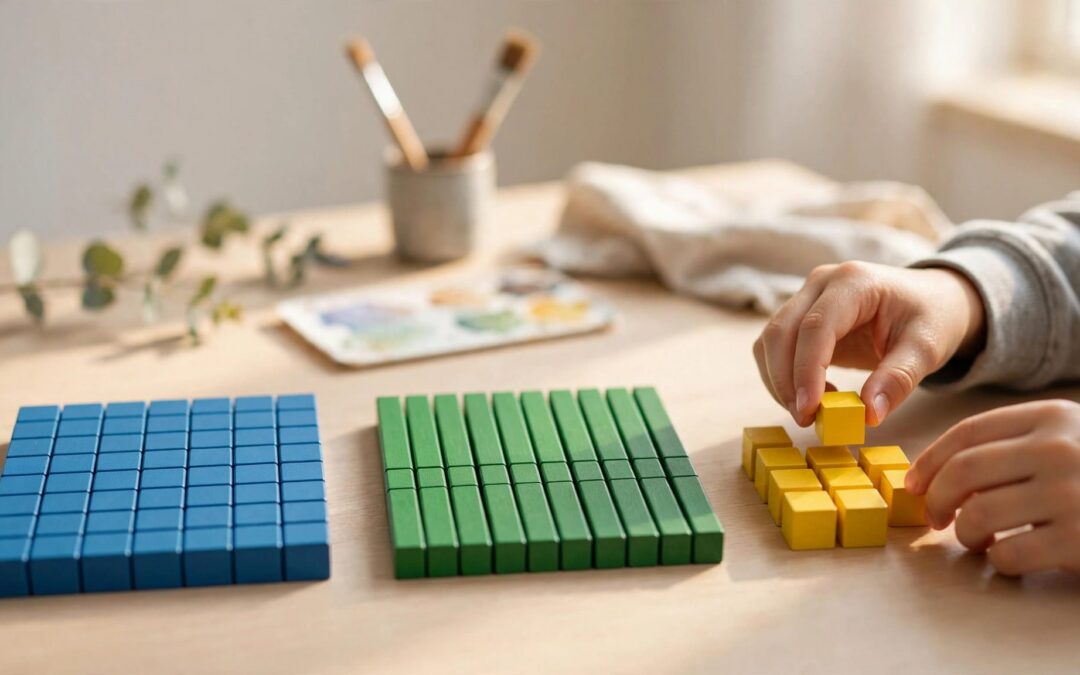
A child can read 407 aloud and still insist that the zero means “nothing is there.” That’s where grade 2 place value gets interesting: your child needs to see what each digit is worth, not just name the number.
You don’t need a box of special supplies to teach it. Bundles, drawings, and a few well-chosen questions can turn three-digit numbers into something your child can build and explain. Start with what the digits mean.
What grade 2 place value asks children to understand
Second graders explore the hundreds, tens, and ones places. The central idea is that a digit’s value depends on its position. In 333, the three digits mean 300, 30, and 3.
Ten of one unit make the next unit
Ten ones can be grouped as one ten. Ten tens can be grouped as one hundred. Children should be able to make that trade in either direction, because it explains why our number system works.
For example, 14 tens are 140. Your child can trade 10 of those tens for 1 hundred, leaving 1 hundred and 4 tens. The amount hasn’t changed; its grouping has.
What the standards say
The Common Core grade 2 base-ten standards set grade 2 Math expectations and describe place value standards used in practical math lessons. These Common Core standards include reading and writing a three-digit number in standard, word, and expanded form, comparing numbers, and using place value in addition and subtraction. Children also count within 1,000, including skip counting, though your child’s school may teach these skills in a different order.
At home, look for understanding of the value of numbers rather than a speedy recital. If your child says 482 is “four hundreds, eight tens, two ones” and can show those groups, the digits have meaning.
Build hundreds, tens, and ones before writing them
A written number is compact. That’s handy for adults, but it hides the groups a learner is trying to understand. Give your child something to move first.

Make a place value chart at home
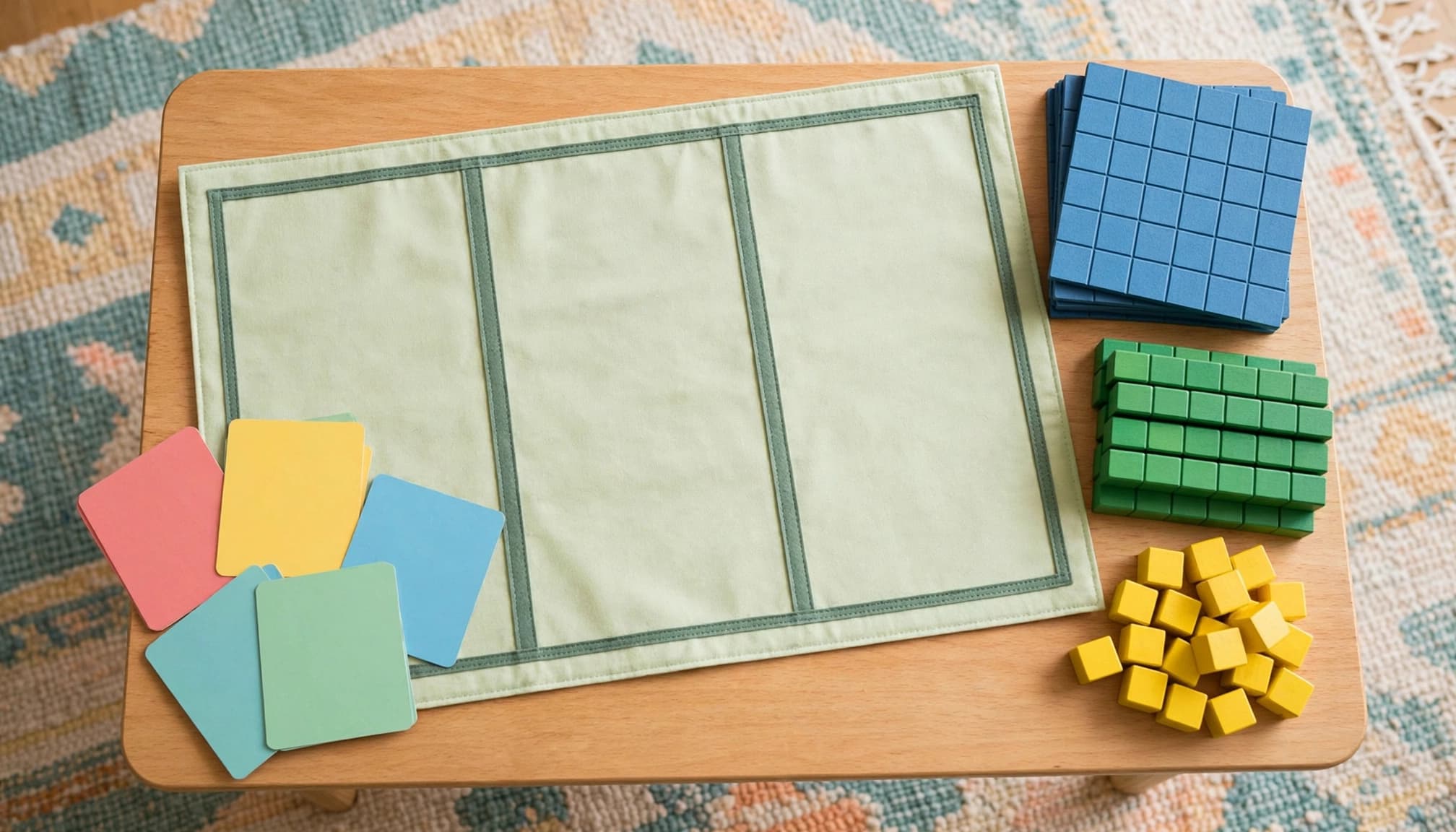
Draw three large columns on paper and label them Hundreds, Tens, and Ones. On the place value chart, put 2 bundles of 100, 4 bundles of 10, and 6 loose items. Ask your child to say and write the number: 246.
Base ten blocks make the sizes easy to see: a small cube is one, a rod is ten, and a flat is one hundred. Familiar household items can model the same groups. Use craft sticks for ones and rubber-banded bundles for tens. For hundreds, draw a square made of ten rows of ten or use a picture of a hundred-flat. Don’t spend the afternoon counting out 246 dry beans unless your afternoon has gone strangely quiet.
Let your child explain the model
Point to the 4 in 246. Ask, “Does it mean 4 or 40? Show me.” Then move the digit 4 to the hundreds column and ask what changed.
Build, draw, write, and explain the same number together as guided practice. These hands-on activities involve different tasks, so give your child time to notice the groups before recording an answer. Once they’ve built 246, ask them to write 200 + 40 + 6 in expanded form. They can also check the four tens by skip counting: 10, 20, 30, 40. A child who can copy 246 may still need help connecting the 4 to four tens.
Play place value games with paper and household supplies
A game works best when your child makes a decision and explains it. These hands-on activities need only homemade cards, counters, and your place value chart, making them easy to use for math practice.
Build the biggest number
Write the digits 0 through 9 on small cards. Draw three cards, then place them in the hundreds, tens, and ones columns to make the greatest possible three-digit number. If you draw 3, 7, and 1, your child should make 731.
Next, make the smallest possible three-digit number with the same cards: 137. Ask why 0 can’t go first when making a three-digit number. If your child draws 0, 5, and 8, the smallest choice is 508, not 058. Build each answer with blocks or quick sketches before comparing them.
Use comparing numbers to ask which is greater than the other and which is less than 731. A sorting activity can also help: group number cards by their hundreds, tens, or ones digit, then explain each choice.
For a scoot activity, place number cards around the room. Your child moves between them, chooses a number, and explains its value.
A correct answer matters less than the reason: “731 is larger because it has seven hundreds, and 137 has one.”
Run a ten-for-one trading shop
Give your child loose counters and paper cups labeled tens and hundreds. When they collect 10 loose counters, trade them for a bundle of ten sticks. After collecting 10 tens, trade those for a hundred drawing or flat. Use skip counting by tens to track the bundles.
Take turns being the shopkeeper. Start with guided practice by modeling one trade, then let your child take over. Occasionally offer a bad trade, such as one ten for eight ones, and let your child catch it. Working backward is useful too: break one ten into 10 ones, then check that the total stays the same.
Connect models to standard, expanded, and word form
Once your child can build a number, show how people record it. Use the same number each time so the notation changes without changing the amount.
| Form | Example for 406 | What your child can point to |
|---|---|---|
| Standard form | 406 | The digits in hundreds, tens, and ones places |
| Expanded form | 400 + 6 | Four hundreds and six ones |
| Word form | Four hundred six | The number said aloud and written in words |
| Picture model | 4 hundreds, 0 tens, 6 ones | The groups shown with blocks or drawings |
The zero in 406 holds the tens place. Expanded form can also show the empty place as 400 + 0 + 6 when you’re teaching what each digit contributes.
Move between standard form, expanded form, and word form in both directions. Give your child “300 + 20 + 5” and ask for 325, then ask them to draw it. Later, show a block model and let them produce all three written forms. For comparing numbers, show two models and ask which amount is larger and how they know. If the writing gets in the way, let them explain the groups aloud first.
Help your child make sense of zeros
Zeros cause some of the most revealing place value mix-ups. They’re worth practicing with blocks and charts, not merely correcting on paper.
Keep the empty place visible
In 706, there are 7 hundreds, 0 tens, and 6 ones. The California Department of Education’s three-digit example uses that same number to show what each position means.
Build 706 on a place value chart, leaving the tens column empty, then build 76 beneath it. 706 is greater than 76 because its 7 represents 700, while the 7 in 76 represents 70. Ask your child to point to the missing tens rather than saying the zero “does nothing.”
Compare zeros in different positions
Put 460 and 406 side by side. Both have a 4 and a 6, yet 460 has 6 tens while 406 has 6 ones. Use base ten blocks to show the groups and make the difference visible.
If your child writes 56 for 506, return to the chart. Place five hundred-flats and six ones, then leave the tens column empty. Ask, “Where does the 6 belong?” The empty column still needs its zero when the number is written.
For a child who needs an earlier bridge, revisit teen numbers with one group of ten and loose ones. That familiar idea from a grade 1 curriculum can be a more helpful bridge than moving straight to three-digit numbers.
Show why place value matters for adding and subtracting
Grouping isn’t a stand-alone trick. It helps children understand addition and subtraction across a ten or hundred, skills that build through Grade 2 math lessons.
For 248 + 35, build 2 hundreds, 4 tens, and 8 ones. Add 3 tens and 5 ones. Your child now has 13 ones. Trade 10 ones for 1 ten, then count 2 hundreds, 8 tens, and 3 ones: 283.
For 302 – 18, the ones column doesn’t contain enough to take away 8 ones. Exchange 1 hundred for 10 tens. Then exchange 1 ten for 10 ones. Now the model shows 2 hundreds, 9 tens, and 12 ones. Remove 1 ten and 8 ones to get 284.
These exchanges make regrouping clearer than “borrow a one” does. Seeing regrouping in a model helps the written method make sense. The Washington grade 2 math standards connect place value standards with addition and subtraction. Keep base ten blocks or sketches available as your child learns the written method.
Try a short home lesson, then check what stuck
A short math practice session is easier to repeat than a marathon worksheet. Keep home math lessons focused on one skill, such as identifying tens in a three-digit number, and choose numbers your child can handle.
Start together, then hand over the chart
Begin with a low-prep, hands-on activity: build one number on a place value chart while describing each group. Next, build a second number together for guided practice. Finally, let your child build and record one independently for independent practice. This moves from demonstration to practice without turning you into a one-person lecture hall.
During the activity, ask, “How many tens are here?” and “What would happen if we traded ten ones?” Listen to the explanation. A child who counts every single piece may need more time seeing bundles as units.
Use a quick check
Keep exit tickets brief with one prompt: “Draw 305, write it in expanded form, and tell me why the zero is there.” The answer gives you a better next step than a page of nearly identical sums.
If your child gets stuck, rebuild 305 together next time. If they explain it comfortably, try skip counting by tens as a second check, or give them a comparison or trading problem. A worksheet is useful once the model makes sense; it shouldn’t have to do all the teaching.
Add video lessons and printable practice thoughtfully
If you’d like a visual explanation before pulling out the counters, use 2cool4school’s human-curated videos as an interactive math lesson. Pause after an example and ask your child to build the number on their own chart.
For a broader look, browse 2cool4school’s free Grade 2 curriculum for more math lessons. It aligns with common core standards in Math and English Language Arts. A homeschool curriculum can give the week structure, but the kitchen-table model still earns its place. Use a few free worksheets for guided practice and extra math practice after your child has handled the groups, not as the first introduction to a new idea.
Key takeaways for parents
- Have your child build and explain a number before asking for standard or expanded form.
- Practice trading 10 ones for a ten and 10 tens for a hundred. The value must stay the same.
- Treat zero as an empty place that still needs to be shown in the written number.
- When an answer is wrong, return to the model and ask what each digit represents.
Common questions about second-grade place value
Should my child know numbers to 1,000?
Under the Common Core grade 2 standards, children work with numbers within 1,000. Start smaller if hundreds are new. A child who understands 146 has a better starting point for 746 than one who has only memorized how to say it.
What if my child understands blocks but struggles with written numbers?
Keep the chart beside the blocks. Have your child place each group in a column, say its value, and write one digit beneath it. Gradually replace the blocks with drawings, then try the written number alone. There’s no prize for hiding the blocks early.
Conclusion
The next time your child calls the zero in 407 “nothing,” give them a chart and ask them to build the number. That empty tens column has a job to do.
Start with groups your child can move, then connect them to drawings and digits. The explanation comes first; the written answer follows.