
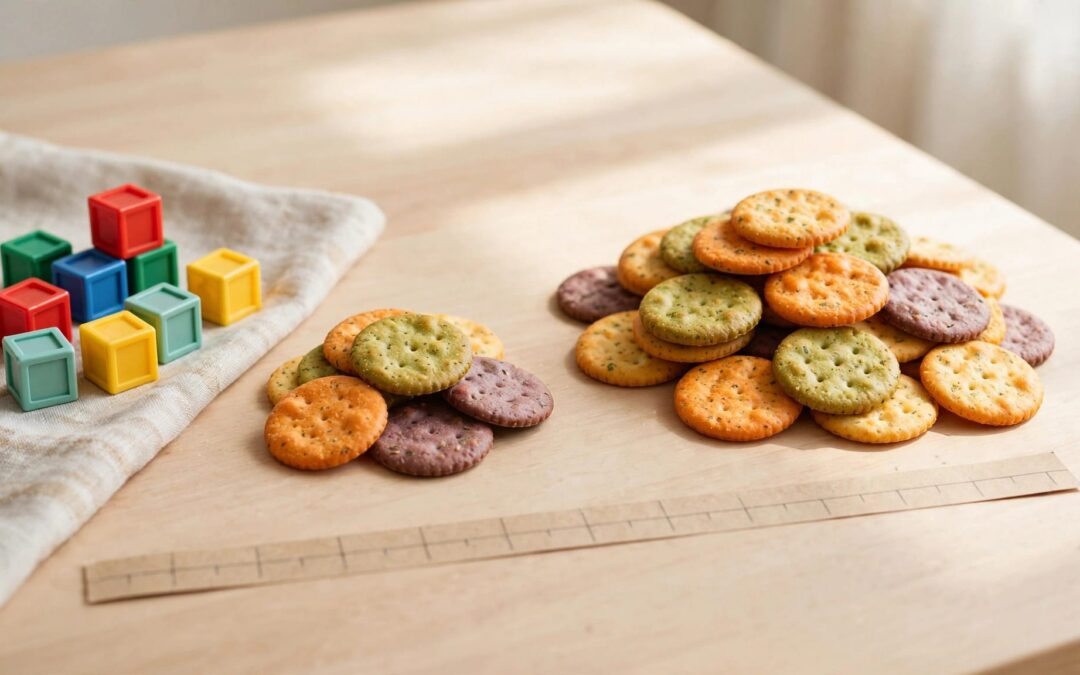
Two piles of crackers can teach more about comparing numbers than a page of symbols. Concrete activities let your child see the difference before asking them to write it.
If your child is in first grade and mixes up greater than and less than, put the pencil down for a moment. A few objects, a number line, and short conversations about quantities can build number sense and make comparisons easier to understand. Start with what your child can move and count.
How grade 1 comparing numbers skills grow
In first grade, children learn to compare quantities and explain which is more, less, or the same. They also compare 2-digit numbers by looking at tens and ones, using place value. The Grade 1 Common Core math standards call for children to record comparisons with >, <, and =, called comparison symbols.
That written answer comes at the end of a useful chain: build the numbers, notice the difference, explain it, then write it. This sequence builds math skills and conceptual understanding. A child who says “31 is bigger because it has more tens than 28” has a reason to trust. A child who points a symbol the right way by luck needs another turn with the objects.
You don’t need to cover every step in one sitting. Keep the numbers small until your child can explain what they’re seeing without constant hints.
Start with objects before comparing digits
Make two groups your child can match
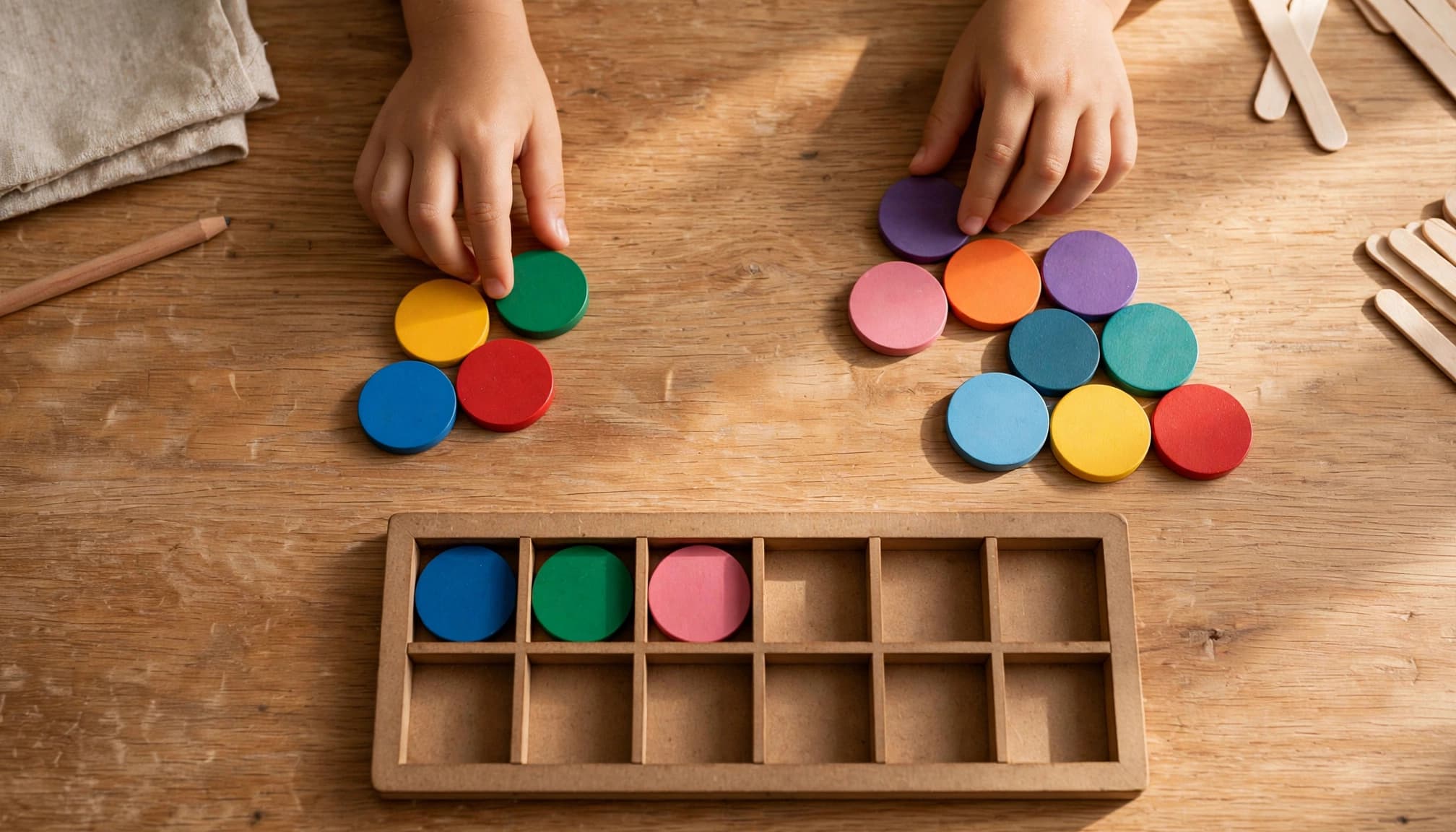
Try these concrete activities with manipulatives such as buttons, blocks, or counters. Put six buttons on one side of the table and eight on the other. Ask, “Which group has more? How can you show me?” Your child can count each group or pair the buttons one by one. After making six pairs, two buttons remain on the eight-button side.
Try equal groups too. Arrange seven objects in a tight cluster and seven in a long row. The row may look bigger, but matching each object shows that both groups have the same amount. That small surprise is worth more than another round of guessing.
Coins, toy cars, cereal pieces, or blocks work. Choose objects large enough to handle safely, and skip tiny pieces if younger siblings are nearby.
Use a ten-frame to make quantities easier to see
Draw two rows of five boxes. Fill the boxes from left to right with counters, then show a second amount on another frame. When your child compares eight and six, ask what each frame has beyond its first full row of five.
If they count every counter, that’s fine. Invite them to notice the groups, which builds number sense. Connecting objects to amounts supports conceptual understanding, so don’t turn a sensible counting method into a speed test. Once comparing numbers within ten feels comfortable, show teen numbers with a full ten-frame and some loose ones.
Connect the groups to numerals and symbols
Give each quantity its written number
After your child builds two groups, write a numeral beside each one. For nine and twelve, they can count, choose the matching number cards, and say, “Twelve is greater than nine.” Then remove the objects and ask them to picture what each card stood for.
A child who recognizes 12 but can’t build it needs more time with a full ten and two extra counters. Moving between objects, drawings, and digits helps keep the written number connected to an amount.
Introduce comparison signs after the words make sense
Write the comparison symbols 8 > 5 and read them aloud: “Eight is greater than five.” The wide opening faces the larger number. Reverse the numbers to write 5 < 8. When both sides are equal, use =, as in 7 = 7, which means seven is equal to seven.
The alligator mouth story can help a child remember which way the opening faces. Another option is the dot strategy: place two dots beside the larger number and one beside the smaller number, then connect them to form the open and narrow ends of the sign.
Use either trick as a memory aid, not the reason an answer is correct. Ask your child to point to the groups or explain the digits before choosing a sign. That builds conceptual understanding and keeps the quantities, not the alligator mouth, in charge of the answer.
Compare two-digit numbers with tens and ones
Look at the tens first
Bundle craft sticks into groups of ten, use base 10 blocks, or draw long lines for tens and small dots for ones. Build 24 as two tens and four ones. Build 31 as three tens and one one.
Ask which number has more groups of ten. Since 31 has three tens and 24 has two, 31 is greater. The four loose ones in 24 don’t change that result. If your child chooses 24 because 4 is bigger than 1, rebuild both numbers and compare the bundles side by side.
This is the reasoning behind Common Core standard 1.NBT.B.3: comparing 2-digit numbers depends on understanding place value, not just noticing an isolated digit. That builds conceptual understanding of what the digits represent.
When the tens match, check the ones
Now build 42 and 47. Both have four tens, so the tens tie. Seven ones are more than two ones; therefore, 47 > 42. Place the numbers in a simple chart with a “tens” column and a “ones” column if your child loses track.
Include equal pairs such as 38 and 38. Ask your child to check both places before writing 38 = 38. For a quick explanation check, ask, “Why didn’t the tens help us decide between 42 and 47?” If they can explain the tie, they’re comparing place values rather than reciting a rule.
Use a number line and 100 chart as visual clues
Walk along a homemade number line
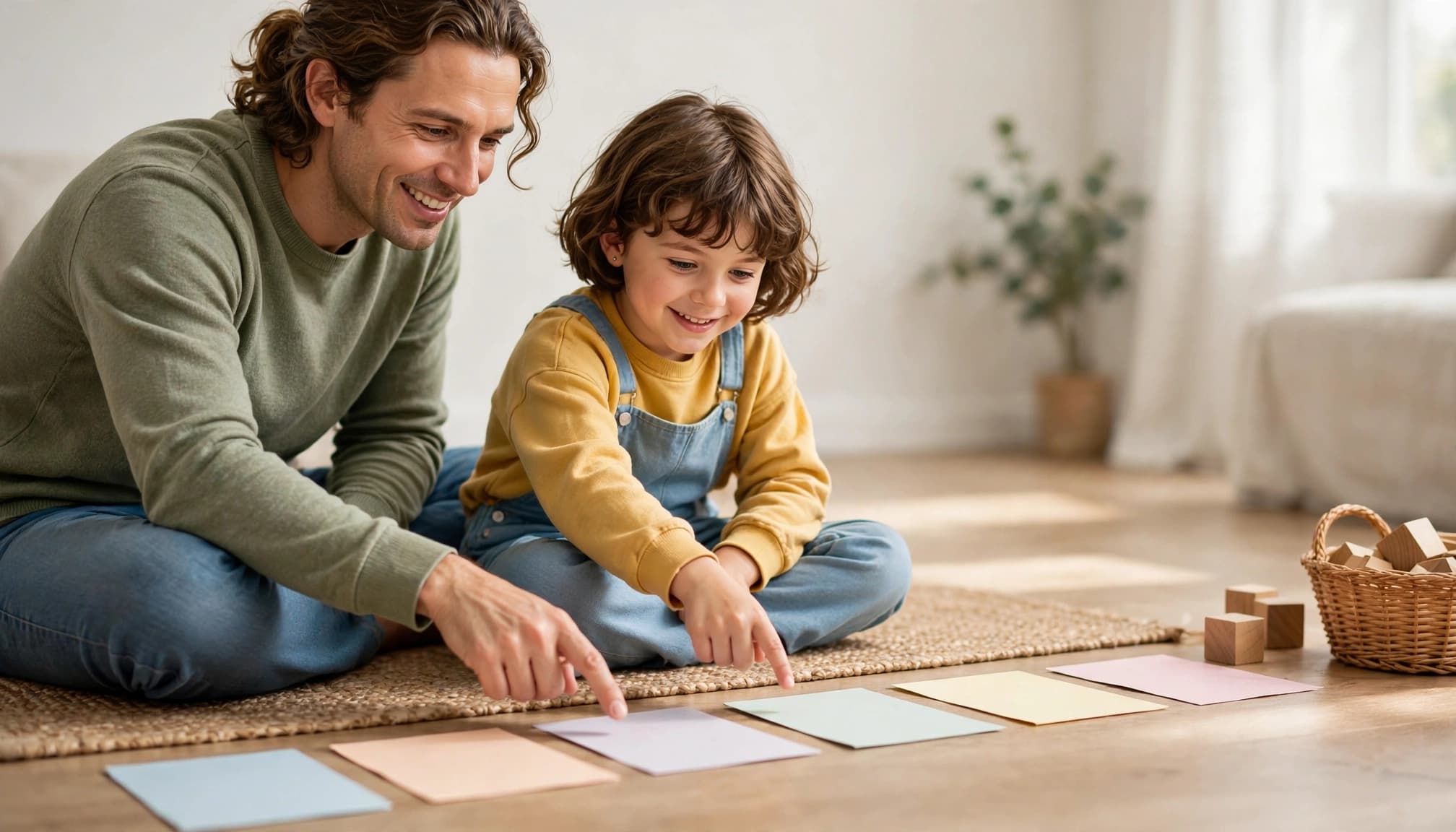
Tape numbered paper squares in order across the floor, starting with 1 to 10. Ask your child to stand on 4, then find 7. Seven sits farther to the right, so it’s greater than four. Next, swap roles and let them challenge you.
Add numbers gradually as your child gets comfortable. Keep the spacing roughly even so the line shows number order clearly. If the cards get knocked about during play, putting them back in order becomes another useful activity.
Find patterns on a 100 chart
On a 100 chart, numbers increase by one as you move right. Move down one row and the number increases by ten. Have your child locate 34 and 35, then 34 and 44. Ask what changed each time.
For close numbers, the chart makes ordering numbers easy to see. For numbers such as 29 and 31, ask your child to explain the tens and ones as well. The chart is a clue, while place value explains why 31 is greater. Keep it nearby rather than expecting your child to remember every number’s position immediately.
Turn comparing numbers into short home games
Short math games make comparing numbers feel like play, with just a few supplies.
Play Roll and Compare
Each player rolls one die, says the number aloud, and shows which roll is greater. The player with the larger roll earns a point, but only after explaining the comparison. Equal rolls are a tie. Roll and Compare also works well as a short activity in math centers.
Once single-digit comparisons feel easy, make number cards for 2-digit numbers using scraps of paper. Each player draws one card, builds the number with bundled sticks or a quick tens-and-ones sketch, and compares. Cards showing 36 and 39 make a good “same tens” round.
Let your child check your answer occasionally. If you claim 26 is greater than 32 because six is bigger than two, they get to prove you wrong with bundles. Catching a grown-up’s mistake can be irresistible.
Set up a number hunt
Place four number cards around a room. Call out a clue such as “Find a number greater than 40” or “Find two numbers with the same tens.” Your child walks to a card and explains their choice.
Change the cards instead of adding more when the game gets easy. A few well-chosen numbers give your child time to think; a room full of cards can turn math into a paper chase.
Help a child who keeps getting stuck
Short, repeatable practice works better than pushing through a long worksheet. For first grade practice, try ten minutes with one pair of numbers: build both, talk about the difference, draw them, and write the comparison. Stop earlier if your child is tired.
Listen for where your child’s math skills break down. If they can’t tell which pile has more, return to matching objects to build conceptual understanding. If they compare 28 and 31 by the ones digits, bundle the tens. If they explain correctly but reverse > and <, leave a drawing of the two-dot and one-dot sign beside their work.
If your child can build and explain 47 > 42 but writes the sign backward, practice the sign. If they can’t explain why 47 is larger, keep the blocks out.
Use free worksheets or grade 1 worksheets for a little written practice after the hands-on work. Printable worksheets can be useful, but one problem your child can explain tells you more than a page of copied signs. If a homeschool curriculum or full curriculum gives your week structure, these small activities can fit between lessons.
For another way to revisit the skill, browse 2cool4school’s Grade 1 mathematics topics. Its human-curated teaching videos can give your child a visual explanation; pause one and ask them to model the example with objects. The free membership includes ads and doesn’t include quizzes. The $9.99-per-month premium membership adds ad-free access, quizzes, progress tracking, and parent email notifications.
Key takeaways for parents
- In first grade, begin with objects your child can count, match, and explain.
- For two-digit numbers, compare tens first and ones only when the tens match.
- Use symbols to show whether one number is greater than, less than, or equal to another, then reinforce the idea with games, videos, and written practice.
Common questions about first-grade comparisons
Should my child learn the alligator mouth first?
In first grade, start with more, less, and equal using objects. Introduce the alligator mouth once your child understands which quantity is greater or less than another. The picture helps with sign direction, but it can’t explain place value.
What if my child can compare small numbers but struggles with two-digit numbers?
Build teen numbers with one ten and loose ones first. Then compare numbers with different tens, such as 21 and 32. Save same-tens pairs, such as 42 and 47, for the next step.
How do I know when to put the counters away?
Ask your child to compare a pair without objects, then explain their answer. Keep counters available if they want to check. Being able to choose a useful tool is part of learning, not a setback.
Make the next comparison count
The next time your child faces 28 and 31, reach for two bundles and three bundles before reaching for a pencil. Let them show you which number has more tens.
A clear explanation is the goal. The symbol can follow, and the crackers can go back to being a snack.