
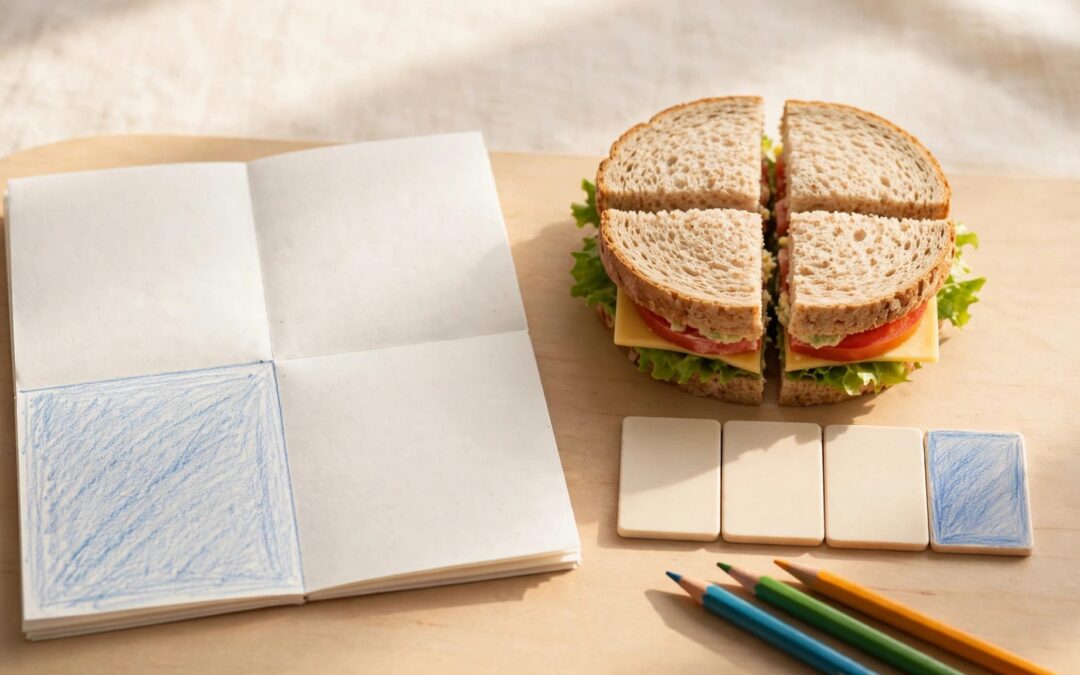
Your child can count four pieces of a sandwich and still miss why one piece isn’t automatically one-fourth. Grade 3 fractions begin with understanding parts of a whole: each piece must contain the same amount.
You can teach that idea with folded paper, simple drawings, and questions about what each number means before reading and writing fractions. A unit fraction names one equal part, such as 1/4; three of those fourth-sized parts make 3/4.
Start with the whole before asking your child to write any numbers.
Key Takeaways
- A fraction describes equal parts of a whole; counting pieces alone does not make them fourths or thirds.
- A unit fraction names one equal part, such as 1/4. The denominator tells how many equal parts make the whole, while the numerator counts the parts being described.
- Use folded paper, shaded shapes, and number lines to help your child see and explain fractions before relying on rules or symbols.
- Compare fractions by looking at equal-sized wholes and pieces. Equivalent fractions, such as 1/2 and 2/4, name the same amount.
What Grade 3 fractions should teach
Grade 3 fractions go beyond spotting a shaded pizza slice. Third-grade students learn to locate, describe, and compare fractions as numbers, building on earlier math concepts.
The Common Core Grade 3 fraction standards include understanding unit fractions, placing fractions on number lines, and explaining simple equivalence. They also include comparing fractions with the same numerator or denominator.
Under these standards, Grade 3 fraction work focuses on denominators of 2, 3, 4, 6, and 8. You don’t need to introduce every possible denominator during the first kitchen-table lesson.
For now, aim for an explanation such as: “The whole has four equal parts. Each part is one-fourth.”
Formal fraction addition, subtraction, and unlike-denominator calculations can wait. A child who explains the pieces has a stronger starting point than one who copies a rule.
Make equal parts visible before naming fractions
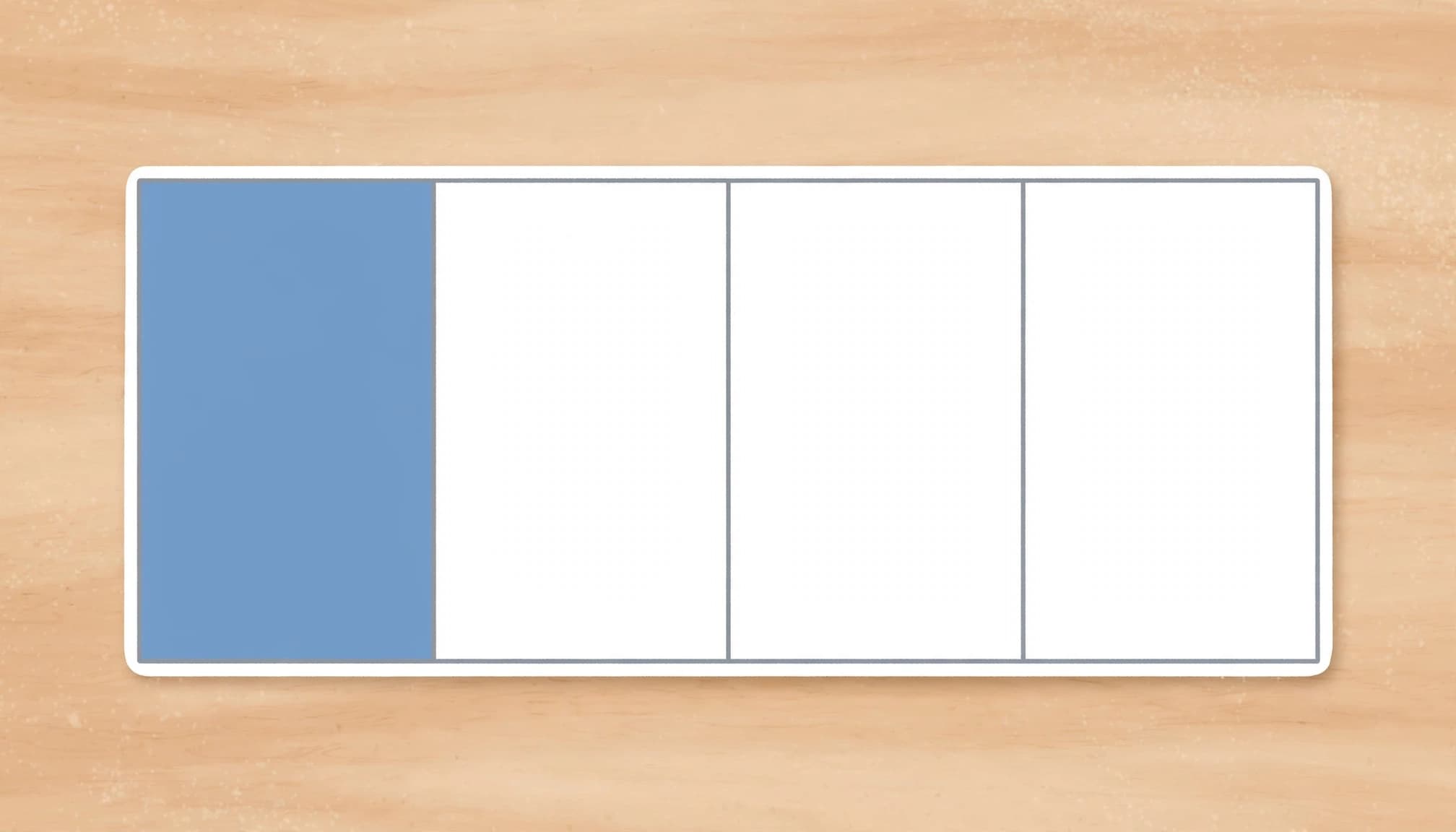
Fold first, then count
Start with visual examples: take a rectangular sheet of paper and call the entire sheet “one whole.” Fold it in half, matching the edges, to divide into equal parts. Fold it in half again, then open it.
The creases create four equal sections. Ask your child to point to one section, then trace the entire sheet.
Say: “Each section has the same amount of paper. One section is one-fourth of this whole.”
Next, draw a rectangle with four clearly unequal sections. Ask whether counting four pieces makes each piece one-fourth. The uneven drawing gives your child something concrete to challenge.
Check size, not just the number of pieces
For a shape model, each section must have equal area. The sections don’t always need identical shapes, although matching strips are easiest for beginners.
Ask your child how they could check a partition. With folded paper, they can match sections by folding or placing cut pieces over one another.
If this feels unfamiliar, revisit the shape-sharing work in a Grade 1 curriculum. Grade 1 worksheets on halves and fourths can provide a gentle reset without a mountain of questions.
Keep the conversation focused on amount. Four pieces alone don’t guarantee fourths; the size of each piece matters too.
Explain unit fractions and the two fraction numbers
Name one equal part
A unit fraction describes one equal part of a whole. Its numerator is 1.
Return to the folded sheet. Point to one section and say “one-fourth,” then write 1/4. Repeat with a sheet folded into halves: one section is 1/2.
These examples connect the drawing and written fraction to the fraction in words.
| Equal parts in the whole | One part | Read it aloud |
|---|---|---|
| 2 | 1/2 | One-half |
| 3 | 1/3 | One-third |
| 4 | 1/4 | One-fourth |
| 8 | 1/8 | One-eighth |
The name tells your child what kind of piece they’re counting. Encourage them to say “fourths” before counting how many fourths they have.
Build larger fractions with those units
Now shade three sections of the four-part sheet. Count aloud: “One fourth, two fourths, three fourths.” Write 3/4 beside the picture.
In this example, the numerator and denominator have different roles. The denominator, 4, identifies the total number of equal parts in the whole, and 3 counts the parts you’ve shaded.
Ask your child to explain the numerator and denominator while pointing to the drawing. “The bottom number tells how many equal parts make the whole, and the top number counts the shaded parts,” they might say.
Also read 2/3 as “two-thirds” and 3/4 as “three-fourths.” Keep practice in reading and writing fractions tied to pictures rather than a long vocabulary list.
Find shaded and unshaded fractions
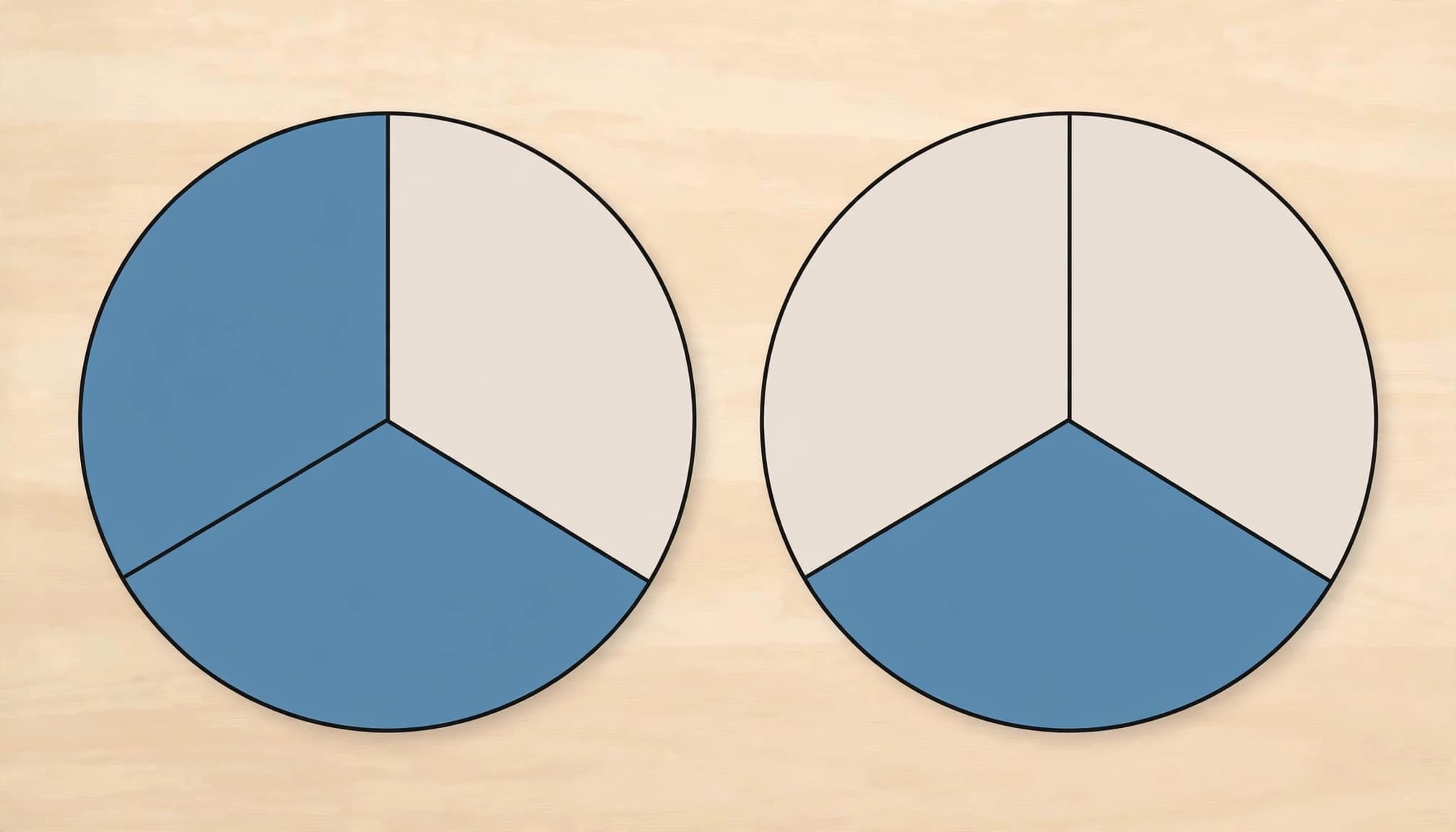
Use the left circle above for a quick conversation. It has three equal sections, with two shaded and one unshaded.
Work through the picture in this order:
- Identify the whole circle and check that its sections are equal.
- Count all three sections to name the parts as thirds.
- Count the requested sections: the shaded fraction is 2/3, and the unshaded fraction is 1/3.
The denominator stays 3 for both answers because you’re describing parts of the same partitioned whole.
Before your child writes, ask them to point to the region the question describes. Have them say the fraction in words, naming 2/3 as the shaded fraction and 1/3 as the unshaded fraction.
Then use the right circle. Ask your child to describe its shaded and unshaded portions without your help. Listen for “one-third shaded” and “two-thirds unshaded,” not just the numbers one and two.
Put unit fractions on a number line
A shape shows an amount of a whole. A number line also shows that a fraction has a location.
Make the interval from 0 to 1 the whole
Draw a line and mark 0 and 1. Explain that the distance between those points is one whole unit.
Divide that distance into four equal intervals. Label the interior marks 1/4, 2/4, and 3/4. The endpoint at 1 represents 4/4. The denominator tells the total number of equal intervals in the whole from 0 to 1.
Have your child move a finger one interval at a time, reading each fraction in words, such as “one fourth.”
For another visual reference, Teach Starter’s fraction number-line resources include printable displays and student reference sheets.
Count spaces instead of tick marks
A common mix-up is counting the marks rather than the intervals. Between 0 and 1, five boundary marks create four spaces.
Ask your child to touch each space while counting. Then ask where two fourth-sized steps land. They should reach 2/4.
On a fraction number line, count equal intervals within one whole, not the number of tick marks.
Extend the line to 2 when your child is comfortable. Five fourth-sized steps land at 5/4, beyond 1. Fractions can describe numbers larger than one whole, too.
Comparing fractions without guessing from the digits
Start with the same denominator
Draw two equal-sized rectangles. Divide each into six equal sections, then shade 2/6 in one and 5/6 in the other. These fractions have like denominators, so their sixth-sized pieces are the same size.
Both pictures use sixth-sized pieces, so five pieces cover more area than two. Write 5/6 > 2/6 beside the drawings to connect the fraction values to the comparison symbol.
Ask your child to finish the explanation: “Five sixths is greater than two sixths because…”
The useful answer mentions more equal-sized pieces. If they only say “five is bigger,” return to the models and ask what five counts.
Keep the wholes the same size. Otherwise, the shaded amounts can distract from the fraction comparison.
Then compare unit fractions
Use equal-length strips to compare 1/3 and 1/6. Divide one strip into thirds and the other into sixths.
One third-sized section is larger than one sixth-sized section. Therefore, 1/3 > 1/6.
This addresses a tempting whole-number guess: six is larger than three, but splitting the same whole into more pieces makes each piece smaller.
Avoid requiring a memorized shortcut before your child sees the difference. Let them place the strips together and explain what changed.
For Grade 3 fractions, clear models and a complete explanation matter more than speedy symbol writing.
Show equivalent fractions before teaching a rule
Take two identical paper strips. Divide the first into halves and shade one half. Divide the second into fourths and shade two fourths.
Place them together. The shaded lengths match, so 1/2 = 2/4. These are equivalent fractions, different names for the same amount.
Ask what changed and what stayed the same. There are more shaded pieces in the fourths model, but each piece is smaller.
Next, locate 1/2 and 2/4 on the same number line. Both names belong at the same point. The Common Core fraction progression includes explaining equivalence as part of developing fractions as numbers.
An equal-length fraction chart gives your child another model to inspect. Have them find matching lengths, then draw one match themselves.
Save the multiply-both-numbers rule for after your child can explain the unchanged amount.
Use short practice to find the sticking point
Match the question to the difficulty
A math worksheet helps when its questions match the skill your child needs. Choose a fraction worksheet with clear models and room to draw.
If equal parts are the problem, choose partitioning questions. If fraction notation causes confusion, choose shaded shapes. For number-line trouble, choose questions about locating fractions rather than coloring circles.
For more fraction practice ideas, 2cool4school’s third-grade math practice guide connects worksheets with broader learning support.
Try three focused questions instead of handing over an entire page. Watch how your child starts; that often reveals more than the final answer.
Combine a model, a video, and an explanation
When using videos and other teaching resources, keep the sequence manageable: model one problem together, watch a relevant explanation, then let your child try a similar question.
Pause the video before its answer. Ask your child to draw the whole and practice reading and writing fractions by naming the unit: “These are fourths.”
Finish by asking, “How do you know?” A useful answer refers to equal pieces, a matching shaded amount, or a number-line location.
If they answer correctly but can’t explain, request one drawing. More questions won’t necessarily repair a missing idea.
Over time, vary the representation. A child who recognizes 3/4 in a rectangle should also practice locating it on a number line.
Frequently Asked Questions
What should a third grader learn about fractions?
Third graders learn to understand unit fractions, represent fractions with models and number lines, and compare simple fractions. They also begin to explain why different fractions can name the same amount.
How do I explain the numerator and denominator?
The denominator tells how many equal parts make the whole, and the numerator counts the parts being described. Point to a fraction model as your child explains what each number means.
Why do fractions need equal parts?
A fraction describes an amount relative to a whole divided into equal parts. Four unequal pieces do not each represent one-fourth, even if there are four pieces.
How can my child compare fractions?
Start with models that use the same-sized whole and equal-sized parts, such as 2/6 and 5/6. For unit fractions, use strips to show that dividing a whole into more pieces makes each piece smaller.
Keep the whole and the unit in view
Equal parts give fraction numbers their meaning. Keep the whole consistent, name one unit fraction, and count those units before introducing harder procedures.
If your child gets stuck, return to one clear model rather than a longer worksheet. Their explanation will help you choose the next step.
Explore 2cool4school’s free curriculum, then ask your child to show the idea with paper or a drawing.