
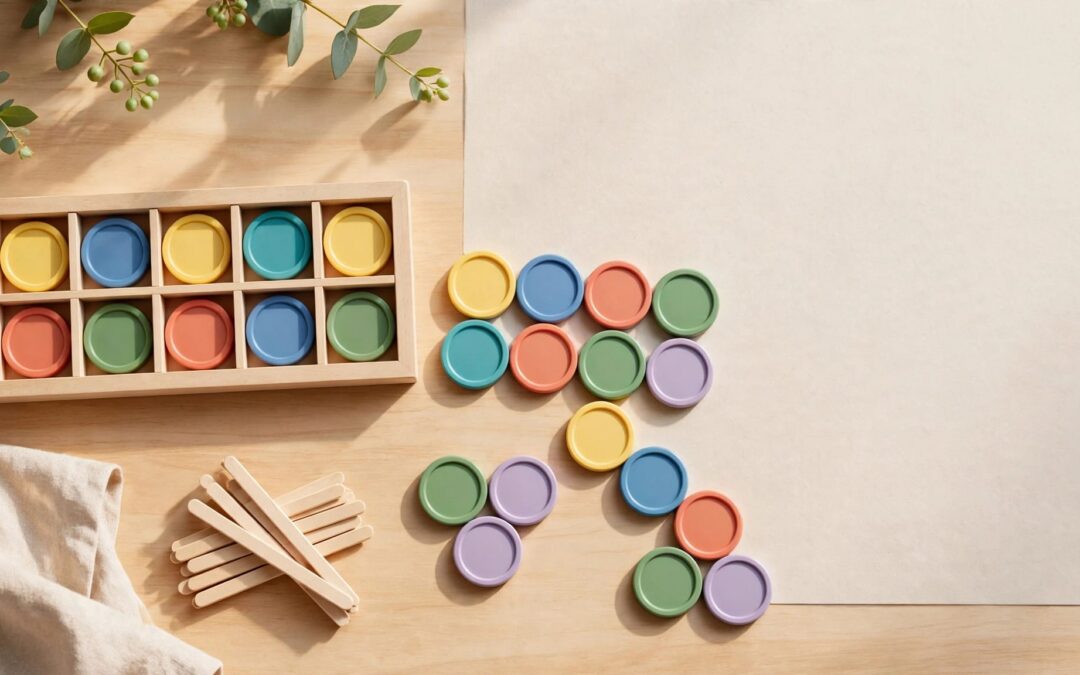
If your child solves 13 – 7 by recounting thirteen counters, keep the counters and change the prompt. Subtraction within 20 gets easier when children recognize groups, use ten as a stepping stone, and connect subtraction to familiar addition facts.
The goal is less recounting, with understanding intact. Fingers and counters can stay on the team while your child learns more efficient strategies.
Start with what first graders need to know, then practice one useful strategy at a time.
What Grade 1 Subtraction Within 20 Requires
Separate solving within 20 from fluency within 10
The Grade 1 Operations and Algebraic Thinking standards make an important distinction. Standard 1.OA.C.6 expects children to add and subtract within 20, while demonstrating fluency within 10.
That means your child can use a drawing or other subtraction strategies for 16 – 9. First grade doesn’t require every subtraction fact through 20 to pop out instantly.
Meanwhile, familiar math facts such as 8 – 3 should become increasingly comfortable, building fact fluency within 10. Practice both ranges, but adjust the support.
Look for readiness rather than a calendar date
Before crossing ten, check whether your child recognizes a full ten-frame and understands smaller number bonds.
Show 8 counters arranged as five and three. Ask how many spaces remain in a ten-frame. Then try splitting 5 into two parts.
If these relationships still need lots of prompting, stay with smaller quantities. Bigger numbers won’t fix a missing foundation, however impressive they look on paper.
Connect Objects, Pictures, and Equations
Build the whole and separate its parts
Start with 9 counters, using them as a manipulative. Move 4 aside, leaving 5. Ask your child to identify the original whole and both parts.
Then record 9 – 4 = 5 and 4 + 5 = 9. The same arrangement explains both operations.
If your child counts every counter, accept that answer. Next, arrange the remaining five in a familiar row, pattern, or ten frame. Ask what they notice without moving anything.
Repeated exposure to organized groups gives children something useful to recognize. A scattered counter parade mostly invites another count.
Draw the same relationship before removing support
Next, draw nine dots in organized rows and cross out four, or show the same relationship on a number line. Connect the representation to the equation.
This progression uses visual models: objects first, pictures next, then symbols. Children can return to objects whenever they need to check their thinking.
Try a missing-part question too: 4 + ___ = 9. Your child can cover one part of the model and describe what’s hidden.
Keep the whole visible when discussing parts. A correct answer matters, but explaining why those quantities belong together reveals more.
Use Ten Frames to Subtract Across Ten
Ten frames have two rows of five spaces. Fill them in a consistent order so your child sees five, ten, and extra ones.
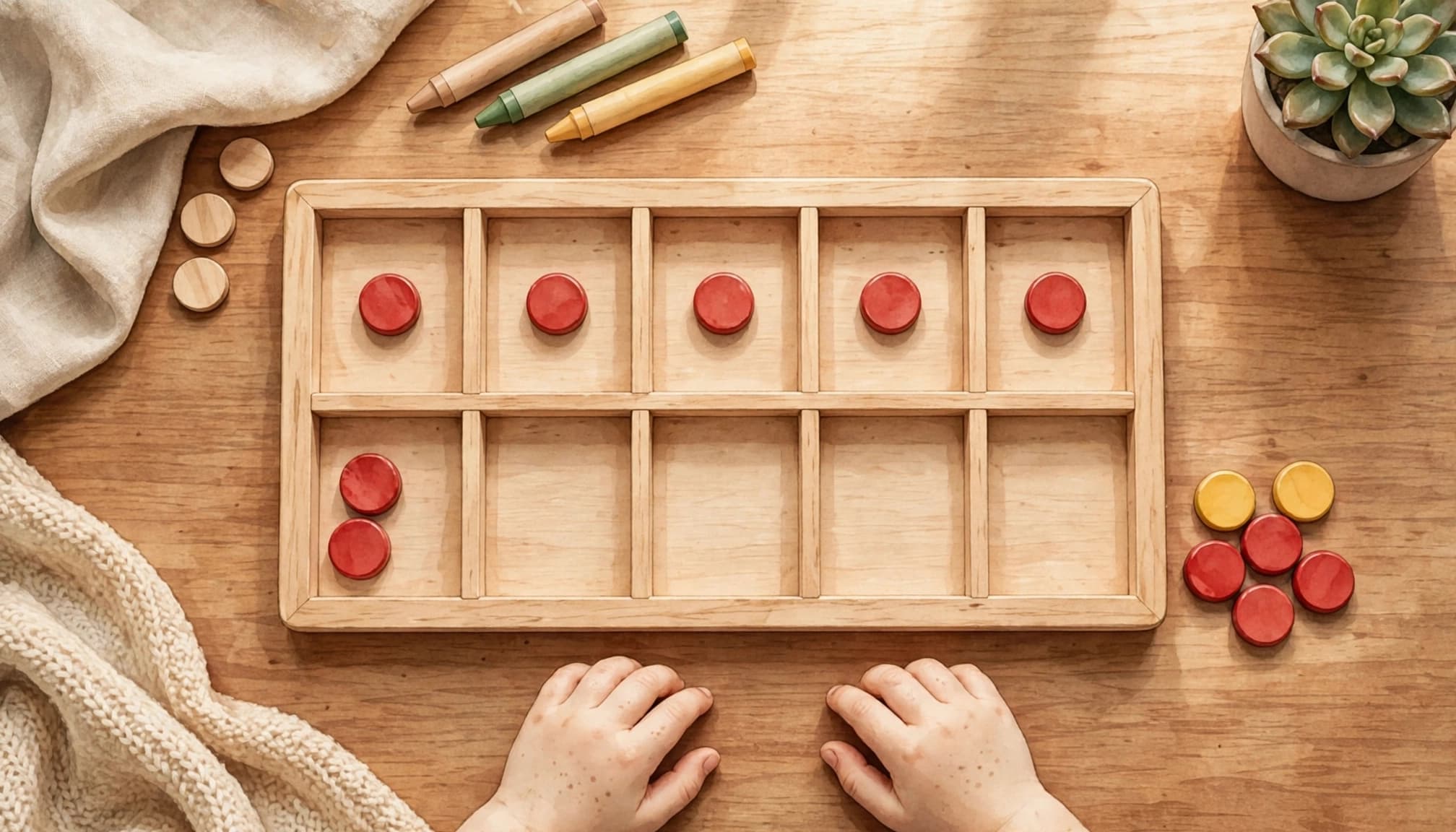
For 13 – 7, show one full frame and three additional counters. Keep the ten organized instead of scattering everything.
Work through the subtraction in two stages:
- Remove the three extra counters first. Say, “We took away 3, so we’re at 10.”
- Split the amount being removed: 7 = 3 + 4. Ask how many more counters must leave.
- Remove four counters from the ten-frame. Six remain.
- Record the steps: 13 – 3 = 10, then 10 – 4 = 6.
Although this strategy often goes by “making ten,” ten is a stopping point in these subtraction strategies. The child breaks apart the number being subtracted.
In 13 – 7, the 7 becomes 3 and 4. After removing 3, remove only the remaining 4.
Try 12 – 5 next: remove 2 to reach 10, then remove 3 to reach 7. Keep the model available until your child can explain both stages.
For additional modeled practice, Numeracy Consultants offers make-ten and subtraction strategy games. Choose a small set that matches the relationship you’re practicing.
Choose a Strategy That Fits the Numbers
Different subtraction problems call for different subtraction strategies. Choose a math strategy that fits the numbers, and introduce options gradually instead of serving a strategy buffet before breakfast.

Count back for a small amount
For 12 – 2, start at 12 and say “11, 10.” Only two backward steps are needed.
On a labeled number line, place a finger at 12 before moving. Count the jumps or landing numbers, not the starting position.
This approach is handy when subtracting 1, 2, or 3. However, moving back nine steps creates plenty of opportunities to lose track.
After solving, ask your child to check the result with addition: 10 + 2 = 12. That gives the answer a second route home.
Count on or use a known addition fact
For 15 – 13, count forward from 13: 14, 15. The gap is 2. Counting on is efficient when the numbers are close together.
For 14 – 7, use 7 + 7 = 14. Therefore, removing one seven leaves the other.
Use fact families to connect 6, 7, and 13. Put the whole, 13, at the top, then connect 6 + 7 = 13 and 7 + 6 = 13 to 13 – 6 = 7 and 13 – 7 = 6.
Ask your child to explain the relationship before copying all four equations.
Correct the Mistake Before Adding More Practice
Watch the first move your child makes. It often reveals the problem faster than the final answer.
Use these responses when familiar errors appear.
| What you notice | What to try next |
|---|---|
| They count the starting number as the first backward step. | Mark the start separately, then count each jump. |
| They remove 3 and then another 7 for 13 – 7. | Show seven counters split into groups of three and four. |
| They confuse a part with the whole. | Rebuild the original amount and point to each part. |
| They reject zero as an answer. | Remove all eight counters for 8 – 8 and discuss the empty group. |
After correcting the model, offer one similar question. For example, follow 13 – 7 with 13 – 6.
If the same mistake returns, reduce the number range or restore the objects. Another entire worksheet would simply give the mistake more rehearsal time.
Try a Short Daily Subtraction Routine
A ten-minute math practice session is a manageable starting point. Stop earlier if your child becomes tired or frustrated.
Use this sequence at the kitchen table or in math centers:
- Spend two minutes recognizing groups. Use ten frames to show eight counters and ask what helps your child see eight.
- Model one subtraction problem together. For 13 – 7, let your child move the counters and explain the split.
- Offer two related questions independently, such as 12 – 7 and 14 – 7.
- Finish with one explanation: “How did ten help you?”
Across several sessions, change the representation rather than constantly increasing difficulty. Use counters one day, drawings or a number line another, and a few task cards later.
Keep a brief record of accuracy and strategy choice to support fact fluency, rather than tracking only speed. NCTM’s Assessing Basic Facts Fluency offers further reading about evaluating fact knowledge.
A correct, well-explained solution tells you what your child understands. A timed score alone doesn’t identify a counting error or a confused number bond.
Make Worksheets and Videos Support the Model
Choose written practice that leaves room for thinking
For focused math practice, look for clear pictures, room to draw, and only a few questions targeting one skill. A page of mixed facts is better for review than for introducing a new strategy.
For grade 1 worksheets, start with three questions and leave the rest covered. Ask your child to build or draw one answer before writing it. A number line is another option if they need a different way to show their thinking.
2cool4school’s free worksheets by grade and subject include printable worksheets, including a Grade 1 math worksheet with questions such as 14 – 7 and 12 – 2.
Those two facts make a useful comparison: a known double helps with the first, while counting back works neatly for the second.
Pause a teaching video before the answer
2cool4school organizes human-curated YouTube teaching videos by grade, subject, and topic. Use a relevant explanation, then pause before the worked answer.
Ask your child to build the problem with counters or show it on a ten-frame. Afterward, compare their reasoning with the demonstration.
Keep the same model nearby during digital practice. Screens can provide another explanation, but your child’s own model shows whether the idea makes sense.
For homeschool learning, this routine connects video instruction to hands-on work and a small amount of written practice.
Key Takeaways for Home Practice
- Use organized groups of five and ten to reduce recounting and build fact fluency, with clear explanations mattering more than speed.
- Match the strategy to the numbers instead of requiring one method for every question.
- Correct the model before assigning more questions.
- Keep objects available as explanations become more independent.
Common Questions About First-Grade Subtraction
Should I stop my child from using fingers?
No. Fingers can support counting and show smaller parts. Instead of banning them, ask whether a known fact or ten-frame pattern could help. Let your child check an answer with fingers when needed.
When should we move above ten?
Introduce teen numbers when your child can recognize ten as a group and explain smaller part-whole relationships with little help. Start with 12 – 2 or 14 – 4 before crossing ten.
Is subtraction fluency within 20 a Grade 2 expectation?
Yes. The Grade 2 Operations and Algebraic Thinking standards include fluent addition and subtraction within 20 using mental strategies. First-grade practice builds toward that expectation through models, relationships, and increasingly efficient choices.
Make the Next Practice Session Count
When thirteen counters trigger thirteen separate counts, organize them as ten and three. Let your child explain what changes before asking for an answer.
For a homeschool curriculum or after-school support, try 2cool4school’s free Grade 1 curriculum. The ad-supported membership provides human-curated video learning across Grades 1 through 8, without quizzes.
Choose one subtraction skill, keep the counters nearby, and aim for a clear explanation before a faster answer.