
A clock has only two hands, yet it can give a first grader plenty to untangle. Start grade 1 telling time practice with whole hours, then introduce half-hours using a clock your child can move.
The goal is understanding before speed: your child should explain the hands, say the time, match it to a digital clock, and write it. Build from time to the hour to half-hours with short lessons, matching games, and a few written questions.
Begin with what first graders need to learn, then build one clock skill at a time.
Key Takeaways
- Grade 1 practice focuses on reading and writing whole-hour and half-hour times, such as 5:00 and 5:30.
- Teach the clock hands first: the short hand shows the hour, and the long hand shows the minutes.
- At :30, the long hand points to 6 and the short hand sits halfway between two numbers.
- Use a movable clock to connect analog and digital times, and keep practice brief and focused on understanding before speed.
What first graders need to know about time
Keep the goal focused on hours and half-hours
The Common Core Grade 1 time standard, 1.MD.B.3, is part of measurement and data. In first grade math, this math standard asks children to tell and write whole-hour and half-hour times using an analog clock and digital time.
That means reading 5:00 and 5:30, connecting each to an analog clock, and recording the time correctly.
Quarter hours fall outside this Grade 1 standard. You can leave 5:15 and 5:45 for later rather than inviting every minute to the party.
Introduce the clock parts first
Show your child the numbered clock face and its two hands. Help them identify the hour and minute hand: the shorter hand shows the hour, and the longer hand shows the minutes.
Have your child find 12, 3, 6, and 9 on the clock face, then trace the numbers in clockwise order.
Before combining everything, check that they recognize numbers through 12 and distinguish the hands. If either skill needs support, practice it separately. Otherwise, a clock-reading mistake may be a number-recognition snag in disguise.
Teach whole hours before half-hours
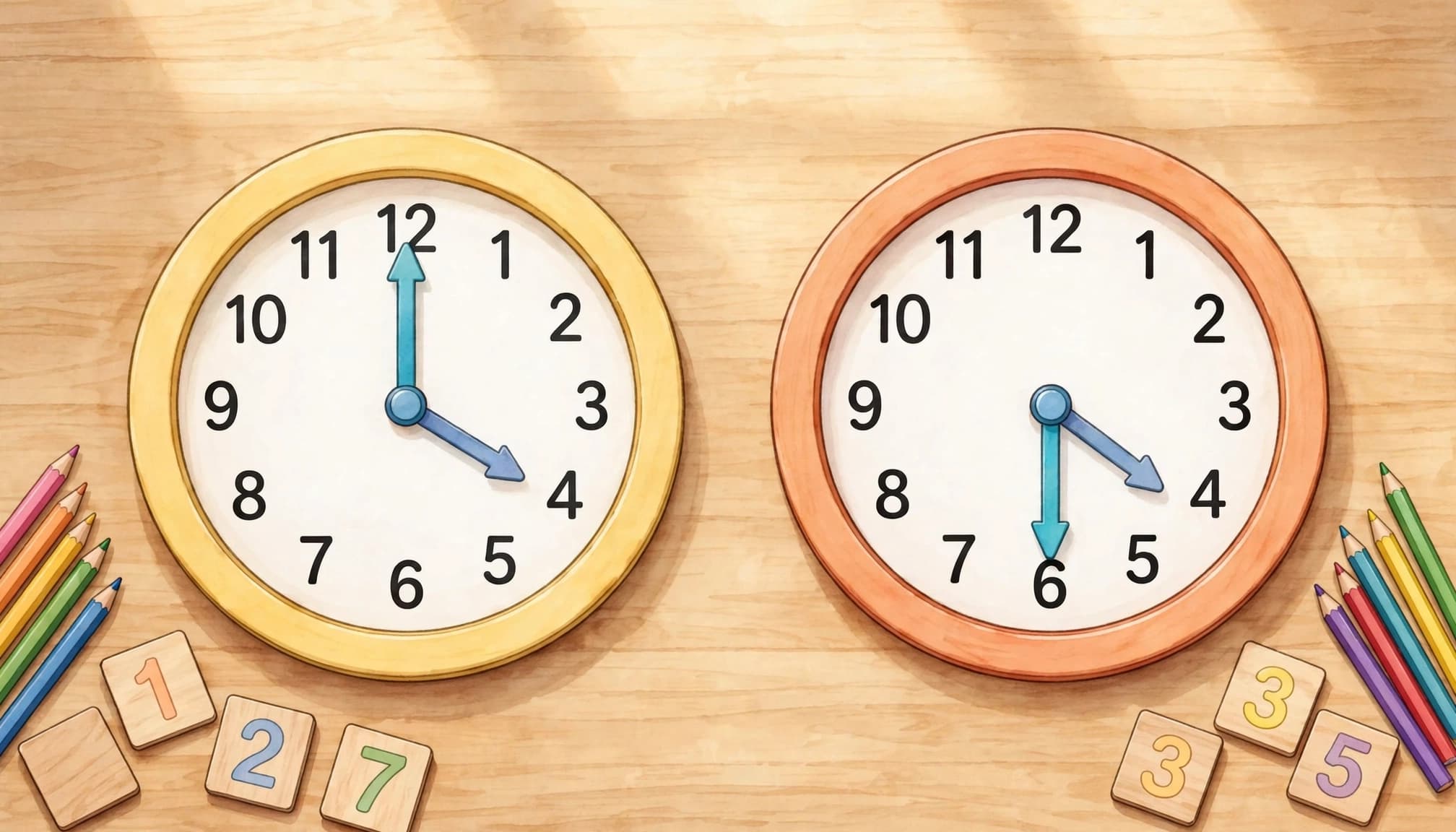
Start with the long hand pointing to 12
Set a movable analog clock to 3:00. Point out that the short hand points to 3 and the long hand points to 12.
Say, “The hour is three. The minute hand is at twelve, so it’s three o’clock.” Then write 3:00.
Repeat with 7:00 and 10:00. Next, make it a short telling time game: call out a time and let your child set the hands.
Keep the minute hand at 12 throughout these first examples. Once your child reads and builds time to the hour with little help, introduce the half-hour. Move forward because the idea makes sense, rather than because Tuesday has arrived.
Show that both hands move at the half-hour
Move a clock from 2:00 to 2:30. The long hand reaches 6, halfway around the clock. Meanwhile, the short hand moves halfway between 2 and 3.
Explain that one hour has 60 minutes, so 30 minutes is half an hour.
Say, “It’s half past two, or two-thirty.” Write 2:30 beside the clock.
Use a geared teaching clock when possible because its hands move together. If the hands move independently, position the hour hand yourself at first. At :30, the short hand belongs between numbers, not parked on the starting hour.
Connect analog and digital clocks
A digital clock shows the same information in a different format. The number before the colon gives the hour; the two digits after it give the minutes.
For this lesson, use a digital clock to focus on :00 and :30. Your child doesn’t need to count by fives around the entire clock yet.
Matching an analog clock with a digital display connects these math concepts. It shows how analog and digital clocks represent the same time.
Keep this small reference chart beside your teaching clock.
| Time | Long minute hand | Short hour hand | Say it |
|---|---|---|---|
| 6:00 | Points to 12 | Points to 6 | Six o’clock |
| 6:30 | Points to 6 | Halfway between 6 and 7 | Six-thirty |
| 12:30 | Points to 6 | Halfway between 12 and 1 | Twelve-thirty |
The hour is the one the short hand has reached or passed, even when the next number looks tempting.
Afterward, cover the chart. Show an analog time and ask your child to write its digital match. Then show 8:30 on a digital clock and ask them to build it.
Hands-on telling time games for home
Make a simple clock your child can move
A paper plate clock activity gives your child a simple way to practice. Add the numbers 1 through 12, placing 12, 3, 6, and 9 first.
Two movable hands, one short and one long, let your child build different times. An adult should handle any cutting, holes, or fastening. If you’d rather skip the craft, draw clocks on scrap paper instead.
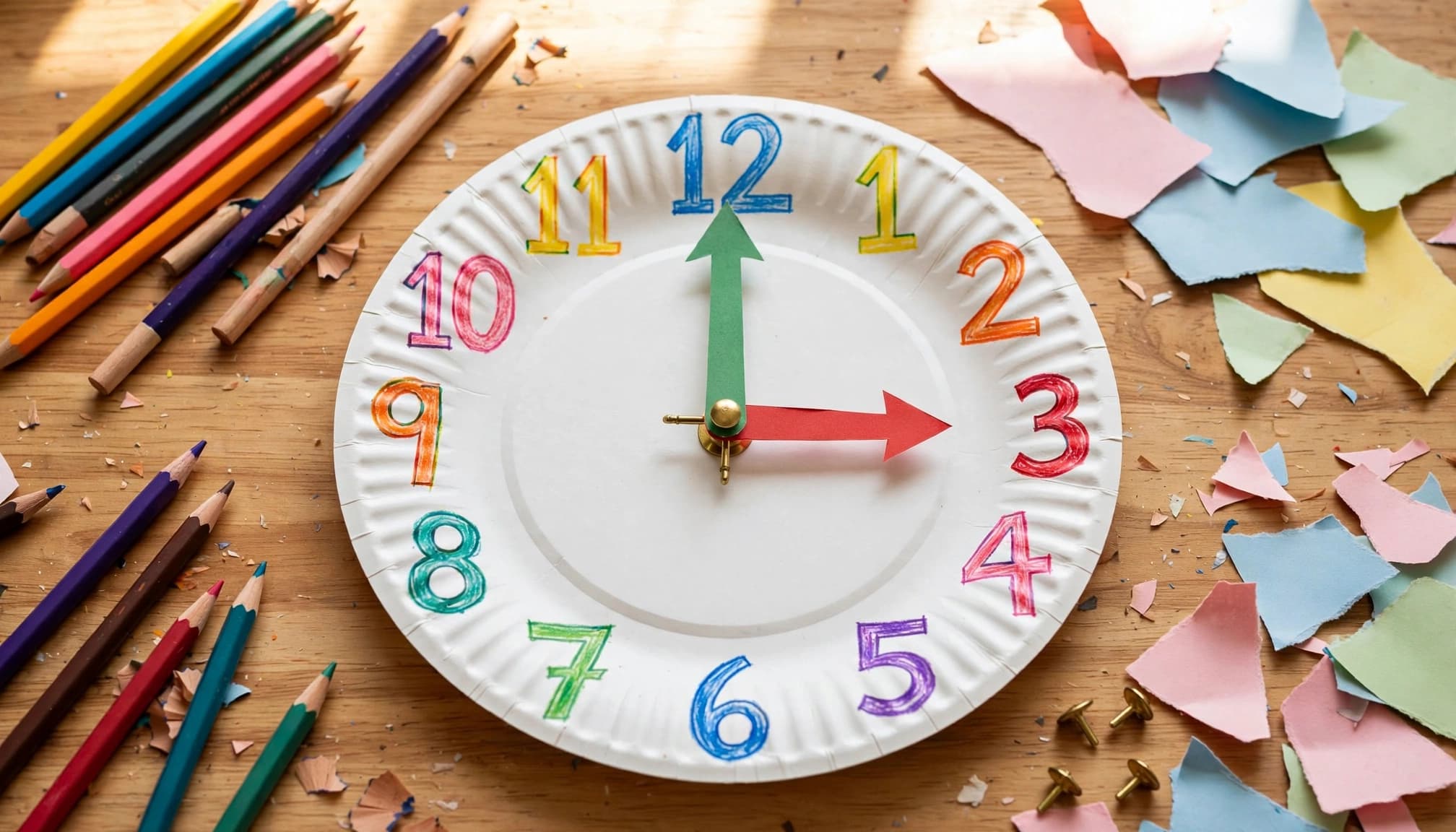
Play “Clock Builder.” Call out 4:00, then 4:30, and ask your child to set both hands. Because homemade hands usually move independently, remind them to move the hour hand too.
Let your child give you a time next. Take turns setting the hands and checking each other’s clocks. These hands-on math activities make telling time games easy to repeat at home.
Match clocks, routines, and stories
Draw four analog clock faces showing 1:00, 1:30, 5:00, and 5:30. Write those digital times on separate cards.
Your child matches each clock to a card and explains one choice. Keep the set small before adding more pairs.
Clock matching and routine checks are simple learning games. Choose a household routine that happens on an hour or half-hour, then check the clock together when it begins.
For a story connection, read Eric Carle’s The Grouchy Ladybug. Its clock illustrations offer opportunities to notice the times as the story progresses. Pause occasionally to read a clock, but keep the read-aloud enjoyable.
A five-day plan for short practice sessions
Aim for about five to ten minutes, and stop sooner if your child is tired. Each session can include one demonstration, a few turns together, and one independent try.
Use this schedule as a flexible starting point.
| Day | Focus | Practice |
|---|---|---|
| 1 | Clock parts | Find the hands and numbers, then build 3:00. |
| 2 | Whole hours | Practice time to the hour by reading and setting four different o’clock times. |
| 3 | Half-hours | Compare 2:00 with 2:30 and move both hands. |
| 4 | Analog and digital matches | Match four clocks to written times. |
| 5 | Mixed review | Read, build, and write whole-hour and half-hour times. |
Repeat a day when needed. Brief formative assessments during the week can help you decide whether your child is ready to move on. Understanding matters more than finishing the schedule.
For a homeschool curriculum, fit this practice alongside your regular math lesson plans. After-school learners can use the same routine without turning the kitchen table into a second school shift.
Short telling time practice you can use today
Practice set A: build the time, then write it
Use an analog clock for these prompts, starting with time to the hour. Have your child set the hands, then read and write each matching time on a digital clock. Make it a quick round of your telling time games.
- Show three o’clock.
- Build eight o’clock.
- Set the clock to half past four.
- Show eleven-thirty.
Check the hands as well as the written answer. The digital answers are 3:00, 8:00, 4:30, and 11:30.
For 4:30, the short hand belongs between 4 and 5. For 11:30, it belongs between 11 and 12. For both :30 times, the long hand belongs at 6.
Practice set B: read, draw, and explain
Prepare these clocks on paper, or set them on your teaching clock.
- Put the long hand at 12 and the short hand at 9. Ask for the time.
- Position the long hand at 6 and the short hand halfway between 7 and 8. Ask for the time.
- Show 10:00 on a digital clock and ask your child to draw the hands.
- Write 12:30 and ask them to draw and explain both hands.
Answers: 9:00, 7:30, 10:00, and 12:30.
Use only two questions if your child needs more support. Their explanation tells you more than a page of copied answers.
For additional paper practice, Education.com’s hour-and-half-hour worksheets target this standard. Choose clear clock faces and a small number of questions.
Fix common clock-reading mistakes
If your child swaps the hands, return to identifying them before reading times. Different colors can help, but keep using the words “short hour hand” and “long minute hand.” Otherwise, color may become their only clue.
When your child reads the 6 as six minutes, move the minute hand halfway around the clock again. Explain that the clock’s numbers help us locate the hands; at 6, the minute hand shows 30 minutes.
At 4:30, the short hand has passed 4 but hasn’t reached 5. Choosing the nearer number won’t reliably identify the hour.
If your child says 5:30 instead of 4:30, slowly move the hands through 4:00, 4:30, and 5:00. Let them describe where the short hand travels.
Finally, separate clock understanding from handwriting. A child who reads the clock correctly but writes 4:3 needs practice recording two minute digits.
Use quick formative assessments: ask your child to read a time to the hour, build a :30 time, and explain the hour hand’s position. Practice the part that breaks down instead of restarting everything.
Use videos and worksheets after hands-on practice
Among browser-based educational apps, The Math Learning Center’s Math Clock interactive tool offers geared and freely movable hands. Use geared hands to show how the hour hand moves as minutes pass, then compare the result with a digital clock.
Ask your child to predict a position before moving the clock. This keeps practice focused on thinking rather than tapping until something looks right.
For organized support, browse 2cool4school’s Grade 1 math topics. Its human-curated teaching videos give parents another way to revisit a difficult skill within the Grade 1 curriculum.
Pause a relevant video before an answer appears. Have your child build the time, explain it aloud, and then check the explanation.
When choosing Grade 1 worksheets, look for readable clock faces, room to draw, and practice that matches today’s goal. The free worksheets by grade and subject provide a starting point for printable practice.
Save a dated sample occasionally. Comparing your child’s hand placement and explanations over time gives you a clearer picture than counting completed pages. Use those samples to revisit reading analog and digital clocks.
Frequently Asked Questions
What should first graders learn about telling time?
First graders should learn to tell and write times to the hour and half-hour using analog and digital clocks. Quarter hours are beyond the Grade 1 standard covered here.
How do you explain 30 minutes on an analog clock?
Explain that 30 minutes is half of an hour, so the long minute hand points to 6. The short hour hand moves halfway toward the next number.
Why is the short hand between numbers at :30?
The short hand moves gradually as the minutes pass. At :30, it has moved halfway from the hour it reached toward the next hour.
How long should a first grader practice telling time?
Aim for about five to ten minutes, with a demonstration, a few guided turns, and one independent try. Stop sooner if your child is tired, and repeat a practice day when needed.
Keep time practice small and repeatable
Those two clock hands become easier to read when children can move them and explain what they show. Build whole-hour understanding first, then teach half-hours with both hands in the correct positions.
For your next short lesson, try one clock-building task and one written answer. Explore 2cool4school’s free curriculum for Grades 1-8 for human-curated videos organized by grade and topic; free membership includes ads and doesn’t include quizzes.