
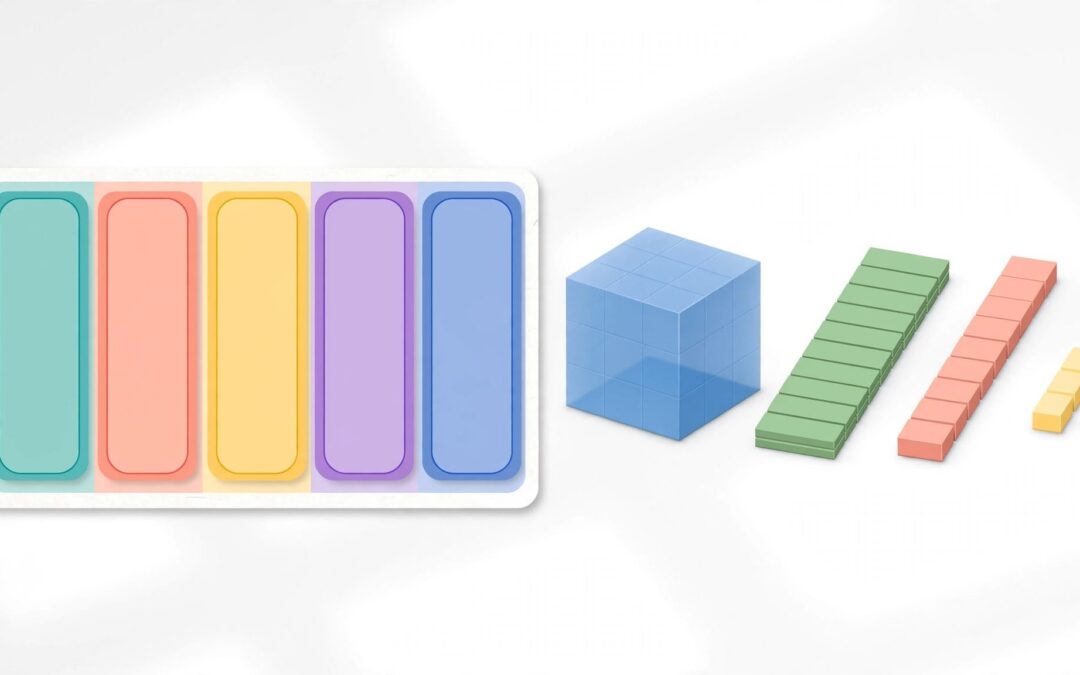
A child can say “point four two” without understanding what the 4 and 2 mean. For 5th grade decimals, the goal is to connect each digit with its place value before writing or comparing numbers.
Start with what each digit represents, rather than a list of rules to memorize. A place-value chart, a simple model, and a few focused questions make a useful starting point.
What fifth graders need to know
A Common Core standard for Grade 5 math, described in the Common Core Grade 5 standards, expects children to read, write, and compare decimals to thousandths. The standards also explain that each place has one-tenth the value of the place immediately to its left.
That pattern continues across the decimal point. Ten tenths make one whole, ten hundredths make one tenth, and ten thousandths make one hundredth.
Here’s how the digits work in 4.307.
| Place | Digit | Value |
|---|---|---|
| Ones | 4 | 4 |
| Tenths | 3 | 0.3 |
| Hundredths | 0 | 0 |
| Thousandths | 7 | 0.007 |
The 7 means seven thousandths, not seven hundredths. Place value determines what each digit represents.
Ask your child, “What is the value of the 3?” An answer of “three tenths” shows more understanding than simply pointing to the digit.
Build a model before writing decimals
Choose what counts as one whole
Before using blocks or drawings, agree on the whole. Otherwise, the same block can accidentally mean different amounts.
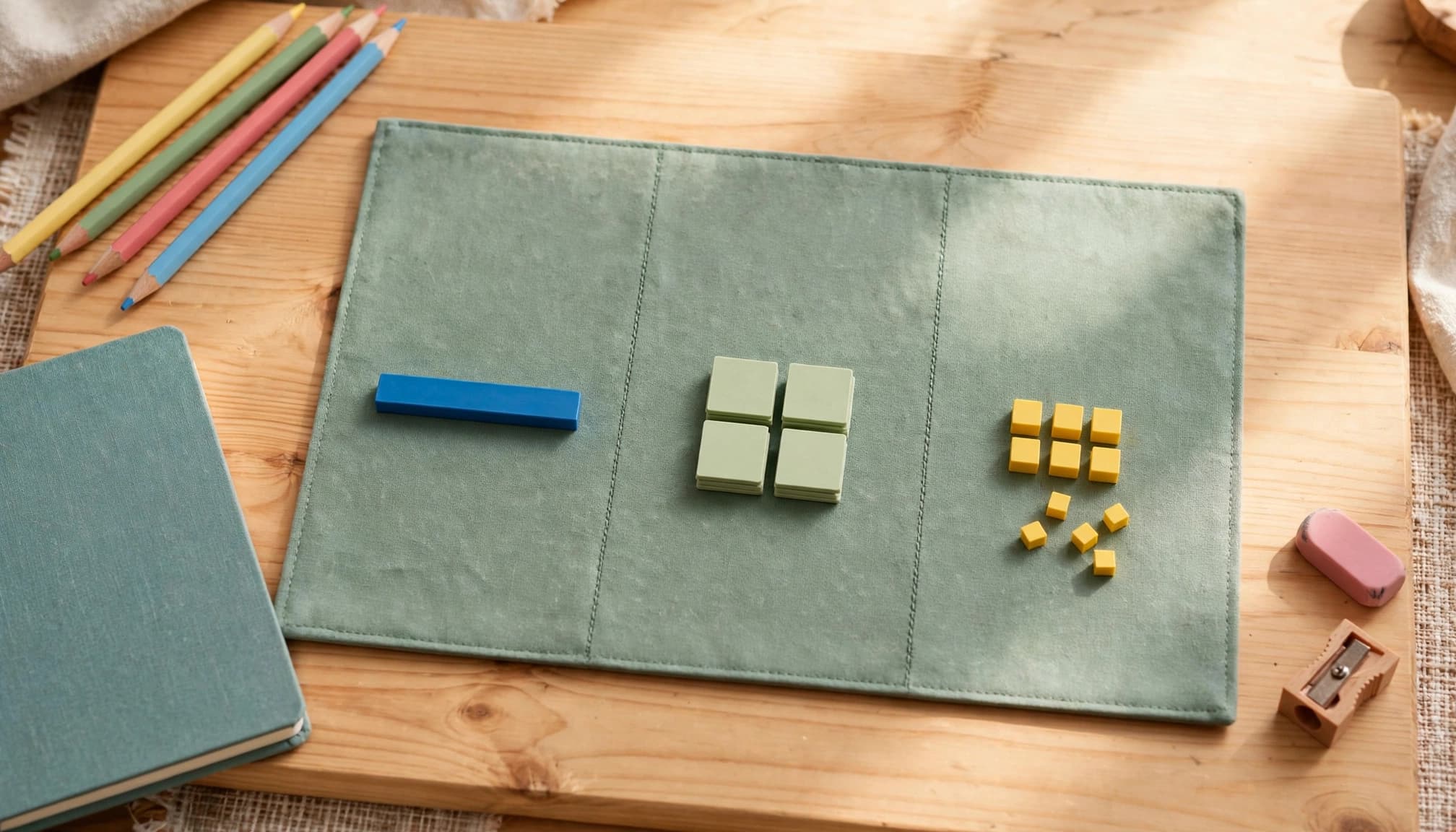
With base-ten blocks, use the large thousand-cube as one whole. In this place value system, a hundred-flat represents 0.1, a ten-rod represents 0.01, and a small cube represents 0.001.
Build 0.234 with two flats, three rods, and four small cubes. This kind of interactive math gives your child a chance to build and explain each group. The supplies don’t need to be fancy, but the unit needs to stay consistent.
Connect decimal names to fractions
For hands-on math activities, divide a strip into ten equal parts and shade six. That’s 6/10, written as 0.6.
On a hundred-square grid representing the same-sized whole, shade sixty squares. That’s 60/100, written as 0.60. Both models show the same amount.
To show thousandths, divide one hundredth-sized square into ten equal pieces. Each piece represents 1/1000.
Then place 0.6 on a number line between 0 and 1. It belongs a little beyond halfway, giving your child another way to check the amount.
Read and write decimals in three forms
Fifth graders move between standard form, word form, and expanded form. The official decimal-writing standard uses 347.392 as an example.
Read the number using its smallest place
For mathematical word form, read the whole-number part as you would other whole numbers. Say “and” at the decimal point, then read the decimal digits as a number. Finish with the name of the final place.
So 347.392 is three hundred forty-seven and three hundred ninety-two thousandths.
For numbers below one, 0.42 is “forty-two hundredths,” while 0.042 is “forty-two thousandths.”
Saying “point four two” is common in everyday speech, but the fractional name reveals the value. Have your child explain both readings rather than treating everyday pronunciation as a disaster requiring emergency pencils.
Write words and expanded form
Reverse the process with “four and seven thousandths.” Write 4.007, because seven thousandths belongs in the third position after the decimal point.
The tenths and hundredths places need zeros. Without them, 4.7 would mean four and seven tenths.
For 347.392, additive expanded form is:
300 + 40 + 7 + 0.3 + 0.09 + 0.002
Multiplicative expanded form makes each unit explicit:
3 × 100 + 4 × 10 + 7 × 1 + 3 × (1/10) + 9 × (1/100) + 2 × (1/1000)
Ask your child to use each digit value to reconstruct 347.392 from either expression.
Help your child understand zeros
Zeros deserve their own conversation. They’re small characters with surprisingly busy jobs.
In decimal numbers like 4.007, zeros leave the tenths place and hundredths place empty, while 7 is in the thousandths place. Removing them changes the number to 4.7.
However, adding zeros at the end of a decimal doesn’t change its numerical value:
0.6 = 0.60 = 0.600
Six tenths, sixty hundredths, and six hundred thousandths describe the same amount. A grid or number line makes that equivalence visible.
A zero at the end of a decimal can preserve its value. A zero inserted between the decimal point and another digit usually changes that digit’s value.
If your child thinks 0.60 is larger than 0.6 because it has more digits, return to the model. Count equal-sized parts instead of counting written characters.
Compare 5th grade decimals by place value

Start with the largest place
When comparing decimals, start with the whole-number parts. If they match, compare tenths, then hundredths, then thousandths. Stop at the first different digit.
For 2.347 and 2.354, the ones and tenths match. At the hundredths place, 4 is smaller than 5, so 2.347 < 2.354.
The thousandths cannot overturn that difference. Place value explains why the first different digit determines the result.
For unequal decimal lengths, rewrite equivalent forms:
0.7 = 0.700 and 0.65 = 0.650
Seven tenths is greater than six tenths, so 0.7 is greater than 0.65. More decimal digits don’t automatically mean a larger number.
Write the comparison symbol last
First, have your child say the relationship aloud: “Seven tenths is greater than sixty-five hundredths.” Then write:
0.7 > 0.65
The wider opening faces the larger number; the pointed end faces the number that is less than the other. Read the completed statement left to right to check it.
Picture tricks can help children remember symbol direction, but they can’t decide which amount is larger. Place value does that work.
For equal numbers, use the equals sign: 0.50 = 0.5. Ask your child to explain the equality with fractions or a drawing.
Connect place value with rounding and operations
Round after identifying the target place
To round 2.347 to the nearest hundredth, identify the hundredths digit, 4. Then inspect the digit immediately to its right, 7.
Because 7 is at least 5, increase the hundredths digit by one. The rounded number is 2.35.
To round the same number to the nearest tenth, inspect the hundredths digit instead. Since 4 is below 5, the answer is 2.3.
Naming the target place first connects place value to rounding and strengthens math skills. Otherwise, children can follow the right rule at the wrong position.
Keep equal units together when calculating
For addition and subtraction, align decimal points so tenths sit under tenths and hundredths sit under hundredths.
For example, rewrite 2.4 as 2.40 before calculating:
2.40 + 1.35 = 3.75
2cool4school’s Grade 5 learning resources provide another explanation of decimal calculations.
Multiplication and division also depend on unit meanings. Three groups of four tenths make twelve tenths: 3 × 0.4 = 1.2. Sharing twelve tenths among three equal groups gives 1.2 ÷ 3 = 0.4.
Let models explain these relationships before introducing shortcuts. Then try a short calculation for extra math practice.
Try a short decimal practice set
Start with one problem together, then let your child try a few independently. This short math practice set checks skills with decimals to thousandths without turning the kitchen table into an examination hall.
- In 6.285, what is the value of the 8?
- Read 3.046 using a fractional name.
- Write “nine and twenty-three thousandths” in standard form.
- Write 5.204 in additive expanded form.
- Compare 0.9 and 0.875 using a comparison symbol.
- Round 7.368 to the nearest hundredth.
Answers: 0.08, or eight hundredths; three and forty-six thousandths; 9.023; 5 + 0.2 + 0.004; 0.9 > 0.875; 7.37.
After checking, ask your child to explain one answer with a model. If the explanation breaks down, use the math practice to identify the skill to revisit instead of assigning another mixed page.
For additional written practice, Education.com’s decimal place-value worksheets target reading, writing, and comparing decimals to thousandths.
Make videos and worksheets support understanding
A homeschool curriculum can organize the week, while hands-on models keep numbers meaningful. Use a simple math lesson sequence: model one decimal together, watch an explanation, then try a similar question independently.
2cool4school organizes human-curated teaching videos by grade and topic. Pause before a worked answer and ask your child to explain what each digit represents.
For written math practice, browse its free worksheets by grade. Choose questions that match today’s difficulty, whether that’s zero placeholders, word form, or comparisons.
Families teaching several ages can select Grade 1 worksheets for younger siblings and decimal practice for fifth graders. Everyone can work nearby without wrestling the same mathematical octopus.
Key takeaways for parents
- Define the whole before using blocks, grids, or number lines.
- Connect each digit to its value before practicing word form or expanded form.
- Compare the largest places first, and use explanations to identify misunderstandings.
A correct answer is useful. A clear explanation tells you whether your child can repeat the reasoning.
Common questions about decimal place value
What if my child mixes up hundredths and thousandths?
Start with 0.1, 0.01, and 0.001 in a labeled chart. Ask your child to name each unit before introducing decimals to thousandths.
Then compare 0.04 and 0.004. Four hundredths is ten times four thousandths, so 0.004 is less than 0.04. Keep the model nearby until your child can explain why.
Should we use money to teach decimals?
Money is helpful for tenths and hundredths: $0.10 is one tenth of a dollar, and $0.01 is one hundredth.
However, ordinary dollar-and-cent examples don’t show thousandths clearly. Add a grid, number line, or base-ten model when you reach three decimal places. Keep the whole and its divisions clear.
Give every digit a meaning
Reading decimals gets easier when your child can explain what each place is worth. Build the amount, connect it to words, and then write the number.
Start with one free worksheet and a few focused questions. When a digit causes trouble, return to its unit rather than adding more rules to remember.