
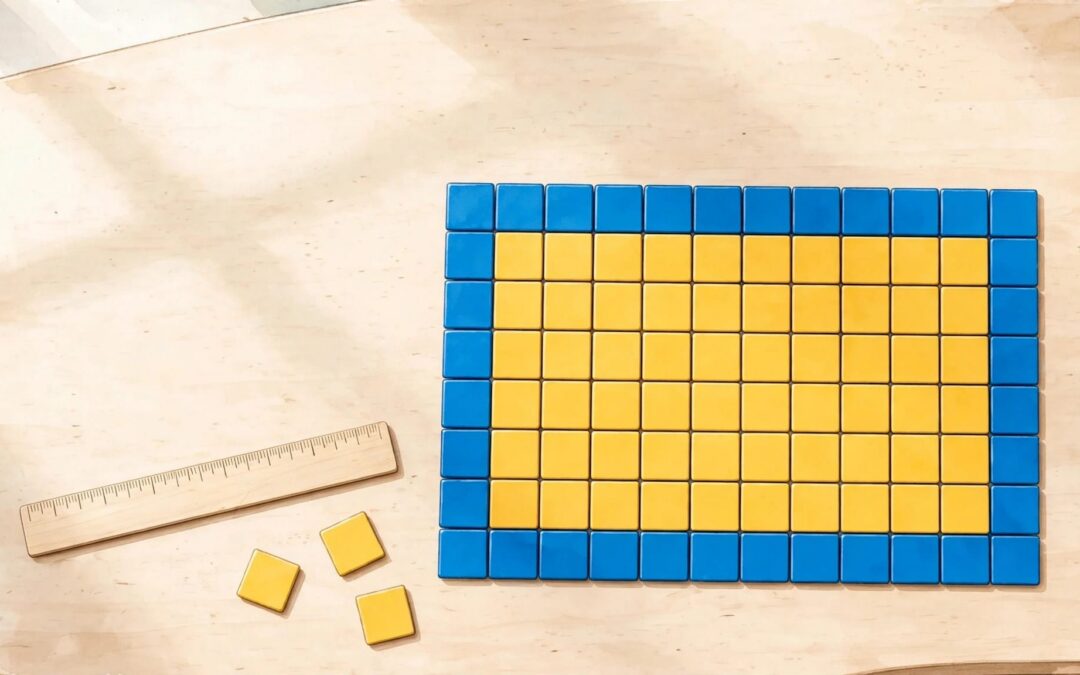
Your child multiplies two numbers, adds them, and hopes the worksheet approves. Grade 3 practice with area and perimeter gets easier when children first understand what they’re measuring: area covers the inside, while perimeter measures the boundary.
For rectangles, count square units or multiply the side lengths to find area; add all four sides to find perimeter. Start with a rectangle your child can touch or sketch as a visual model, then connect it to the calculations.
Key Takeaways
- Area measures the space inside a shape; perimeter measures the total distance around its boundary.
- Find a rectangle’s area by multiplying its length by its width, and label the answer in square units.
- Find perimeter by adding all four side lengths; perimeter uses ordinary length units such as centimeters or inches.
- Draw, tile, measure, or trace a rectangle to connect each calculation to what it measures, then check the units and explain the answer.
Area and Perimeter Measure Different Things
Use one rectangle to teach both geometric concepts, then show how the same ideas apply to other shapes. Changing the picture immediately can make children associate each measurement with a different shape.
Area covers the inside
Area tells you how much flat space a shape covers. Picture square tiles covering a rectangular tabletop without gaps or overlaps.
Each tile measures one square unit when its sides are one unit long. Therefore, 24 such tiles cover an area of 24 square units.
Ask your child to sweep a hand across the rectangle’s interior. Then ask, “What are we covering?” Their answer should describe the inside space, not the edges.
Perimeter follows the outside
Perimeter is the total distance around a shape. Have your child trace the rectangle’s boundary with a finger, returning to the starting point.
Unlike area, perimeter measures length along a path. Its units are centimeters, inches, or other length units, without the word “square.”
A paper rectangle needs ribbon around its edge and paper to cover its face. The ribbon measures perimeter; the covering measures area. Keep both gestures handy when the vocabulary gets tangled.
Find Rectangle Area With Tiles, Then Multiplication
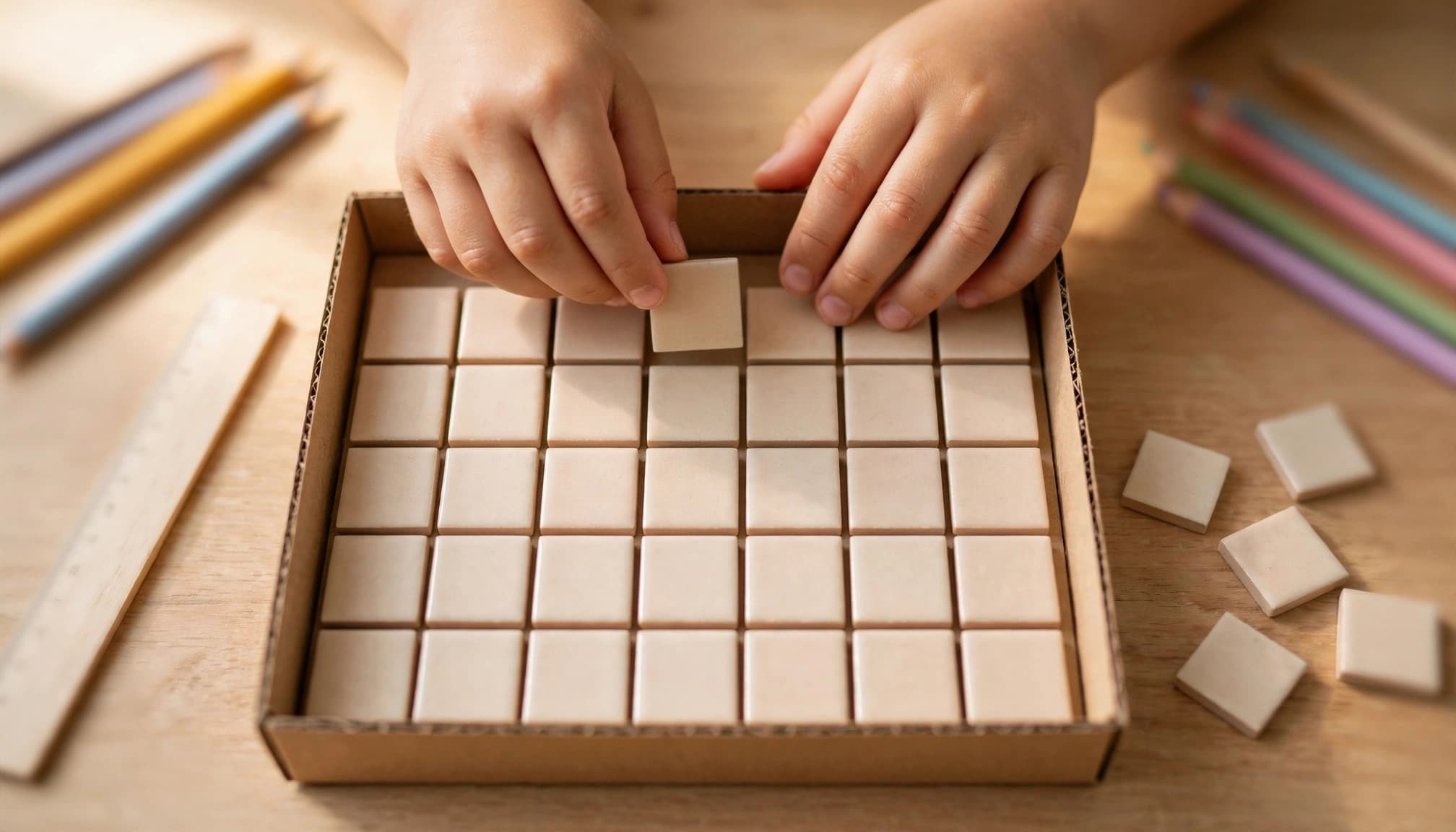
Build equal rows first
Draw a rectangle on graph paper that’s six squares across and four squares down. Treat each small square as one square unit.
First, let your child count all 24 squares. Next, count by rows: 6 + 6 + 6 + 6 = 24.
Ask them to identify four equal groups of six. This area model connects the picture to multiplication instead of presenting a formula as a mysterious instruction.
The Common Core Grade 3 area standards in 3.MD.C.7 include understanding square units, counting them, and connecting rectangular area to multiplication.
Replace counting with a calculation
Now label the rectangle’s side lengths as 6 units and 4 units. The calculation is area = length × width, so 6 × 4 = 24 square units.
Turning the rectangle changes its position, but its area stays the same. Four rows of six and six rows of four contain the same number of squares.
If multiplication facts interrupt the lesson, keep the grid available. Your child can practice the model while building recall through Grade 3 multiplication facts practice.
Check the explanation before increasing the numbers. “Four rows with six squares in each row” shows more understanding than a correct answer alone.
Find Perimeter by Measuring All Four Sides
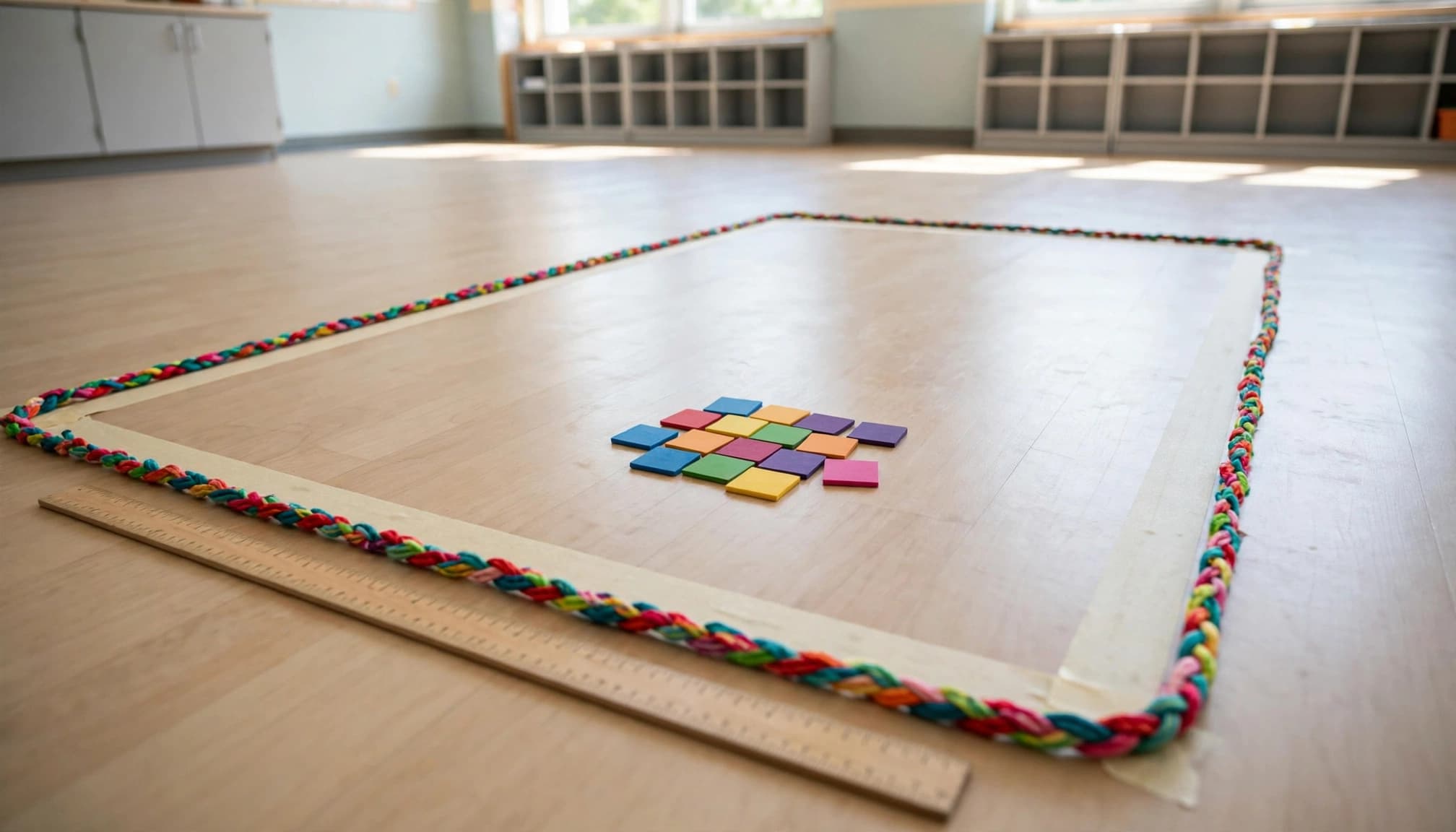
Measure without ruler mix-ups
Draw a rectangle with side lengths of 6 cm and 4 cm. Ask your child to place the ruler’s zero mark at one corner.
Some rulers have a small blank space before zero. Starting at the ruler’s physical edge can change the measurement, so check the alignment together.
Measure and label every side using the same unit. Opposite sides of a rectangle have equal lengths, so the labels should read 6 cm, 4 cm, 6 cm, and 4 cm.
Rotating the paper doesn’t change those lengths. A rectangle keeps its properties even when it looks sideways.
Add the complete boundary
Start at one corner and move around the rectangle in order. Add 6 + 4 + 6 + 4 = 20 cm.
Children often stop after adding one length and one width. Have them mark each side after including it in the calculation.
Once all four sides make sense, introduce the formula: perimeter = 2 × (length + width). Here, 2 × (6 + 4) = 20 cm.
For a square, all four sides are equal. A square with 5 cm sides has perimeter 5 + 5 + 5 + 5 = 20 cm. However, adding every side remains a useful method for other polygons, too.
Compare Area and Perimeter on the Same Rectangle
The 6-by-4 rectangle has an area of 24 square units and a perimeter of 20 units. Each answer is a different measurement, so the numbers don’t need to match.
Compare these rectangles, with all side lengths measured in units.
| Length | Width | Area | Perimeter |
|---|---|---|---|
| 6 | 4 | 24 square units | 20 units |
| 8 | 3 | 24 square units | 22 units |
| 7 | 3 | 21 square units | 20 units |
The first two rectangles have equal areas but different perimeters. Meanwhile, the first and third have equal perimeters but different amounts of surface coverage.
Have your child draw them on graph paper and check both measurements. The pictures help explain why knowing one measurement doesn’t determine the other.
A correct number can still describe the wrong measurement. Ask your child to point to what the answer measures before checking the arithmetic.
Find a Missing Side Without Guessing
These word problems become manageable when children label each known measure before finding the unknown side length.
When perimeter is known
Suppose a rectangle has a perimeter of 26 cm and a length of 8 cm. Its opposite long side also measures 8 cm.
Together, those sides use 16 cm of the boundary: 8 + 8 = 16. Subtract that amount from the perimeter: 26 – 16 = 10 cm.
The two equal widths share the remaining 10 cm, so each width is 5 cm. Check by adding 8 + 5 + 8 + 5 = 26 cm.
A common mistake is calling 10 cm the width. Tracing both unmeasured sides shows why the missing side is half that amount.
When area is known
Suppose a rectangle covers 24 square units and one side measures 6 units. Ask, “How many rows of six make 24?”
Because 6 × 4 = 24, the missing side measures 4 units. Division records the same reasoning: 24 ÷ 6 = 4. This division reverses multiplication.
Draw the rows if your child needs support. Then check by multiplying the two side lengths.
Although the area uses square units, the missing side uses ordinary length units. That distinction deserves its own quick check.
Split Rectangles to Make Area Easier
A rectangle can show how smaller multiplication calculations combine into a larger area.
Draw a 7-by-4 rectangle. Split the 7-unit side into sections measuring 5 units and 2 units.
The smaller rectangles have areas of 5 × 4 = 20 and 2 × 4 = 8 square units. Together, they cover 28 square units, matching 7 × 4.
The Washington Grade 3 mathematics standards connect this area reasoning to multiplication and addition.
As an optional next step, try an L-shaped rectilinear figure made from two non-overlapping rectangles. Calculate each rectangle’s area, then add the results. SEDL’s Grade 3 additive area demonstration illustrates this extension.
For perimeter, trace only the outside boundary. A dividing line inside the figure doesn’t belong in that total.
Try This Grade 3 Rectangle Practice Set
Begin with one question together, then let your child try two independently. Ask them to draw each rectangle and include units.
Cover the answer column, or copy the questions onto paper to make reusable practice worksheets.
| Question | Answer |
|---|---|
| A rectangle measures 5 cm by 3 cm. Find its area and perimeter. | Area: 15 square cm. Perimeter: 16 cm. |
| A rectangle measures 8 m by 2 m. Find its area and perimeter. | Area: 16 square m. Perimeter: 20 m. |
| A square has sides measuring 4 inches. Find its area and perimeter. | Area: 16 square inches. Perimeter: 16 inches. |
| A rectangle has perimeter 22 cm and length 7 cm. Find its width. | 4 cm. |
| A rectangle has area 35 square units and one side measuring 5 units. Find the other side. | 7 units. |
| Word problem: A rectangular garden measures 6 m by 3 m. How much fencing surrounds it completely? | 18 m. |
Discuss the square question carefully. Both answers contain 16, but one describes surface coverage and the other describes boundary length.
Then change the garden question: “How much ground does the garden cover?” The answer becomes 18 square meters. Matching numbers don’t make the measurements interchangeable.
Afterward, ask your child to explain one solution without looking at the answer column. A clear explanation with fresh numbers is stronger evidence than remembering the table.
Fix the Mistake Before Adding More Questions
Listen for the source of the error. A child who calculates 6 × 4 correctly but calls it perimeter needs help choosing the measurement. Extra multiplication drills won’t fix that confusion.
If they choose area correctly but calculate 6 × 4 incorrectly, return to equal rows. If their calculation is correct but the unit is wrong, revisit what one unit measures. A parent-made anchor chart can serve as an optional reminder of the difference between area and perimeter.
Use a short routine:
- Ask your child to show the space or boundary being measured.
- Let them draw, tile, or label the rectangle before calculating.
- Check the answer and units together, then try one similar problem.
If counting or shape recognition needs attention, revisit a focused activity from the Grade 1 curriculum. Grade 1 worksheets can refresh that skill without restarting an entire year’s learning.
For a homeschool curriculum or after-school review, keep practice focused on the current difficulty. 2cool4school organizes learning for Grades 1-8 by subject and topic, with human-reviewed educational videos. Pause a relevant lesson before the solution and let your child demonstrate their method.
For broader review, its Grade 3 math practice resources connect written practice with further learning support.
Frequently Asked Questions
What is the difference between area and perimeter?
Area measures how much space is covered inside a shape. Perimeter measures the total distance around its outside boundary.
How do you find the area of a rectangle?
Multiply the rectangle’s length by its width. Write the answer in square units, such as square centimeters or square meters.
How do you find the perimeter of a rectangle?
Add the lengths of all four sides. You can also use 2 × (length + width), and write the answer in ordinary length units.
Can two rectangles have the same area but different perimeters?
Yes. For example, a 6-by-4 rectangle and an 8-by-3 rectangle each have an area of 24 square units, but their perimeters are different.
Keep the Next Rectangle Lesson Focused
Grade 3 area and perimeter become easier when your child connects each calculation to something they can show. Cover the inside for area, trace the boundary for perimeter, and check the units for each measurement.
Choose one rectangle for your next session and ask for both measurements. For follow-up printables, browse 2cool4school’s free worksheets for Grades 1-8 and select practice that matches the skill your child needs next.