

The leftover apple can teach your child more about division with remainders than another page of calculations. With grade 4 division remainders, the story determines what to do with what remains after making equal groups.
In elementary school math, your child needs two skills: finding the leftover and interpreting remainders. Start with objects, connect them to written calculations, then tackle questions about bags, passengers, and shareable food.
What remainders mean in Grade 4 division
Division with remainders shows how much is left after making as many complete groups as possible.
Build equal groups your child can see
Place 24 counters on a table. Ask your child to make groups of five.
They’ll build four complete groups, using 20 counters, with four left over. Write 24 ÷ 5 = 4 R4 and read it as “24 divided by five equals four, remainder four.”
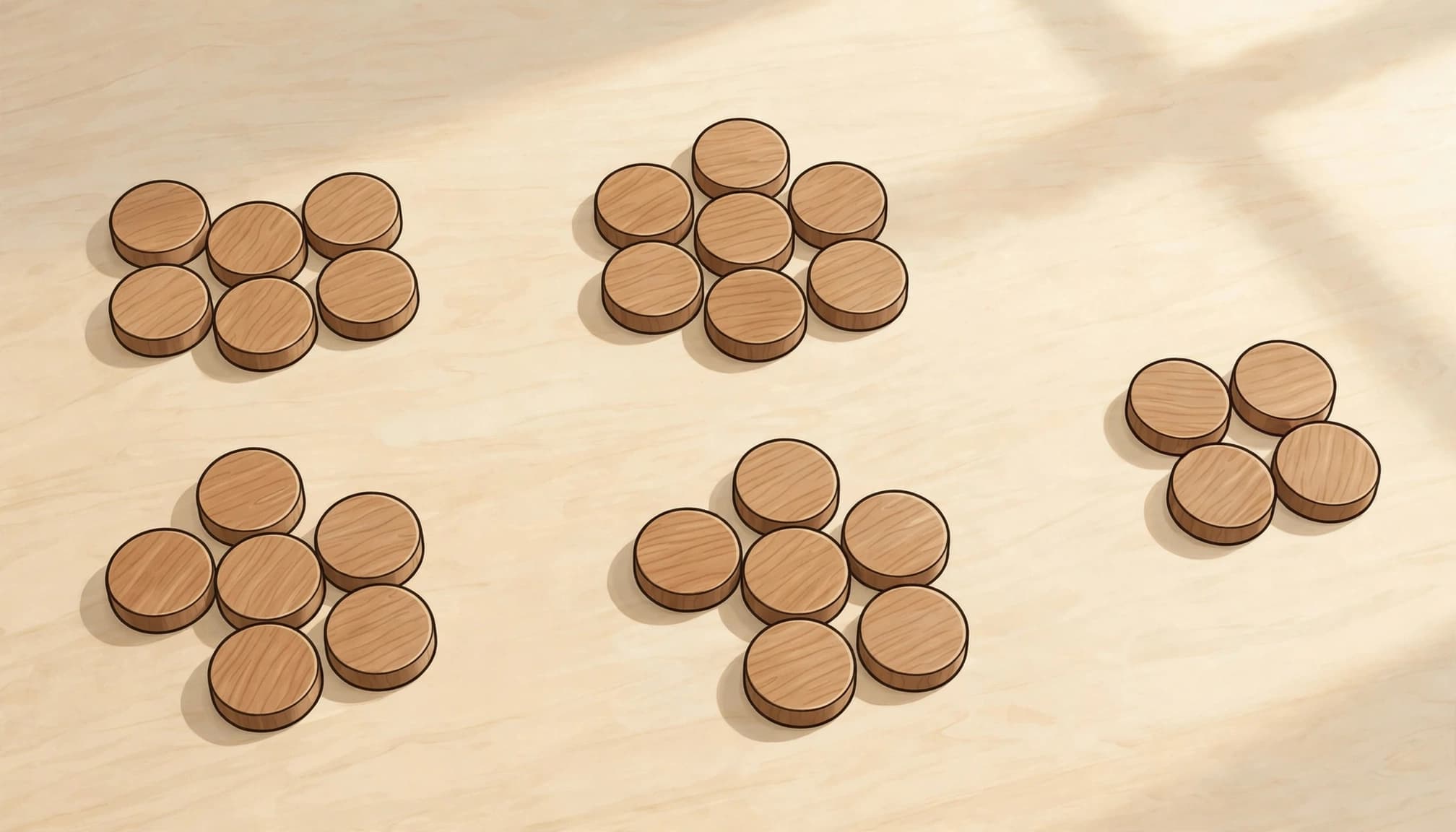
Ask whether the leftovers can make another group of five. They can’t, so the grouping is finished.
For whole-number division, the remainder must be smaller than the divisor. Five leftover counters would make another complete group, so the answer needs another look.
Give the numbers useful names
In 24 ÷ 5 = 4 R4, the dividend is 24, the starting amount. The divisor is five, the number in each group. The whole-number quotient is four, the number of complete groups. The remainder is four, the leftover amount.
Now change the task: share 24 counters among five children. Each child gets four, with four remaining.
The calculation stays the same, but the numbers describe different things. Encourage your child to name what each number counts instead of reciting vocabulary without a model.
Know what fourth graders are expected to learn
The Common Core Grade 4 division standard, part of common core math, covers whole-number quotients and remainders when dividing a four-digit number or smaller by a one-digit divisor.
Children use place value, properties of operations, and multiplication’s relationship to division. They explain their thinking with equations, area models, or rectangular arrays.
That means understanding 157 ÷ 6 matters more than memorizing a chant about division steps. Long division and the standard algorithm are useful methods, but the standard doesn’t require one exclusive approach.
Begin with smaller numbers if your child still struggles to build equal groups. Multi-digit numbers add complexity; they shouldn’t come before the groups make sense.
Fractions and decimals can help explain shareable leftovers later. However, they aren’t required ways to express answers under this particular whole-number division standard.
Use an area model to divide in manageable chunks
For 157 ÷ 6, break the three-digit number into chunks that divide evenly by six.
First, 6 × 20 = 120. Subtract 120 from 157, leaving 37. Next, 6 × 6 = 36, leaving one.
The partial quotients are 20 and six. Add them: 157 ÷ 6 = 26 R1.
Draw a rectangle with one side labeled six. Split the other side into lengths of 20 and six. The two areas are 120 and 36, totaling 156. Keep the remaining one outside the rectangle. This drawing shows how area models represent the groups.
The California Grade 4 division standard includes explaining calculations through equations, rectangular arrays, or diagrams. Unlike the standard algorithm, area models make clear why 26 groups of six account for 156.
If your child already understands area model multiplication, connect it to these division methods. Multiplication finds the total area, while division finds the missing side length.
As in other worked examples, check the answer: 6 × 26 + 1 = 157. That final addition returns the leftover to the original total.
Connect long division to place value
Use the same problem, 157 ÷ 6, so your child can compare methods without juggling new numbers.
Divide the tens first
Because 157 is a three-digit number, start with its hundreds. One hundred can’t give each of six groups a whole hundred, so regroup it with five tens to make 15 tens.
Divide 15 tens among six groups. Each group gets two tens because 6 × 2 tens = 12 tens. Write two in the tens place of the quotient.
Subtract 12 tens from 15 tens. Three tens remain.
Explain the subtraction aloud: “We’ve used 120 of the 157, so 37 remain.” This connects the written steps to real amounts, not mysterious digits marching down the page.
Regroup and divide the ones
Regroup the three remaining tens as 30 ones. Add the original seven ones, giving 37 ones.
Each group gets six ones because 6 × 6 = 36. Write six in the ones place of the quotient, then subtract 36 from 37.
One remains, so this division with remainders gives 26 R1.
The standard algorithm follows a familiar routine: divide, multiply, subtract, and bring down. In long division, “bring down” means combining the remainder with the next place-value unit. Ask your child to explain that amount before continuing.
Finally, check both conditions: 6 × 26 + 1 = 157, and one is smaller than six.
Let the word problem decide what happens next
A correct calculation in division with remainders doesn’t always give the final answer to a word problem. Your child must reread the question and identify what it asks.
In division word problems, decide whether to leave the remainder, round up, or express it as a fraction.
Use 25 ÷ 4 = 6 R1 across different situations:
| Situation | What happens to the remainder? | Final answer |
|---|---|---|
| Pack 25 apples into bags holding four each. How many full bags? | Leave one apple unpacked. | Six full bags |
| Transport 25 passengers in cars with four passenger spaces each. How many cars? | Use another car for the remaining passenger. | Seven cars |
| Put 25 markers into groups of four. How many markers remain? | Report the leftover itself. | One marker |
| Share 25 meters of ribbon equally among four people. How much each? | Divide the remaining meter into equal parts. | 6 1/4 meters each |
Interpreting remainders means checking what the question counts, which is why the same arithmetic can produce different final answers.

For full bags, only complete groups count. For transportation, everybody needs a seat, so any remaining passengers require another vehicle. Ribbon can be cut, so the leftover can be shared.
A remainder of one still requires another car. Don’t apply ordinary “round to the nearest whole number” rules to a seating problem.
Have your child finish with a sentence containing the unit: “We need seven cars.” Units help catch answers that make arithmetic sense but don’t fit the story.
Show shareable remainders as fractions or decimals
Some leftovers must stay whole. Others can be split into smaller equal parts.
Turn the remainder into a fraction
Return to 25 meters of ribbon shared among four people. Each person first gets six meters, leaving one meter.
Cut that remaining meter into four equal pieces. Each person receives another one-fourth meter, so the answer is 6 1/4 meters.
The remainder becomes the numerator, and the divisor becomes the denominator: 25 ÷ 4 = 6 + 1/4.
Draw four equal sections on a paper strip before introducing the rule. The denominator describes the equal parts, and the numerator counts them. For more model-based practice, connect this with Grade 4 fraction skills.
Explain why R1 doesn’t mean 0.1
Because 1/4 = 0.25, the same ribbon answer can be written as 6.25 meters, the decimal equivalent. Writing 6.1 would change the amount.
As an optional extension, continue the division by renaming the leftover one as ten tenths. Dividing ten tenths by four gives two tenths per person, leaving two tenths.
Rename those two tenths as 20 hundredths. Dividing by four gives five hundredths each. Together, six wholes, two tenths, and five hundredths make 6.25.
Save this procedure until place value is comfortable. A drawing of one-fourth provides a clearer starting point than a sudden parade of decimal zeros.
Practice briefly and find the actual sticking point
Try these practice questions together:
- Divide the two-digit number 29 by 4 using groups or a drawing, then check with multiplication.
- Solve 85 ÷ 6 using partial quotients or long division.
- Find how many boats are needed for 29 passengers if each boat holds four passengers.
The division calculations are 7 R1 and 14 R1. The boat problem needs eight boats, because the remaining passenger also needs a place.
If multiplication facts interrupt every step, revisit multiplication facts with visual models. For example, use 5 × 6 = 30 to help find 6 × 6 = 36.
If subtraction causes trouble, check that step separately. Meanwhile, a child who gets the answers right but chooses seven boats needs practice interpreting the story, not another multiplication drill.
For counting or equal-sharing gaps, revisit individual first-grade curriculum skills. Grade 1 worksheets can provide a simpler starting point without requiring your fourth grader to repeat an entire grade.
Choose home learning resources that match the difficulty
For a homeschool curriculum or after-school review, combine area models, a short explanation, and a few independent questions.
2cool4school organizes human-curated educational videos by grade and topic. Pause a video during a worked example, before the answer appears. Then ask your child to show their own groups or calculation.
For written practice, use printable fourth-grade math worksheets. Choose questions that match today’s difficulty: equal groups, multi-digit division, or word problems.
Free worksheets are most useful after your child has seen an explanation. A worksheet can reveal confusion, but it can’t always repair it alone.
For additional problem-solving practice, Illustrative Mathematics division tasks provide activities connected to the Grade 4 standard. Ask for an explanation alongside the answer.
Key takeaways for parents
- Make the leftover visible with counters before introducing written procedures.
- When interpreting remainders, check that divisor × quotient + remainder equals the dividend.
- Keep the remainder smaller than the divisor, then use the story to decide the final answer.
Frequently asked questions
Can a remainder be zero?
Yes. For example, 24 ÷ 6 = 4 because four groups of six use all 24 objects. There’s nothing left over. You can write R0, although it’s usually unnecessary.
What if there’s a zero in the quotient?
Keep its place. For example, 123 ÷ 6 = 20 R3. Each group gets two tens and zero whole ones, with three remaining. Writing 2 R3 would lose the tens value.
Help the leftover make sense
Grade 4 division gets easier when your child explains the groups, calculation, and what the leftover means. That’s interpreting remainders in context.
Try one counter model, then one matching question from the fourth-grade worksheet resource. That leftover apple deserves an explanation before the next worksheet page arrives.