

Your child can know their multiplication facts and still freeze when a problem stretches across the page. To divide, start with equal groups, follow a repeatable routine, and multiply to check the result.
Place value matters most: children need to understand what the digits mean before using a written method.
Begin with Grade 4 expectations, then tackle the written steps together.
What Grade 4 Division Actually Requires
Start with one-digit divisors
The Common Core Grade 4 division standard, 4.NBT.B.6, covers a whole-number dividend of up to four digits divided by a one-digit divisor. Children use place value strategies, equations, rectangular arrays, or area models to solve and explain their work.
So, 2,456 ÷ 6 belongs here. A two-digit divisor and decimal answers are extensions, not Grade 4 requirements. Your fourth grader doesn’t need to conquer every example below immediately.
Long division is useful, but the standard doesn’t require children to use only that method.
Repair the missing skill first
Before starting, ask your child to make equal groups with counters. With 24 counters, they can make four groups of five, with four left over as the remainder.
Then ask what the groups and remainder represent. This connects division vocabulary to a visible model.
If counting or making tens still causes trouble, a few Grade 1 worksheets can refresh those skills. One weak foundation doesn’t mean restarting an entire Grade 1 curriculum.
Set Up the Division House and Follow the Cycle
The curved bracket is sometimes called the division “house.” The divisor goes outside, the dividend goes inside, and the quotient, or answer, goes on top.
Place each answer digit above the last digit of the portion you’re working with, keeping place values aligned.
The long division cycle follows these steps:
- Divide the current portion by the divisor.
- Multiply that number by your chosen answer digit.
- Subtract the product from the current portion.
- Bring down the next digit and combine it with what’s left.
- Repeat until no digits remain to bring down.
Any amount left at the end is the remainder.
At the start, use enough digits to make a portion large enough for at least one group.
Bringing a digit down is shorthand for regrouping: combine the leftover amount with the next place value, rather than treating it as a separate operation.
Work Through Multi-Digit Division: 4,682 ÷ 6
Estimate, then test the digit
To divide 4,682 by 6, use estimation to choose the first digit. The dividend begins with 46, and 6 fits 7 times because 6 × 7 = 42. Eight would be too large because 6 × 8 = 48.
That makes 7 groups of 6, with 7 in the hundreds place of the quotient.
Finish the calculation and check
Subtract 42 from 46, leaving 4. Bring down the 8 to make 48.
Six fits into 48 eight times, so write 8 in the tens place. Subtract 48, leaving 0.
Lower the final 2. Six fits zero times into 2, so write 0 in the ones place; 2 remains.
Therefore, 4,682 ÷ 6 = 780 R2. The divisor is 6, and the final remainder, 2, is smaller than the divisor.
Multiply the quotient, 780, by 6 to get a product of 4,680; add 2 to reach 4,682.
Try Two Shorter Worked Examples
Divide 723 by 5
Begin with 7. Since the divisor is 5, write 1 above the 7.
Subtract 5 from 7, leaving 2. Then bring down 2 to make 22.
Five fits into 22 four times. Write 4 above the 2, then take 20 from 22, leaving 2. Lower the 3 to make 23.
Five fits into 23 four times. Write 4 in the ones place, then take 20 from 23, leaving 3.
The quotient is 144 R3. The remainder, 3, is smaller than 5, so no more whole groups fit.
Check: 5 × 144 + 3 = 723.
Divide 981 by 9
Begin with 9. Nine fits into 9 once, so write 1 above the 9. Taking 9 from 9 leaves 0.
Lower the 8. Nine doesn’t fit into 8, so write 0 in the quotient. Lower the 1 to make 81.
Nine fits into 81 nine times. The answer is 109.
Check: 9 × 109 = 981.
Use Partial Quotients When Long Division Feels Crowded
With partial quotients, your child removes large, easy-to-see multiples of the divisor instead of choosing one answer digit at a time.
To divide 2,456 by 6, treat 2,456 as the dividend and begin with an easy multiple:
6 × 400 = 2,400.
Subtract 2,400 from 2,456, leaving 56. The first partial quotients step removes 400 groups of six; place value shows why 400, not 4, belongs in the answer.
Next, use:
6 × 9 = 54.
Take 54 from 56, leaving 2. Add the two amounts: 400 + 9 = 409.
Therefore, 2,456 ÷ 6 = 409 R2.
Check by reversing the operation: 6 × 409 + 2 = 2,456. The quotient is 409, and the remainder is 2, less than 6.
The partial quotients add the removed amounts, while the equation confirms the result.
Ask your child why 400 belongs in the answer. It represents 400 sixes, not four.
If they understand our area model multiplication guide, connect division to finding a missing side length. The model gives those large multiples a job beyond taking up pencil space.
Keep Zeros in Place and Catch Common Errors
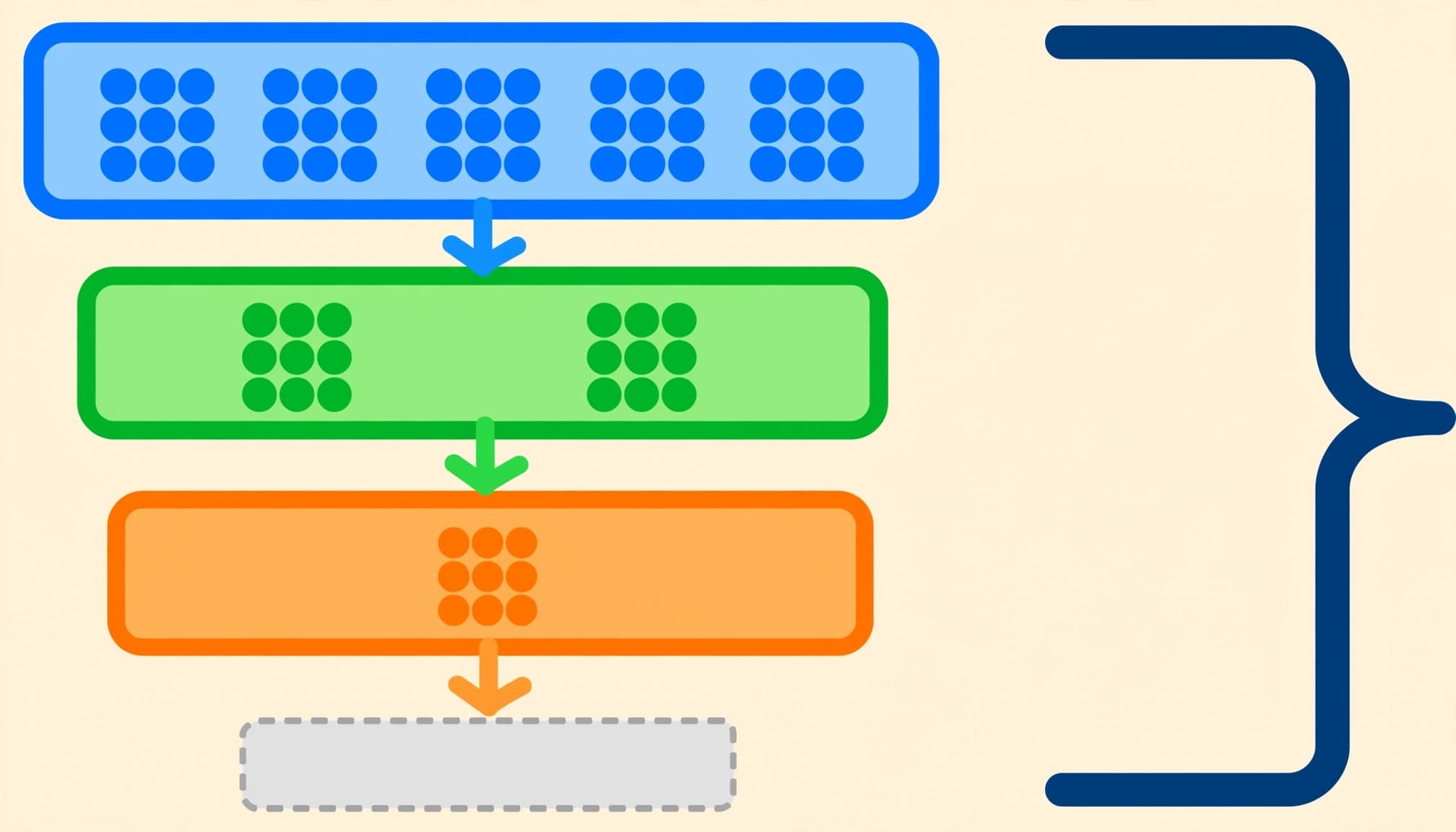
Write a zero after the answer has started
For 1,224 ÷ 6, start with 12. Six fits twice, so write 2 in the hundreds place.
Subtract 12, then bring down the next 2. Since 2 can’t hold a full group of 6, write 0 in the tens place before using the 4.
Now you have 24. Six fits four times, giving 204.
Writing 24 loses the hundreds value in long division.
Compare each difference with the amount being divided
After each subtraction, the difference must be smaller than the amount being divided. Otherwise, the answer digit is too small, and more groups fit.
If the product is larger than the current amount, reduce the digit and multiply again.
Graph paper helps keep answer digits above the correct places and subtraction digits in their columns.
A valid remainder is smaller than the divisor. For the final check, multiply the quotient by the divisor, then add the leftover to get the dividend.
Make Larger Divisors Less Intimidating
Grade 4 standard 4.NBT.B.6 focuses on division with one-digit divisors. A two-digit divisor is optional enrichment, not a required next step.
A short list of multiples can help connect multiplication and division. For 165, start with 165, 330, and 495 to compare with the dividend.
The Grade 4 multiplication standard includes multiplying two two-digit numbers using place-value strategies. Strengthen that skill before trying larger division problems.
Add Decimal Answers Only When Your Child Is Ready
A remainder doesn’t become a decimal just by placing a point in front of it.
For example, 25 ÷ 4 = 6 R1. To continue, write the dividend as 25.00 and move its decimal point straight up into the quotient.
Bring down the first zero. Regroup the leftover one whole as 10 tenths.
Four fits into 10 twice. Subtract 8 to leave 2 tenths. Bring down the next zero to make 20 hundredths.
Four fits five times, giving 6.25. Place the quotient’s decimal point directly above the dividend’s decimal point.
Khan Academy’s decimal division lessons cover this later-stage skill. For Grade 4 practice, whole-number quotients and remainders can remain the focus.
Practice Briefly and Look for the Sticking Point
Try one calculation together, then let your child attempt two independently. In a homeschool curriculum, this can be a short practice session rather than a whole afternoon of division negotiations.
Ask your child to divide the total into equal groups and subtract each product. Have them explain the remainder, then use multiplication to check the result.
| Problem | Answer | Verification |
|---|---|---|
| 157 ÷ 6 | 26 R1 | 6 × 26 + 1 = 157 |
| 123 ÷ 6 | 20 R3 | 6 × 20 + 3 = 123 |
| 723 ÷ 30 | 24 R3 | 30 × 24 + 3 = 723 |
| 981 ÷ 11 | 89 R2 | 11 × 89 + 2 = 981 |
The first two use one-digit divisors, which match Grade 4 expectations. The others are extensions.
When choosing free worksheets, match the difficulty to the skill you’re practicing. If the product is wrong, review multiplication facts. If the subtraction step is wrong, practice regrouping. If your child misreads the amount left over, review what it means.
For video practice, pause before the answer appears. Ask your child to predict the next digit and explain it before pressing play.
Key Takeaways for Parents
- Start with equal groups or use place-value reasoning.
- Follow a steady divide, multiply, subtract, and bring-down routine.
- Keep placeholder zeros in place as you work.
- Interpret the remainder in context and check the quotient with multiplication.
The story problem determines what the leftover means. It might be an unpacked apple, another vehicle, or a shareable fraction.
Frequently Asked Questions
What is a divisor?
The divisor is the number you divide by. In 4,682 ÷ 6, the divisor is 6.
Where does the divisor go in long division?
Write the divisor outside the curved bracket, with the dividend inside. Write the quotient above the bracket.
Do Grade 4 students need to divide by two-digit divisors?
No. Grade 4 standard 4.NBT.B.6 covers whole-number dividends of up to four digits divided by a one-digit divisor; two-digit divisors are an extension.
How can you check a division answer with a remainder?
Multiply the quotient by the divisor, then add the remainder. The result should equal the dividend, and the remainder must be smaller than the divisor.
Help the Steps Make Sense
When your child gets stuck, return to what the numbers mean. Try a smaller problem, show a group, or explain one subtraction to find the sticking point.
Try another example with our Grade 4 division remainder resources. Keep practice short enough for your child to explain their answer, not just finish.